
Pakistan Shunned Minority
Democracies in Asia Risk Failing on Religious Freedom
COMMENTARY
Published Sept. 26, 2023 • Read time: 5m
Earlier this month, an important regional summit about International Religious Freedom took place in Taipei, Taiwan. Holding the summit there sent a powerful message; Taiwan exists in the shadow of the world’s most infamous abuser of freedom of religion, conscience, and belief – namely, the Chinese Communist Party. It took courage and conviction for Taiwan’s democratically elected government to host a summit where speakers boldly advocated for religious freedom for everyone, everywhere, all the time.
Taiwan, and many other countries, are stepping up to join the growing international religious freedom movement, and there has perhaps never been more awareness about the need to protect and expand this fundamental human right.
Yet at the same time, religious persecution and restrictions on freedom of religion or belief are growing just as quickly. What is most alarming is that government-sanctioned abuses of religious freedom are not necessarily limited to authoritarian regimes. We increasingly find them in democratic nations.
Sadly, we are no longer surprised by some of the most extreme and visible cases of religious persecution: the genocide being committed against the Uyghurs on a vast scale in the Xinjiang region of China, the ethnic cleansing of the Rohingya in Myanmar, or the brutal crackdown on Iranian women fighting for freedom from state-imposed religious dictates. We have come to expect, though we will never accept, this disregard for basic human rights by dictators and despots.
An Easter Lesson in Judging Not
Is ISIS Faithful to Islam?
Press Club Welcomes Rezaian Back Home
Hostility to Tradition
It is somehow even more shocking to see the growing acceptance of religion-based persecution in countries with democratically elected governments.
India, the world’s largest democracy, faces what some experts term a “religious freedom crisis.” As the U.S. Commission on International Religious Freedom (USCIRF) recently noted, for the past several years the Indian government has supported national and state-level policies that discriminate against and hinder the freedom of religious minorities, such as Christians, Muslims, Sikhs, and Hindu Dalit communities. These discriminatory policies have emboldened or even inspired citizens to carry out violent mob attacks against religious minority groups in places like Manipur, and USCIRF has urged the State Department to designate India a Country of Particular Concern (CPC) with regards to religious freedom.
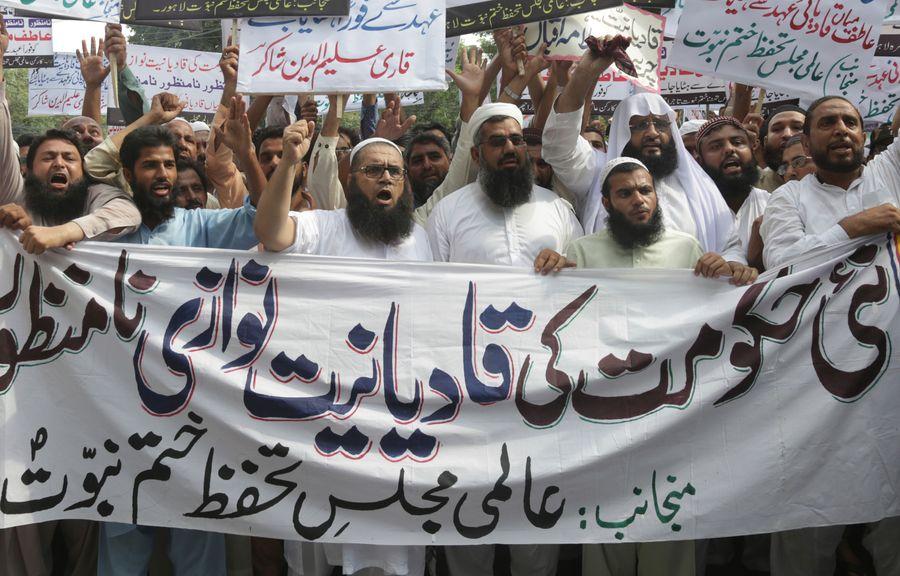
Next door in Pakistan – a country that also holds democratic elections – charges of blasphemy can carry sentences of 10 years up to the death sentence. The most recent State Department report on religious freedom notes that police have at times “killed, physically abused, or failed to protect religious minorities.” For minority faith communities like the Ahmadiyya Muslims in Pakistan, this utter disregard for freedom of religion or belief has led to a climate of terror and fear. Dozens of mosques have been desecrated. In 2023, alone, Ahmadi lawyers have been banned from practicing in some parts of the country, and the community faces systemic exclusion from basic civil rights, such as voting or obtaining an identification card. This state-supported persecution, again, often results in mob violence and even brutal killings.
While these examples are chilling and demand immediate attention from the international community, there is a more improbable situation brewing further east in Asia. Japan, which has been a beacon of democracy and human rights protection for several decades, is flirting with the idea of trampling on religious freedom. In a move that is much more reminiscent of current practices in China and Russia, Japan’s government is now threatening to dissolve a legally constituted religious group for seemingly political reasons.
Scholars of religion and human rights have watched with concern the developments in Japan following the tragic assassination in 2022 of former Prime Minister Shinzo Abe. The assassin claimed the attack was motivated by his anger at the Family Federation for World Peace and Unification (formerly the Unification Church), to which his mother belongs and which had ties, through politics, to Abe.
There is no doubt that this murder constituted a heinous crime. But the assassin’s crime and his grievance against the church should in no way serve as condemnation of the entire Family Federation community. Dissolving a religious organization that has not been found guilty of any crime would taint the image of Japan as a country committed to democratic principles. Democracies must live by their values and can never follow the path of totalitarian regimes, where unpopular religious minorities are “liquidated” after the ground has been prepared by slanderous media campaigns.
Everywhere in the world, freedom of religion or belief is most vital when it comes to protecting unpopular, misunderstood, marginalized, or wrongly maligned faith communities. Whether minority sects like the Ahmadi Muslims of Pakistan, one of the dozens of minority religious communities in India, or a new religious movement like the Family Federation of Japan, every democracy should protect the fundamental right to practice one’s own faith or beliefs. Governments that truly embrace freedom of religion or belief safeguard their religious communities against the tides of negative public opinion and against prejudice. Laws, policies, or actions that disregard or trample on this fundamental right have no place in democratic nations.
Friends of human rights and religious freedom, including U.S. Ambassador at Large for International Religious Freedom Rashad Hussain and his counterparts around the world, should speak out boldly to ensure that the world’s democracies avoid the terrible mistake of letting freedom of religion or belief fall by the wayside.

Democrats Won the Midterms. Common Sense Won, Too
Jordanne Kemper • RealClearPolitics
The 120th Congress Shapes Up
Carolina Lumetta • RealClearPolitics
Flooding GOP Primaries With Democrats
Robert Natelson • RealClearPolitics
Washington Keeps Rewarding Oracle—Veterans Keep Paying the Price
Darin Gaub • RealClearPolitics
The Seeds of Unrestricted Warfare
John Teichert • RealClearPolitics
The Primary System Is Losing the Next Generation
Sean Trende • RealClearPolitics
RCP Today
Top stories on RealClearPolitics
The Takeaway
Polling intelligence and analysis delivered to your inbox
World News
Featuring the latest world news
Policy
Featuring the latest policy news
Support Our Mission
As part of RealClearPolitics, authors aim to provide balanced, non-partisan analysis by presenting top reporting and commentary from all sides of the political spectrum.
Trusted by policymakers and citizens alike since 2000