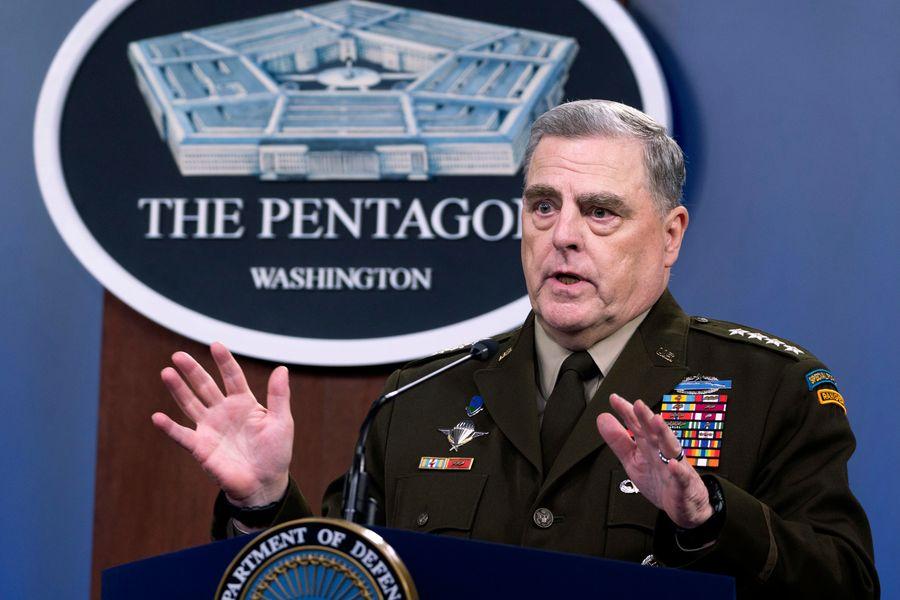
Pentagon Briefing Austin Milley
Who Wins, Who Loses Gen. Milley's Long War?
Published April 8, 2022 • Read time: 5m
Speaking of the seven-week war in Ukraine ignited by Vladimir Putin, Gen. Mark Milley, chairman of the Joint Chiefs of Staff, is warning us to expect a war that lasts for years.
"I do think this is a very protracted conflict ... measured in years," Milley told Congress. "I don't know about a decade, but at least years, for sure."
As our first response, said Milley, we should build more military bases in Eastern Europe and begin to rotate U.S. troops in and out.
Yet this sounds like a prescription for a Cold War II that America ought to avert, not fight. For the territorial integrity and sovereignty of Ukraine, while a declared goal of U.S. policy, is not a vital U.S. interest to justify risking a calamitous war with Russia.
Proof of that political reality lies in political facts.
For 40 years of the Cold War, Ukraine was an integral part of the Soviet Union. In 1991, Bush I warned Ukrainian secessionists, who wanted to sever ties to Russia, not to indulge such "suicidal nationalism."
And though we brought 14 new nations into NATO after 1991, Bill Clinton, George W. Bush and Barack Obama never brought in Ukraine.
Indeed, during the seven weeks of this war, President Joe Biden has refused to transfer to Ukraine the 28 MIG-29s that Poland offered to make available, if the U.S. would replace the Polish MIGs with U.S. fighter jets.
Biden has warned that this could ignite a collision with Russia that could lead to World War III. And he is not going to risk a third world war that could escalate to nuclear war -- for Ukraine.
Is Trump Right About NATO?
Over Here: Competence Amid Repulsive Politics
We're Not a Poor Country, Donald
U.S. Officials Say 2 Americans Died in Brussels Attack
What is Biden saying by denying the MIGs to Ukraine?
That preventing Russia from amputating Donbas, Crimea and the Black Sea coast of Ukraine is not a U.S. interest so vital as to be worth our risking war with Russia. Ukraine is not only outside NATO; it is outside the perimeter of U.S. vital interests justifying war.
This crisis in Ukraine is calling forth the larger question:
For whom and for what should the United States go to war with a nation with a larger nuclear arsenal than our own, but which does not directly threaten us?
Currently, the Beltway war hawks and neocons are bristling with demands the U.S. send the MIGs to Ukraine, and the S-300 air-defense system, and anti-ship missiles to sink Russia's Black Sea fleet.
They tell us Putin is blustering and bluffing when he suggests that Moscow might use tactical nuclear weapons rather than accept defeat and humiliation in Ukraine.
Yet, looking at a cost-benefit analysis of continuing this war, it would appear that the sooner it ends, the better.
For who would be the likely winners and the losers of Milley's "protracted conflict" that will last "at least years for sure"?
The greatest losers would be the nation and people of Ukraine.
Already, in seven weeks, 10 million Ukrainians have been uprooted from their homes, and 4 million of them have fled the country. That is a fourth of the nation uprooted, and a tenth lost to Ukraine.
Thousands of Ukrainian soldiers and civilians have died resisting the invasion. Thousands may have been murdered. Cities like Kharkiv have been horribly damaged, with Mariupol on the Sea of Azov destroyed.
President Volodymyr Zelensky's willingness to negotiate with Putin after the proven atrocities and to accept temporary occupation of part of Ukraine suggests that he knows that, from here on out, Ukraine, which has won the first battles, could steadily lose the longer war.
Indeed, if the known huge losses for Ukraine came from the first seven weeks of fighting, what will be the losses from a second seven weeks, or a third, on the bloody road to Milley's long war?
Putin's Russia is a second loser in this war.
The initial invasion failed to capture Kiev or Kharkiv. The Russian army around Kiev has departed and, reportedly, many thousands of Russian troops have been killed, wounded, captured or gone missing.
The Russian economy is suffering from severe sanctions.
Yet over 80% of the Russian people still support Putin and his war. And Russia's renewed drive into the Donbas and to take the Black Sea coast of Ukraine from Crimea to Odessa is not yet lost.
But while Ukraine and Russia have suffered greatly, the U.S. and NATO have suffered barely at all. Nor has China, which stands to be the major beneficiary when a bleeding, isolated Russia goes in search of support.
What Americans have to worry about is the long war that Gen. Milley is predicting, and the possibility that Russia's continued bleeding causes it to resort to tactical nuclear weapons to end the losses and humiliation and prevent an outright defeat.
Thus, the sooner this war ends, the better for us and our friends -- even if it means having to talk to the man Biden cannot stop calling a war criminal and clamoring for his prosecution.
COPYRIGHT 2022 CREATORS.COM

A RealClear Thanksgiving: Investing in a Better Future
David DesRosiers • RealClearPolitics
Trump’s Newsom Problem: Antagonist-in-Chief
Carolina Lumetta • RealClearPolitics
America’s Free Spirit
John Maxwell Hamilton • RealClearPolitics
The GOP Majority Should Go Out in Glory
Daniel McCarthy • RealClearPolitics
Republican Majorities Could Return Sooner Than Expected
J.T. Young • RealClearPolitics
The Danger Before the Attack
Leslie J. Sullivan • RealClearPolitics
RCP Today
Top stories on RealClearPolitics
The Takeaway
Polling intelligence and analysis delivered to your inbox
World News
Featuring the latest world news
Policy
Featuring the latest policy news
Support Our Mission
As part of RealClearPolitics, authors aim to provide balanced, non-partisan analysis by presenting top reporting and commentary from all sides of the political spectrum.
Trusted by policymakers and citizens alike since 2000