
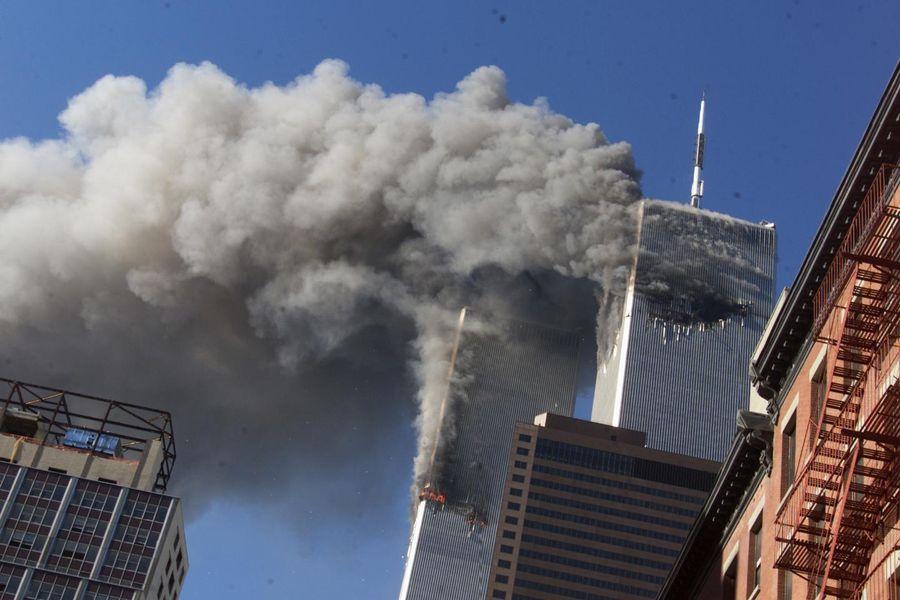
FILE - In this Sept. 11, 2001 file photo, smoke rising from the burning twin towers of the World Trade Center after hijacked planes crashed into the towers, in New York City. Every American of a certain age has a 9/11 story _ vivid memories of where they were, what they saw, how they felt on that awful day. Donald Trump is one of them. And for New Yorkers like him, 9/11 melds first-hand experience with what they felt in their guts, what they saw on television and what was playing out in the lives of friends and loved ones in a city under siege. (AP Photo/Richard Drew, File)
White House Set to Release Secret Pages From 9/11 Inquiry
Published April 25, 2016 • Read time: 5m
WASHINGTON (AP) -- The Obama administration will likely soon release at least part of a 28-page secret chapter from a congressional inquiry into 9/11 that may shed light on possible Saudi connections to the attackers.
The documents, kept in a secure room in the basement of the Capitol, contain information from the joint congressional inquiry into "specific sources of foreign support for some of the Sept. 11 hijackers while they were in the United States."
Bob Graham, who was co-chairman of that bipartisan panel, and others say the documents point suspicion at the Saudis. President Barack Obama has hinted the administration might soon release at least part of the documents, noting that James Clapper, national director of intelligence, has been reviewing the classified pages.
The disclosure would come at a time of strained U.S. relations with Saudi Arabia, a long-time American ally.
"I hope that decision is to honor the American people and make it available," Graham told NBC's "Meet the Press" on Sunday. "The most important unanswered question of 9/11 is, did these 19 people conduct this very sophisticated plot alone, or were they supported?"
Tim Roemer, who was a member of both the joint congressional inquiry as well as the 9/11 Commission and has read the secret chapter three times, described the 28 pages as a "preliminary police report."
"There were clues. There were allegations. There were witness reports. There was evidence about the hijackers, about people they met with - all kinds of different things that the 9/11 Commission was then tasked with reviewing and investigating," the former Democratic congressman from Indiana said Friday.
Over Here: Competence Amid Repulsive Politics
We're Not a Poor Country, Donald
What America Should Learn from the Attack in Brussels
Anti-Muslim Rhetoric Profits the Enemy
Fifteen of the 19 hijackers were citizens of Saudi Arabia. The Saudi government says it has been "wrongfully and morbidly accused of complicity" in the attacks, is fighting extremists and working to clamp down on their funding channels. Still, the Saudis have long said that they would welcome declassification of the 28 pages because it would "allow us to respond to any allegations in a clear and credible manner."
The pages were withheld from the 838-page report on the orders of President George W. Bush, who said the release could divulge intelligence sources and methods. Still, protecting U.S.-Saudi diplomatic relations also was believed to have been a factor.
Speaking of the Clapper review, Ben Rhodes, Obama's deputy national security adviser, said "when that's done we'd expect that there will be some degree of declassification that provides more information."
Neither the congressional inquiry nor the subsequent 9/11 Commission found any evidence that the Saudi government or senior Saudi officials knowingly supported those who orchestrated the attacks that killed nearly 3,000 people. But Graham, the relatives of victims and some lawmakers think there is reason to further probe possible Saudi links.
Roemer said many questions remain about the roles of Fahad al Thumairy, an official at the Saudi consulate in Los Angeles who allegedly helped two of the hijackers find housing and transportation after they arrived in Southern California. Al Thumairy was later denied entry into the United States in May 2003 after the State Department alleged that he might be involved in terrorist activity. Roemer also wants to know more about Omar al Bayoumi, who was strongly suspected of being a Saudi spy and was alleged to have been helpful to the hijackers.
"We did not discover ... Saudi government involvement at the highest level of the 9/11 attacks," Roemer said. But he added: "We certainly did not exonerate the Saudis. ... Saudi was a fertile ground for fundraising for al-Qaida. Some of these issues continue to be problems today. That's why we need to continue to get to the bottom of this."
An Internet site pushing to get the documents released, 28pages.org, points to another document declassified in July 2015 that outlined ways in which the commission could examine possible Saudi links.
That 47-page document lists several pages of individuals of interest and suggests questions that could be pursued. One name is suspected al-Qaida operative Ghassan al Sharbi.
Al Sharbi, who was taking flight lessons in the Phoenix area before 9/11, was captured in 2002 in the same place in Pakistan as Abu Zubaydah, a top al-Qaida trainer who was apprehended and waterboarded dozens of times by U.S. interrogators.
The document said that after al Sharbi was captured, the FBI discovered some documents buried nearby. One was al Sharbi's pilot certificate inside an envelope from the Saudi Embassy in Washington, although it's unclear whether the license had been mailed by the embassy or if the envelope was simply being reused.
A CIA inspector-general report in June 2015 said there had been no reliable information confirming Saudi government "involvement with and financial support for terrorist prior to 9/11." But it said also that people in the CIA's Near East Division and Counterterrorism Center "speculated that dissident sympathizers within the government may have aided al-Qaida." The rest of the chapter, titled "Issues Related to Saudi Arabia," is blacked out.
A bill directing the president to release the 28-page chapter was introduced in the Senate, and nearly three dozen Republicans and Democrats in the House are backing a similar resolution.
Reps. Walter Jones, R-N.C., Stephen Lynch, D-Mass., and Thomas Massie, R-Ky., wrote Obama last week saying they don't think releasing the chapter will harm national security and could provide closure for the victims' families.
California Rep. Adam Schiff, the top Democrat on the House Intelligence Committee, has read the pages and said this past week that while he wants to see them declassified to end speculation about what they say, releasing them will not quell the debate over the issue.
"As is often the case, the reality is less damaging than the uncertainty," he said.
© 2016 The Associated Press. All rights reserved. This material may not be published, broadcast, rewritten or redistributed. Learn more about our Privacy Policyand Terms of Use.
Jon Finer’s Old and Dangerous ‘New Approach’ to Israel
Peter Berkowitz • RealClearPolitics
The President Deserves Better
John Ullyot • RealClearPolitics
Congress Doesn’t Need Another Blame Game. It Needs To Find What’s Broken
Jarrod Bernstein • RealClearPolitics
Democrats Won the Midterms. Common Sense Won, Too
Jordanne Kemper • RealClearPolitics
The 120th Congress Shapes Up
Carolina Lumetta • RealClearPolitics
Flooding GOP Primaries With Democrats
Robert Natelson • RealClearPolitics
RCP Today
Top stories on RealClearPolitics
The Takeaway
Polling intelligence and analysis delivered to your inbox
World News
Featuring the latest world news
Policy
Featuring the latest policy news
Support Our Mission
As part of RealClearPolitics, authors aim to provide balanced, non-partisan analysis by presenting top reporting and commentary from all sides of the political spectrum.
Trusted by policymakers and citizens alike since 2000