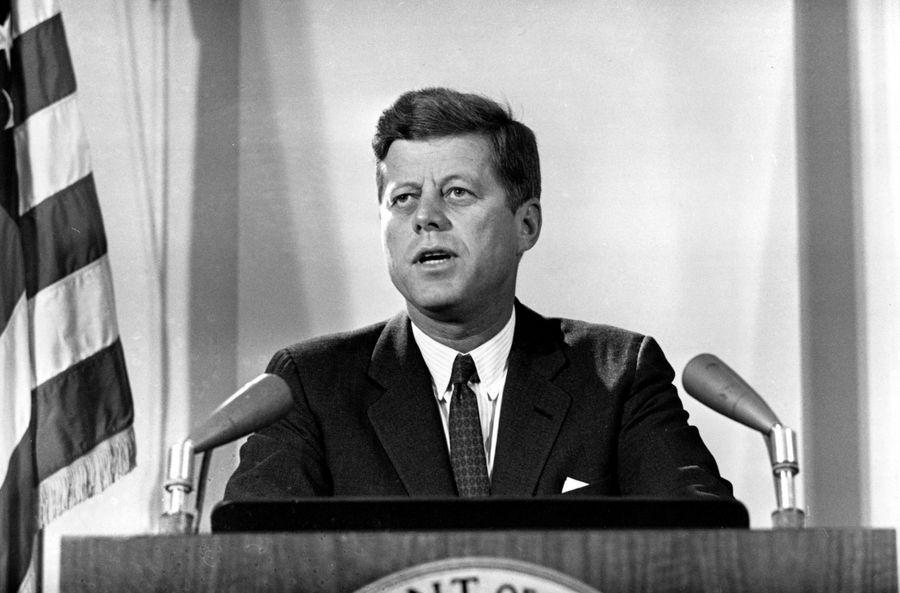
U.S. PRES KENNEDY CUBAN CRISIS
Trump's Iran Strike Parallels JFK's Soviet Missile Crisis
COMMENTARY
Published July 8, 2025 • Read time: 5m
The world stood on the edge of nuclear conflict as a U.S. president held firm and took radical action to end that threat while the world held its breath. That president was John F. Kennedy over two weeks in 1962. And last month, President Donald Trump, for the first time in many decades, took similar action, and again, it worked.
Contrast that with the results of so many well-meaning presidents and European leaders who urged peace and offered appeasement through actions such as Obama took in shipping billions of dollars of cash to Iran in a secret airlift. Under their stewardship, threats to the world have grown consistently larger and the global framework became increasingly insecure as Russia, China, North Korea, and Iran all grew in strength and took actions to control their people and suppress all internal dissent.
As many will recall from their childhood, Kennedy acted on the basis of intelligence that showed that the Soviet Union was going to install nuclear missiles in Cuba, just minutes away from the United States, giving them a superior first-strike capability. The president set up a blockade around Cuba, directly confronting ships and their cargo; Soviet Premier Khrushchev at first threatened war, but ultimately backed down.
The actions of President Trump stand in parallel to Kennedy. The world faced a clear nuclear threat from an uncontrollable adversary and Trump drew a red line that he then backed up with bold but limited military action to remove that threat rather than hesitate. And to conclude the threat, both leaders turned not to escalation but to negotiation.
Is Trump Right About NATO?
Over Here: Competence Amid Repulsive Politics
We're Not a Poor Country, Donald
U.S. Officials Say 2 Americans Died in Brussels Attack
Back then, Kennedy faced Republican criticism for his actions beforehand. Some said he had been too lenient; others said he did not go far enough and should have issued a pre-emptive strike. So too in this case, the Democrats unfurled banners of criticism as the president acted, accusing him of acting unconstitutionally and of setting us on a path toward World War III. With a few notable exceptions such as Ritchie Torres, Josh Gottheimer, and John Fetterman, Democratic leaders opposed or questioned Trump’s actions, missing an opportunity to bring the country together against a universally feared enemy.
Their arguments were weak and were meant to hold their base against supporting anything the administration does – Presidents Clinton (Bosnia) and Obama (Libya) and others throughout history have taken limited military actions of similar size and scope and these were unquestionably constitutional. And you can accuse any president who takes any action of increasing risk, but the strike was clearly successful and an example of what the American military can do today. In this case, unlike with other military actions in the Middle East such as the Iraq war, there was a critical ally and partner both to help support and to carry out the mission, and that critical difference was overlooked by the back benchers.
After Kennedy was successful, the country largely came together across party lines with everyone from then head of the Armed Services Committee Carl Vinson to Richard Nixon praising how the president had achieved peace through strength. It was called the 13 days that shook the world. In this case it was 12.
Now the Democrats have a similar opportunity to show that they can put country over party when it matters and gain the public’s respect. It’s not too late to rally all Americans behind a clear success for America, Israel, and the world. This would leave behind those in the far-left “Squad” who were actually rooting for Iran against Israel and would show that the Democratic party can put aside its hatred of the president when the national interest is at stake. This is a fragile ceasefire, and Iran is a wily opponent – the more they see national unity in America, the more likely they are to change their course and give up nuclear ambitions, not because they want to, but because to survive they have no choice.
Trump and Netanyahu could have escalated here and taken out the regime. But they made a calculation that leaving a weakened regime in place was less risky for the world than creating the kind of vacuum that occurred in Libya when President Obama took out Muammar Gaddafi. They took the Kennedy way out, with the same hope that the regime will eventually fall of its own weight now that they have been unmasked.
Trump’s efforts here were unquestionably aggressive and risky. But he also showed the kind of restraint that gets you the Nobel Prize or a place on Mt. Rushmore. It may be counterintuitive that Trump and not Obama would achieve these kinds of remarkable outcomes, but then the lesson of Kennedy is that achieving peace in the face of an aggressive enemy requires taking the kinds of risks and actions that Trump took against Iran, not shipping them billions in cash.

A RealClear Thanksgiving: Investing in a Better Future
David DesRosiers • RealClearPolitics
Trump’s Newsom Problem: Antagonist-in-Chief
Carolina Lumetta • RealClearPolitics
America’s Free Spirit
John Maxwell Hamilton • RealClearPolitics
The GOP Majority Should Go Out in Glory
Daniel McCarthy • RealClearPolitics
Republican Majorities Could Return Sooner Than Expected
J.T. Young • RealClearPolitics
The Danger Before the Attack
Leslie J. Sullivan • RealClearPolitics
RCP Today
Top stories on RealClearPolitics
The Takeaway
Polling intelligence and analysis delivered to your inbox
World News
Featuring the latest world news
Policy
Featuring the latest policy news
Support Our Mission
As part of RealClearPolitics, authors aim to provide balanced, non-partisan analysis by presenting top reporting and commentary from all sides of the political spectrum.
Trusted by policymakers and citizens alike since 2000