
Iran US Nuclear Timeline
Trump Wants an Iran Deal. Nukes Alone Won't Cut It.
ANALYSIS
Published March 23, 2026 • Read time: 4m
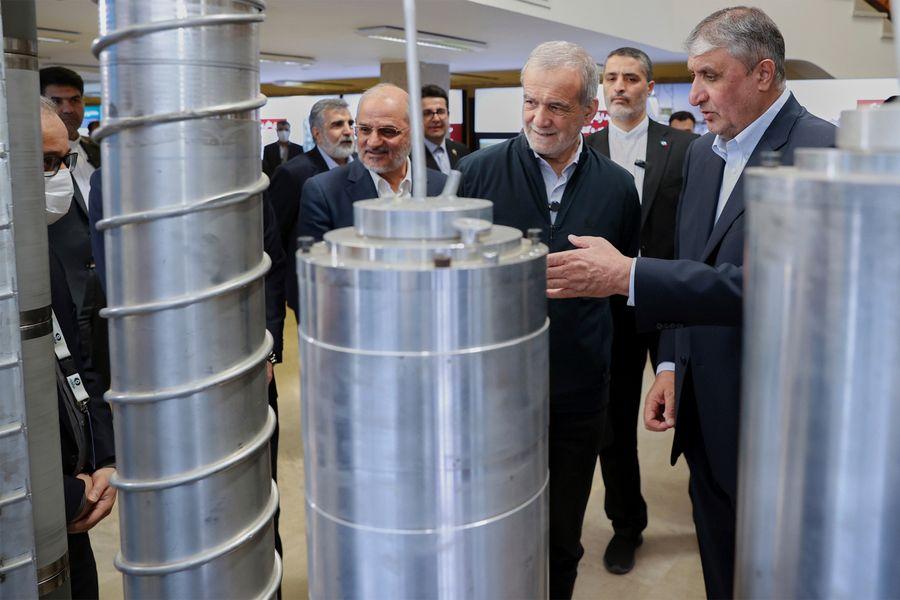
Twenty-five days into Operation Epic Fury, it looks like a deal may be around the corner – though that remains up in the air at time of writing. Overnight, President Trump took to Truth Social to announce that the United States and Iran have been holding what he described as “very good and productive conversations” toward a “complete and total resolution of our hostilities in the Middle East.” He ordered the Department of War to postpone any strikes on Iranian energy infrastructure for five days, and presented this as Tehran’s final opportunity to “end its threats.”
The framework that it has laid out so far – zero enrichment, handover of Iran’s roughly 440 kilograms of highly enriched uranium, broader denuclearization – suggests an overwhelming focus on the nuclear dynamic to the exclusion of the other aspects that have long made Iran such a regional threat. When asked specifically about Tehran’s ballistic missile arsenal, the president offered only that Iran would be “low-key on the missiles” – a throwaway line that shows a concerning dismissal of the Islamic Republic’s strike capability.
Since Operation Epic Fury began on Feb. 28, Iran has fired thousands of ballistic missiles, cruise missiles, and drone swarms at Israel and Gulf countries alike, often aimed at civilian targets. Civilian infrastructure from Israel to Saudi Arabia to Bahrain and beyond has been struck, and Qatar’s Ras Laffan LNG facility was damaged badly enough to cut export capacity dramatically. Perhaps the most concerning case came on Friday when Tehran launched two intermediate-range ballistic missiles at Diego Garcia – the joint U.S.-U.K. base in the Indian Ocean – demonstrating that the Islamic Republic’s missile capabilities were far more long-range than previously thought. That arsenal was developed under, and in many cases directly funded by, the last nuclear-only deal the United States struck with Tehran.
Over Here: Competence Amid Repulsive Politics
We're Not a Poor Country, Donald
What America Should Learn from the Attack in Brussels
Anti-Muslim Rhetoric Profits the Enemy
The 2015 Joint Comprehensive Plan of Action, or JCPOA, offered Iran sanctions relief worth over $100 billion in unfrozen assets and resumed oil revenue in exchange for constraints on centrifuges, enrichment levels, and reactor designs, while the Islamic Republic’s ballistic missile program and proxy armies were treated as someone else’s problem entirely. Tehran wasn’t subtle about exploiting the gap – the Foundation for the Defense of Democracies tracked 23 separate ballistic missile tests in the three years following the deal’s conclusion alone, a pace that only accelerated after the agreement’s already-weak missile-related provisions expired entirely in October 2023.
Western estimates had placed Iran’s missile stockpile at roughly 1,000 short and medium-range systems when the JCPOA was signed – mostly liquid-fueled Shahab-3 variants that weren’t very precise in their targeting. By late 2022, that number had more than tripled to over 3,000 ballistic and cruise missiles, with at least 10 entirely new systems unveiled in the last decade; solid-fuel staging that allows for mobile launchers to fire on short notice; and the extended-range boosters that on Friday doubled Iran’s self-declared range limit, putting much of continental Europe within reach for the first time.
That same sanctions windfall simultaneously supercharged the proxy network that made this inevitable in the first place. Hezbollah’s arsenal swelled to as many as 150,000 missiles, built and shipped to Lebanon specifically with the intention of overwhelming Israeli air defense systems to defend Tehran. The Houthis, meanwhile, graduated from a Yemeni insurgency into a force capable of disrupting global shipping across the Red Sea, requiring multiple rounds of Western intervention over the last few years. Total Iranian spending on propping up the Assad regime, Iraqi paramilitaries, and the Houthis in Yemen between 2012 and 2018 exceeded $16 billion – and while some of that would have doubtlessly taken place without the JCPOA, the inflow of cash to the Islamic Republic certainly helped expand their spending while aiding the regime economically at home.
Operation Epic Fury has succeeded thus far in degrading Iran’s conventional forces in ways that would have been unthinkable just a few months ago, and no American government has held this kind of leverage over the Islamic Republic since its founding. Any agreement reached must be comprehensive in nature to address the nuclear program, but also its missile arsenal, the proxy forces that have dragged this region into conflict after conflict, and ideally, must mandate political reform within the country where executions for political dissent continue.
But a deal that merely confiscates enriched uranium while leaving these other aspects of Iranian power intact buys into the same false premise of the original 2015 JCPOA, at the precise moment that we have the leverage to demand something real.
Support Our Mission
The Internet provides an endless stream of content. Not all of it is worth your time. That's why, every day, RealClearPolitics curates the most essential news and information—from all sides and across mediums. The links, videos, and podcasts curated here are the product of human judgment, not algorithms or AI. Please help power our mission of presenting a thoughtful, balanced public discourse through a tax-deductible donation.
Would you consider supporting us today?
Democrats Won the Midterms. Common Sense Won, Too
Jordanne Kemper • RealClearPolitics
The 120th Congress Shapes Up
Carolina Lumetta • RealClearPolitics
Flooding GOP Primaries With Democrats
Robert Natelson • RealClearPolitics
Washington Keeps Rewarding Oracle—Veterans Keep Paying the Price
Darin Gaub • RealClearPolitics
The Seeds of Unrestricted Warfare
John Teichert • RealClearPolitics
The Primary System Is Losing the Next Generation
Sean Trende • RealClearPolitics
RCP Today
Top stories on RealClearPolitics
The Takeaway
Polling intelligence and analysis delivered to your inbox
World News
Featuring the latest world news
Policy
Featuring the latest policy news
Support Our Mission
As part of RealClearPolitics, authors aim to provide balanced, non-partisan analysis by presenting top reporting and commentary from all sides of the political spectrum.
Trusted by policymakers and citizens alike since 2000