
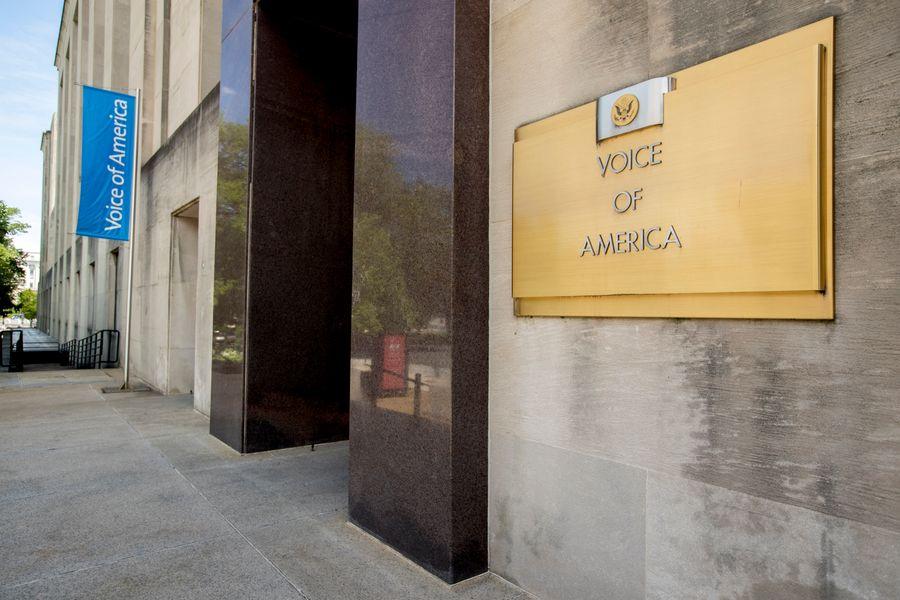
Voice of America
Telling the American Story: Public Diplomacy in the Trump Era
COMMENTARY
Published March 20, 2025 • Read time: 6m
The news this past weekend that the Trump administration plans to shutter the United States Agency for Global Media was hardly unexpected. It nonetheless came as a shock to many who work in what is called “public diplomacy” – government-sponsored efforts to affect public opinion overseas, which had been done by Voice of America, Radio Free Europe, and other entities since World War II.
On Friday, Congress passed the Continuing Budget Resolution, which included funding USAGM for another year. Nonetheless, on Saturday, Kari Lake – who is serving as a special White House adviser to USAGM – suspended some 1,300 VOA reporters, producers, and other public diplomacy professionals and canceled the charter of those independent agencies controlled by the board. (On Monday, Radio Free Europe/Radio Liberty filed a lawsuit against Lake and USAGM acting CEO Victor Morales seeking to restore the news organization’s federal funding.)
It is my fervent hope that the administration sees this not as a final chapter, but as an opportunity for a new beginning.
All but the agency’s harshest critics see some need for public diplomacy – or “soft power” as it is sometimes called. Gunboats, tanks, and pinstriped ambassadors are important, but in a world inundated with instant communications, the idea that the U.S. government should stop trying to tell our side of the story to a global audience is shortsighted and counterproductive. Our adversaries have already doubled down on the information wars. We should not cede the field, least of all at this critical moment.
Over Here: Competence Amid Repulsive Politics
We're Not a Poor Country, Donald
What America Should Learn from the Attack in Brussels
Anti-Muslim Rhetoric Profits the Enemy
Further, our story – the American story – is a powerful diplomatic tool that is uniquely our own. There are reasons that American movies, music, books, and television captivate audiences worldwide. As a nation of immigrants from across the globe, ours is a culture that is as close to universal in its appeal as any in history. It is no wonder that two of the post-war presidents we consider great communicators – Franklin Roosevelt and Ronald Reagan – both embraced public diplomacy. They understood the power of a great story and the need to deliver it to a world they wanted to change.
This is our chance to reimagine how we tell America’s story abroad. Here are a few modest suggestions:
-- Streamline the bureaucracy. On the Eastern Shore of Maryland where I live, we have what we call “telescope houses.” These are dwellings that may have started in the 18th century as humble lean-to’s, with rooms, wings, and outbuildings added by ensuing generations. The result can be architecturally charming, but impractical. Our current public diplomacy apparatus is the bureaucratic equivalent, minus the charm: an improvised ramshackle assembly of acronyms, boards, missions, and budgets that need to be gutted and built anew. To that end: The White House could name a new public diplomacy czar who reports directly to the Secretary of State, give him or her clear direction and authority, and redesign the organization from the ground up to serve the mission.
-- Speaking of mission, there has always been a headache-inducing debate at the root of our conduct of public diplomacy. One side argues that we succeed best by modeling for foreign audiences the independence enjoyed by our own fourth estate. For that reason, some public diplomacy practitioners – including most of the reporters, producers, and editors at Voice of America – consider themselves journalists and subscribe to a code of objectivity. They believe that by placing truth-telling above advancing the State Department’s immediate (and sometimes transitory) objectives, they in fact serve America’s greater cause.
Others argue that, inasmuch as we have a profusion of wire services, networks, newspapers, and online outlets that already cover America “warts and all,” the primary role of any initiative should be to hone and deliver content that supports America’s global agenda. Message first; journalism second.
It is time to decide. I come down on the side of the latter argument. This doesn’t mean blatant propaganda, disinformation, or lies – but the guiding principle for managers, editors, and reporters should be: Does what we write, produce, and broadcast increase America’s chances for foreign policy success? Clarifying the mission would help attract individuals who – like our military and state department personnel – understand and honor the greater goal for which they labor. We need the best people all rowing in the same direction, especially given the growing sophistication of our adversaries and the state of the current media landscape.
-- Speaking of the current media landscape, it is time to reevaluate some of the most fundamental aspects of the public diplomacy apparatus in light of what has happened – and is about to happen – to global communications. There is no crystal ball, but a few high-level trends are already clear, and we have to adjust.
For one, a Cold War culture still infuses much of our activities. By that I mean we still think in terms of messaging in an environment of “media scarcity” – that is, reaching audiences whose governments ruthlessly suppress outside voices. That challenge continues in some countries and remains important. But when it comes to reaching a large portion of the global population, the challenge now is the just the opposite: There is an abundance of communication options assaulting the audience on a 24/7 basis – streaming from radio, satellite television, and the Internet. The task at hand isn’t always to pierce an iron curtain with a single beam of information; rather, it is to harness the power of those fast-multiplying platforms across the globe that have already amassed audiences and are thirsty for content.
We’ve modeled too many of our current public diplomacy institutions after traditional radio, cable, and television networks in the belief that we need to control the pipes to deliver the message. We should be also be thinking like producers and create “VOA STUDIOS” – a distribution-agnostic entity with the goal of creating a range of high quality content with the power to appeal to the largest audience possible on as many platforms as possible. This opens the door to co-productions and novel distribution arrangements and provides a multiplying effect for money and resources. There are now a thousand conduits through which America can push content – we should acknowledge this reality and pursue those opportunities with a brand new entity, purpose-built for the modern era.
Past generations of public diplomacy practitioners embraced change. They harnessed the best of American ideals and translated them into programming that resonated with global audiences and changed the world for the better. They adjusted as communications technology advanced.
President Trump certainly understands the importance of messaging, media, and storytelling. I find it hard to believe that he is going to discard such a valuable diplomatic tool, just when we need it most. Let’s take this opportunity to reinvigorate public diplomacy and tell our story to the world.
The Danger Before the Attack
Leslie J. Sullivan • RealClearPolitics
Jon Finer’s Old and Dangerous ‘New Approach’ to Israel
Peter Berkowitz • RealClearPolitics
The President Deserves Better
John Ullyot • RealClearPolitics
Congress Doesn’t Need Another Blame Game. It Needs To Find What’s Broken
Jarrod Bernstein • RealClearPolitics
Democrats Won the Midterms. Common Sense Won, Too
Jordanne Kemper • RealClearPolitics
The 120th Congress Shapes Up
Carolina Lumetta • RealClearPolitics
RCP Today
Top stories on RealClearPolitics
The Takeaway
Polling intelligence and analysis delivered to your inbox
World News
Featuring the latest world news
Policy
Featuring the latest policy news
Support Our Mission
As part of RealClearPolitics, authors aim to provide balanced, non-partisan analysis by presenting top reporting and commentary from all sides of the political spectrum.
Trusted by policymakers and citizens alike since 2000