
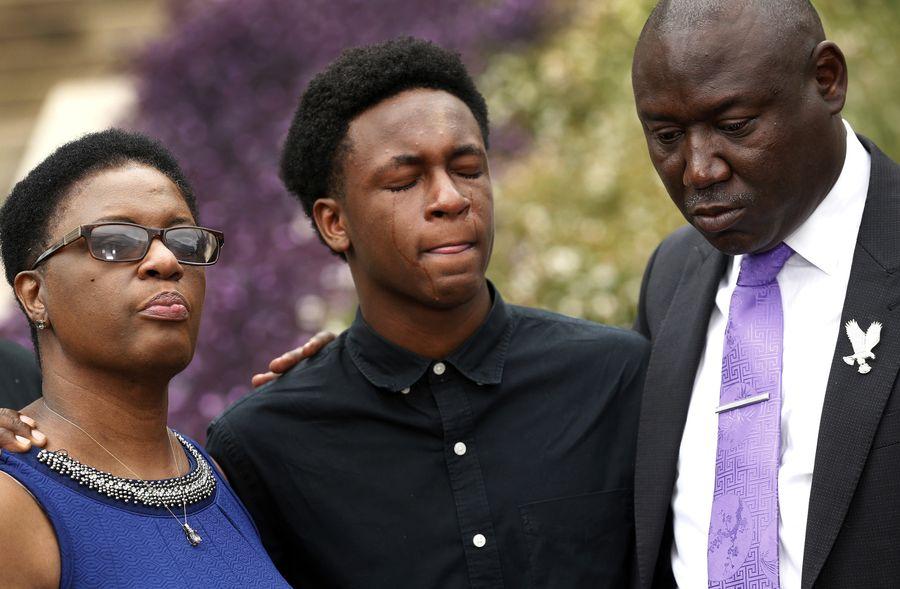
Brandt Jean, center, brother of Botham Jean, cries as he attends a news conference outside the Frank Crowley Courts Building on Monday, Sept. 10, 2018, in Dallas, about the shooting of Botham Jean by Dallas police officer Amber Guyger on Thursday. He was joined by his mother, Allison Jean and attorney Benjamin Crump. (Tom Fox/The Dallas Morning News via AP)
Restoring Our Faith in Redemption
COMMENTARY
Published Nov. 7, 2019 • Read time: 6m
On Sept. 6, 2018, an immigrant from the Caribbean island of Saint Lucia was fatally shot in his own apartment by a disoriented Dallas policewoman. Last month in a Dallas courtroom, Botham Jean’s 18-year-old brother, Brandt (pictured), said he forgave his brother’s shooter and hoped that she would turn her life to Christ. The young man then proceeded to hug her in the courtroom.
His actions surprise many Americans, but they didn’t surprise me.
Brandt exemplifies the Judeo-Christian values on which America was based: redemption and second -- or even third -- chances. In the 40-plus years of building the team that created the $15 billion Brandywine Fund, I paid less attention to a person’s past or where they are today but instead focused on what that person could become. Harnessing people’s strengths and ignoring their weaknesses was also important to our success.
Last year, the media spotlight descended unflatteringly on Virginia Gov. Ralph Northam for wearing blackface when he was in medical school. The governor promptly apologized and was adamant that he understood his decades-old actions were hurtful and offensive, but that they did not reflect his heart.
Many, on both sides of the aisle, demanded that he resign. Instead, he tried to atone. We should take Northam at his word that he sincerely regrets the incident and learned why it was so hurtful. Haven't we all done things in life we wish we could go back and change?
We lose something when we become an unforgiving society. The University of Iowa’s Stead Family Children’s Hospital almost lost $3 million. Here is how it happened:
The Crossroads of History
Nancy Reagan's Inspiring Legacy for Women
The Politics of Homicide
Pope Francis, the Climate and Leftism
Early on the morning of Sept. 14, a 24-year-old Iowan named Carson King went to the annual Iowa State Cyclones-Iowa Hawkeyes rivalry game in Ames, where he had attended college. The tailgating at that football game began early, as does ESPN’s "GameDay" show. Hoping to be seen by his friends back home, King fashioned a homemade sign reading “Busch Light Supply Needs Replenishing,” adding his Venmo handle.
King’s puckish sign struck viewers as humorous – and they responded by sending money, lots of it. When $600 reached his account he called his grandmother and told her that he wasn’t keeping the money, that he was giving it to Stead Family Children’s Hospital. When word of that gesture became public, the money really began pouring in. Anheuser-Busch announced it would match the money Carson raised, and by the end of the weekend the total had soared to $1 million.
But only plaster saints are perfect, and it turned out that while in high school, Carson King had used racially offensive language in a couple of tweets. He had apparently been riffing off jokes by comedian Daniel Tosh, but in our current culture, such nuance is invariably lost. When the Des Moines Register decided to profile King, the editors felt it was essential to mention those tweets (even though Carson immediately deleted them), explaining later that including the tweets were part of "the process, to understand the whole person."
Anheuser-Busch promptly disassociated itself with King, despite his public contrition. "In re-reading it today — eight years later — I see it was an attempt at humor that was offensive and hurtful,” King said. “I am embarrassed and stunned to reflect on what I thought was funny when I was 16 years old. I want to sincerely apologize."
But the damage didn’t end with King. It turned out that Aaron Calvin, the young reporter who’d written the Des Moines Register profile, also had posted a few off-color and homophobic tweets from his teenage years. Calvin told BuzzFeed News that the tweets were "frankly embarrassing" and that they had been "taken out of context." There is no reason to doubt him, but you can’t reason with a mob and the vigilantes demanded his ouster. The Des Moines Register quickly granted their wish. Calvin was fired.
Ultimately, the cause of fighting childhood cancer, which is what Stead Family Children’s Hospital is best known for nationally, overshadowed this controversy. Carson King ended up helping raise $3 million from his little placard wryly asking for beer money. And Iowa Gov. Kim Reynolds designated Sept. 28 “Carson King Day.”
In so doing, the governor acknowledged that too many of us forget: that it easy to believe that both these young men have grown up, and in their efforts to build a more just and loving world, have changed. Why do their teenage tweets matter?
"You can make a mistake in your life,” Reynolds said, “and still go on to do amazing things."
That goes for Aaron Calvin as well as Carson King. Embedded in our ability to believe in second chances is our brain's ability to leave the past in the past -- to forget. Unfortunately, rabid partisans have weaponized social media and background checks in ways that destroy people's chances to move on from past mistakes.
One of the culprits of our diminished ability to believe that people can change is the sound-bite media. Driven by profits and clicks, instead of truth and trust, the press often leaves out context. They demand "yes or no" sound bites to complex and usually old events. We should judge past events not from the 140-character click-bait environment of today, but with as much context as can be found and with the belief that people change.
Where do the values of resentment, revenge and “cancel culture” emanate from? Look no further than the religion of secularism. We all benefit from the many Judeo-Christian values our Founding Fathers embraced: "Forgive seven times? No, I say seven times seventy."
One of President Trump's most significant achievements is signing bipartisan legislation on criminal justice reform, which cemented the notion that once you've paid your due to society, you get a second chance, a chance to start again.
There is hope on the horizon, as just last week President Obama castigated those who engage in "cancel culture" and rejected the ostracization that often takes place when people disagree with one another. He reminded his young audience: “The world is messy, there are ambiguities. People who do really good stuff have flaws."
It might seem impossible to restore our national faith in redemption, but if you've ever made a mistake, or needed a second chance, share this article. Together we can get there.

Democrats Won the Midterms. Common Sense Won, Too
Jordanne Kemper • RealClearPolitics
The 120th Congress Shapes Up
Carolina Lumetta • RealClearPolitics
Flooding GOP Primaries With Democrats
Robert Natelson • RealClearPolitics
Washington Keeps Rewarding Oracle—Veterans Keep Paying the Price
Darin Gaub • RealClearPolitics
The Seeds of Unrestricted Warfare
John Teichert • RealClearPolitics
The Primary System Is Losing the Next Generation
Sean Trende • RealClearPolitics
RCP Today
Top stories on RealClearPolitics
The Takeaway
Polling intelligence and analysis delivered to your inbox
World News
Featuring the latest world news
Policy
Featuring the latest policy news
Support Our Mission
As part of RealClearPolitics, authors aim to provide balanced, non-partisan analysis by presenting top reporting and commentary from all sides of the political spectrum.
Trusted by policymakers and citizens alike since 2000