
Trump Intelligence Director
Trump Pulls Pulte Appointment, Nominates Jay Clayton
Published June 11, 2026 • Read time: 11m
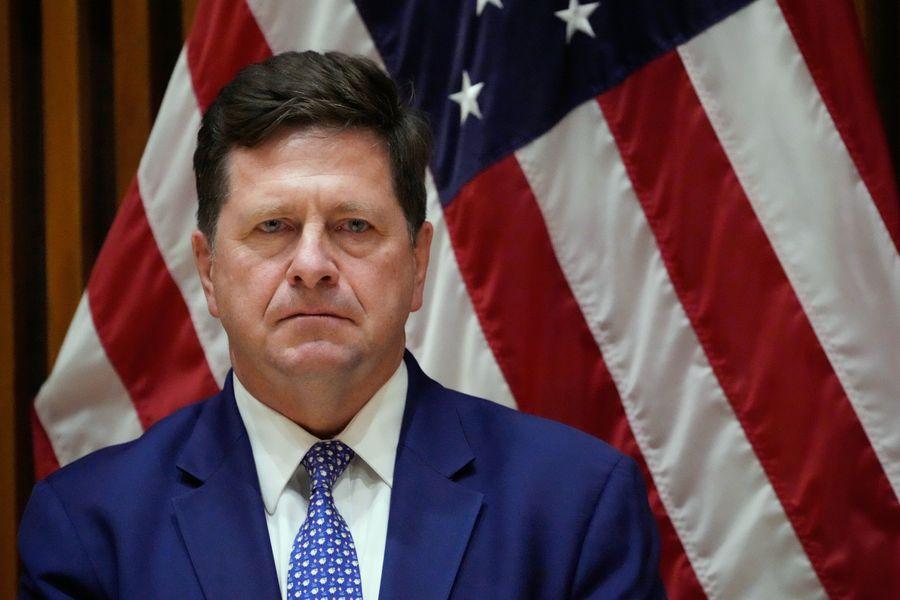
UPDATE: Despite asking for more time to conduct interviews and make a decision, Trump made his ODNI choice on Thursday afternoon, after both the House and the Senate failed to proceed with a short-term FISA extension. Former Securities and Exchange Commission chairman Jay Clayton will now field the Senate’s advice and consent role in a confirmation hearing date soon. Clayton is currently the U.S. attorney for the Southern District of New York. In that role, he signed an indictment against Venezuelan president Nicolas Maduro and his wife Cilia Flores, who are still incarcerated in New York.
In his announcement on Truth Social, Trump said Clayton is well respected in the legal community, but it remains to be seen how the intelligence community views him. His portfolio has little overlap with military or intelligence matters, but he has weathered a Senate confirmation process in the past. In 2017, Clayton received endorsements from Manhattan District Attorney Cyrus Vance, Jr., and Nevada Sen. Catherine Cortez Masto, both Democrats. Overall, nine Senate Democrats voted in favor of his nomination to the SEC.
Last year, Clayton’s nomination to the Southern District of New York stalled in the Senate due to a Democrat blockade of judicial nominees. After his own 120-day interim period ran out, judges in the district appointed him in August of 2025. This allowed him to fill the role permanently unless Trump nominated someone new. At the time, it was Clayton’s first prosecutorial role.
The announcement was too late to renew or briefly extend FISA, though. The House defeated a three-week extension in a 198-218 and left on recess for a week.
* * * *
Obamas Host "Hamilton" Cast at White House
Obama Starts 2015 on the Upswing, But Can It Last?
Obama Tests His Sway Against a GOP-Run Congress
Obama Looks Past GOP in Promoting 2015 Agenda
One week ago, Congress was sailing toward relatively easy passage of a bill to reauthorize Section 702 of the Foreign Intelligence Surveillance Act, which authorizes intelligence agencies to spy on non-U.S. electronic communications without a warrant. Then President Donald Trump announced he would install director of the Federal Housing Finance Agency Bill Pulte as the part-time acting director of national intelligence. His announcement upended the congressional calendar yet again, with Congress unsure of who will be exercising the spy powers if they renew the authority.
While the Senate protests and demands a new nominee, FISA is slated to expire on Friday, and Trump is digging in and asking for an extension to give him more time to interview permanent replacements for outgoing DNI Tulsi Gabbard.
Congress created the Office of the Director of National Intelligence in 2004 to respond to security and intelligence communication failures that led to the 9/11 terrorist attacks. The director was envisioned as a collator of intelligence across the CIA, FBI, and Pentagon for the president, and a facilitator of each department communicating with each other.
Starting June 19, Pulte will have access to the nation’s top secrets, if his security clearance is approved.
Trump has touted Pulte’s loyalty and success at FHFA and in leading the government-sponsored enterprises Fannie Mae and Freddie Mac. Over the past year, Pulte has pressed criminal mortgage fraud charges against New York Attorney General Letitia James, Federal Reserve board governor Lisa Cook, former Rep. Eric Swalwell, and Sen. Adam Schiff – all Democrats.
“He’s done a great job at Fannie Mae,” Trump told reporters Wednesday in the Oval Office . “I put him in charge as soon as I got here, and he’s done an amazing job … Smart people are smart people. I’d rather have smart than experience, but experience is good, too.”
Trump reiterated that Pulte will not be the permanent director, but the president added that he is resisting calls from congressional Republicans to release a new name quickly. Trump said he’s interviewing five people who have “done this kind of thing before.” He gave no indication whether his decision would come in enough time to clear bipartisan hurdles and renew Section 702 by Friday.
“I am asking Congress to send me a short-term extension of FISA to provide time for the selection and confirmation of a permanent head of the agency,” Trump wrote in a Truth Social post after a meeting Wednesday with House Speaker Mike Johnson .
“It would not make sense for someone who’s never had an economic background to be the secretary of commerce,” retired CIA analyst Brian O’Neill told RealClearPolitics. He also served as a senior executive in the National Counterterrorism Center, an agency within the ODNI. “It makes no sense that you put someone who’s wholly unqualified and would not even know some of the basic acronyms and what those functions are.”
Although the charter establishing the ODNI mandates that the director and deputy have experience in the intelligence community, the Federal Vacancies Reform Act does not have any such stipulation. In the event of a vacancy, the president is allowed to temporarily install anyone who has simply gone through the Senate confirmation process before, even for an unrelated role.
“The whole point of why it exists is because Senate confirmation takes time,” Cato Institute Director of Constitutional Studies Thomas Berry told RCP. “But Senate consent is important. The framers of the Constitution were worried that if the president didn’t have any check on who he appointed to any office, he might be tempted to just appoint people based on loyalty or nepotism or cronyism. When you have people filling offices without Senate confirmation, even temporarily, it’s still dangerous.” According to the Vacancies Act, Trump has 210 days before he must nominate someone else for Senate confirmation, but then Pulte could remain in the job for as long as that process plays out. Congressional Democrats said Wednesday that they’re not comforted by Trump’s promises that he’s interviewing candidates.
“This exemplifies the downsides of having such a broad category of eligibility,” Berry said. “Yes, the Senate has decided he was qualified for another position. That does not mean the Senate would be comfortable with him in a completely different agency.”
It’s a playbook Trump used in his first term. He appointed Justice Department chief of staff Matthew Whitaker as acting attorney general, and he moved Mick Mulvaney from the Office of Management and Budget to be acting director of the Consumer Financial Protection Bureau. In a Friday interview with the Wall Street Journal, Trump said the transience works in his favor to get things done without needing Senate buy-in.
“You’re less shackled,” Trump said. “It sort of gives you more power.”
White House spokesman Davis Ingle told RCP that Trump chooses “the best and most talented people to serve in his Cabinet.”
“Bill Pulte is a great selection and he will do a great job on behalf of the American people,” Ingle said. “Holding FISA hostage puts America’s national security at risk and it is shameful that some Democrats are threatening to put partisan politics ahead of the safety of the American people.”
Trump has said publicly that he wants Pulte to downsize the office and delve into possible federal election fraud. The directive indicates that he wants Pulte to do some of the more controversial tasks he wants, leaving the full-time nominee with plausible deniability during a Senate confirmation hearing.
O’Neill admits the ODNI has expanded beyond what the original 2004 authorization envisioned, but says it still serves an important function for the president.
“It was supposed to be an integrator, the President’s senior advisor,” O’Neill told RCP. “The CIA director still held a great deal of sway with the president, and so the role had an administrative purpose, which I think is valuable.”
The top daily task for each director is delivering the President’s Daily Brief, a process in which the DNI serves as a publisher or editor-in-chief, O’Neill said. The DNI receives edits from the CIA, NSA, and other intelligence agencies, puts them into a comprehensive report, and then delivers the brief to the president, sometimes in conjunction with the CIA director.
“The statute was broad to go ahead and establish offices to help them meet the mission of ODNI. Over the years, as with any bureaucracy, it grew,” O’Neill said. “Looking at what would make it more efficient is a reasonable thing.”
During her tenure, Gabbard reduced the overall staff by at least 40%, saving roughly $700 million in taxpayer funding, according to an unclassified release. But the cuts were also based on an internal analysis about which positions were redundant and how to cover the workload with the staffers left. It is unclear whether Pulte will take the same approach or whether he’s also working with a particular quota.
“It’s more of a politicalization exercise than a true efficiency exercise,” O’Neill said. “Intelligence is supposed to be apolitical, it’s an assessment. What I always told my analysts … is you’re there to tell the president what he needs to hear, not what he wants to hear.”
Democrats are pushing for Pulte’s ouster before he even starts.
“Bill Pulte cannot serve a minute as acting Director of National Intelligence, and until that elevation is abandoned, there’s nothing really to talk about,” House Minority Leader Hakeem Jeffries said on Wednesday.
“As long as Pulte is designated to run that agency, an extension is a non-starter for me,” Sen. Adam Schiff said Wednesday afternoon.
In the Oval Office Wednesday, Trump said Democrats should not be allowed to extort the administration. He described the five people he’s considering as “all very good, very different.” Although he didn’t reveal the names, several possibilities being mentioned in official Washington have the requisite experience:
Rep. Elise Stefanik – The New York Republican sits on the House Permanent Select Committee on Intelligence, and she had originally gained Trump’s nomination in November 2024 to be the ambassador to the United Nations. Trump abruptly pulled the nomination in March of 2025, after the Senate had already advanced Stefanik out of committee. At the time, he said that the House could not spare any members with its slim majority. Later that year, Stefanik launched a campaign for New York governor but suspended it in December.
Sen. Tom Cotton – The Arkansas Republican is the chair of the Senate Intelligence Committee. He has often pushed for renewing FISA and is considered a China hawk. He also supported the Trump administration’s push to eradicate diversity, equity, and inclusion programs in the federal government. Cotton said he agreed with Trump’s desire for Pulte to further trim staff at ODNI. His long tenure in the Senate would likely make for a smooth confirmation process.
Aaron Lukas – Lukas is currently Gabbard’s second in command, but Pulte’s rise could mean that Lukas has been passed over. He joined the CIA as an analyst in 2004 and later served as a clandestine operations officer on deployments across multiple regions. He eventually rose to become an intelligence aide to former Acting Director of National Intelligence Richard Grenell before serving as a deputy senior director on the National Security Council. The Senate already confirmed him as the principal deputy director of national intelligence last year.
Michael Ellis – Ellis is the current deputy director at the CIA. He has experience both at the White House and on Capitol Hill. He worked on the House Permanent Select Committee on Intelligence between 2012 and 2016, during which time he worked on reports related to Edward Snowden’s leak of classified information. In 2017, he joined the Office of the White House Counsel and the National Security Council. In 2020 he reviewed a copy of former National Security Adviser John Bolton’s memoir and determined it included classified information, which later led to Bolton’s arrest in 2025. The Pentagon’s acting inspector general found Ellis was wrongfully suspended after he moved to the National Security Agency during the transition from the Trump administration to the Biden administration. He was a visiting fellow for law and technology at the Heritage Foundation and general counsel for the video platform Rumble. He became the CIA’s youngest-ever deputy director in February.
Sen. John Cornyn – The Texas Republican is also on the Senate Intelligence Committee, and some Democrats have reportedly floated his name as someone they’d be comfortable voting for. But Cornyn recently lost his first election ever, in part because Trump endorsed Ken Paxton for Texas’ Senate seat. This week, he told reporters that he wants to move to the private sector and that he’d like to kick any Democrat who floats his name in the shins.
Support Our Mission
The Internet provides an endless stream of content. Not all of it is worth your time. That's why, every day, RealClearPolitics curates the most essential news and information—from all sides and across mediums. The links, videos, and podcasts curated here are the product of human judgment, not algorithms or AI. Please help power our mission of presenting a thoughtful, balanced public discourse through a tax-deductible donation.
Would you consider supporting us today?

The Danger Before the Attack
Leslie J. Sullivan • RealClearPolitics
Jon Finer’s Old and Dangerous ‘New Approach’ to Israel
Peter Berkowitz • RealClearPolitics
The President Deserves Better
John Ullyot • RealClearPolitics
Congress Doesn’t Need Another Blame Game. It Needs To Find What’s Broken
Jarrod Bernstein • RealClearPolitics
Democrats Won the Midterms. Common Sense Won, Too
Jordanne Kemper • RealClearPolitics
The 120th Congress Shapes Up
Carolina Lumetta • RealClearPolitics
RCP Today
Top stories on RealClearPolitics
The Takeaway
Polling intelligence and analysis delivered to your inbox
World News
Featuring the latest world news
Policy
Featuring the latest policy news
Support Our Mission
As part of RealClearPolitics, authors aim to provide balanced, non-partisan analysis by presenting top reporting and commentary from all sides of the political spectrum.
Trusted by policymakers and citizens alike since 2000