Obama Relying on Public for Gun Control Push
Published Jan. 17, 2013 • Read time: 5m
Join the Conversation
0“An executive power grab.”
That was the Republican National Committee’s reaction to President Obama’s gun violence proposals Wednesday, while the National Rifle Association dismissed the president himself in a statement that exalted Congress as the ultimate power player on guns.
Between accusations that Obama acted like a king, or had stirred up a king-sized battle on Capitol Hill, the president insisted he’s powerless without the public’s embrace of the gun policies he backed after a month of study and consultations.
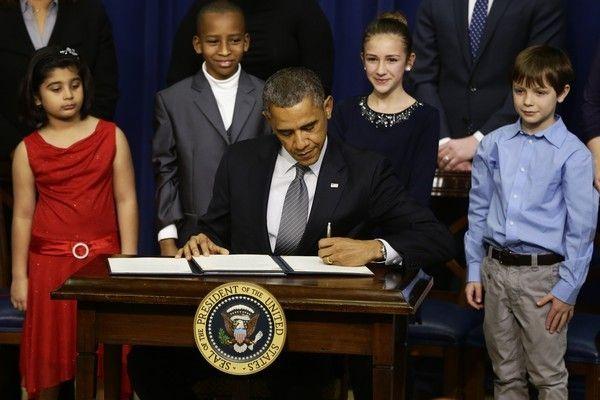
“They have the support of the majority of the American people, and yet, that doesn’t mean any of this is going to be easy to enact or implement,” he said during a White House event that featured survivors of mass shootings and four picture-perfect schoolchildren who had written to Obama in reaction to December’s Newtown, Conn., shootings.
Obama, with Vice President Biden by his side, pressed Congress to revive the expired assault weapons ban, place restrictions on high-capacity ammunition clips, and support background checks for everyone who buys a gun. He described the measures he wanted to enact, but the White House said he won’t send Congress a bill. (Sen. Dianne Feinstein will introduce legislation echoing these proposals next week; a similar bill is expected to be sponsored in the House.)
The president asked Congress to approve about $500 million in fiscal 2014 appropriations for his package of initiatives. He also challenged the Senate to confirm his newest nominee to head the Treasury Department’s Bureau of Alcohol, Tobacco, Firearms and Explosives -- after the gun rights lobby blocked prior nominees over a period of six years. And Obama signed presidential memoranda and blessed agency administrative actions dealing with federal research, law enforcement, mental health assistance, and grants for school safety personnel -- a collection of efforts the White House promoted as “23 executive actions.”
Obama's Foolish Gitmo Fixation
Choices Loom For Obama on Climate Change
Obama's Cloud-Based Transparency
Obama Signs Executive Order on Gov't Waste
“If there is even one thing we can do to reduce this violence, if there is even one life that can be saved, then we've got an obligation to try. And I’m going to do my part,” the president vowed.
Nothing on Obama’s list of executive decisions Wednesday was intended to flagrantly usurp Congress’s role. Anticipating a ferocious legislative battle, especially in the House, the president is eager for the public to perceive consensus behind his actions, not a presidential rebuke of the Second Amendment or other constitutional protections.
For example, he could have used his authority to recess-appoint an ATF director, a step New York Mayor Michael Bloomberg, a prominent gun control advocate, urged the president to take. But Obama instead said he would nominate Minnesota Attorney General B. Todd Jones -- after Senate opponents blocked a different nominee for the past two years.
By contrast, Obama said a year ago that leadership of the Consumer Financial Protection Board was too important to wait for Senate approval, and so he put Richard Cordray in the job without confirmation.
Last year, with an eye on his re-election, the president exercised his executive powers to appeal to Latinos, issuing a waiver of deportation requirements. He similarly curried favor with the LGBT community through his decision not to enforce the Defense of Marriage Act. He reached out to women voters with his decision to require almost all employers to cover contraception under the Patient Protection and Affordable Care Act. And he gave his nod to cash-strapped young people through an order granting college students a break on annual loan repayments.
“We Can’t Wait” was the White House slogan for the president’s executive actions.
On Wednesday, Obama told his audience that nothing he could do as president would ever be powerful enough, far-reaching enough, or quick enough to protect all children from gun violence. But Americans can insist on change, he said. Congress can make new laws. And the federal government can help.
“It’s time,” he said. “We can’t put this off any longer.”
Maybe so, but gun violence was not a front-burner project in the White House until December. And lawmakers who are not flat-out opposed are best described as wary. With Biden’s help, the president has embraced what he calls “sensible” gun control policies supported by Americans, according to recent polls.
In the month since 20 children and six adults died at Sandy Hook Elementary School, more than 900 people in the United States have reportedly been killed “at the end of a gun,” the president lamented. He labeled gun violence an “epidemic.”
Less than a week before his inauguration, Obama insisted that public pressure -- more than the power of his office or the stroke of his executive pen -- is the power behind the gun debate. His comments were intended to nudge Congress into the spotlight; to keep lawmakers there, Obama will use his bully pulpit, the memories of dead kindergartners, and national media attention.
“The most important changes we can make depend on congressional action,” Obama repeated. “They need to bring these proposals up for a vote, and the American people need to make sure that they do. Get them on record. Ask your member of Congress if they support universal background checks to keep guns out of the wrong hands. Ask them if they support renewing a ban on military-style assault weapons and high-capacity magazines,” he continued.
“And if they say no, ask them why not. Ask them what’s more important: doing whatever it takes to get an ‘A’ grade from the gun lobby that funds their campaigns? Or giving parents some peace of mind when they drop their child off for first grade?”
It was tough talk. But even by Obama’s yardstick, it did not come close to a power grab.

A RealClear Thanksgiving: Investing in a Better Future
David DesRosiers • RealClearPolitics
Trump’s Newsom Problem: Antagonist-in-Chief
Carolina Lumetta • RealClearPolitics
America’s Free Spirit
John Maxwell Hamilton • RealClearPolitics
The GOP Majority Should Go Out in Glory
Daniel McCarthy • RealClearPolitics
Republican Majorities Could Return Sooner Than Expected
J.T. Young • RealClearPolitics
The Danger Before the Attack
Leslie J. Sullivan • RealClearPolitics
RCP Today
Top stories on RealClearPolitics
The Takeaway
Polling intelligence and analysis delivered to your inbox
World News
Featuring the latest world news
Policy
Featuring the latest policy news
Support Our Mission
As part of RealClearPolitics, authors aim to provide balanced, non-partisan analysis by presenting top reporting and commentary from all sides of the political spectrum.
Trusted by policymakers and citizens alike since 2000