
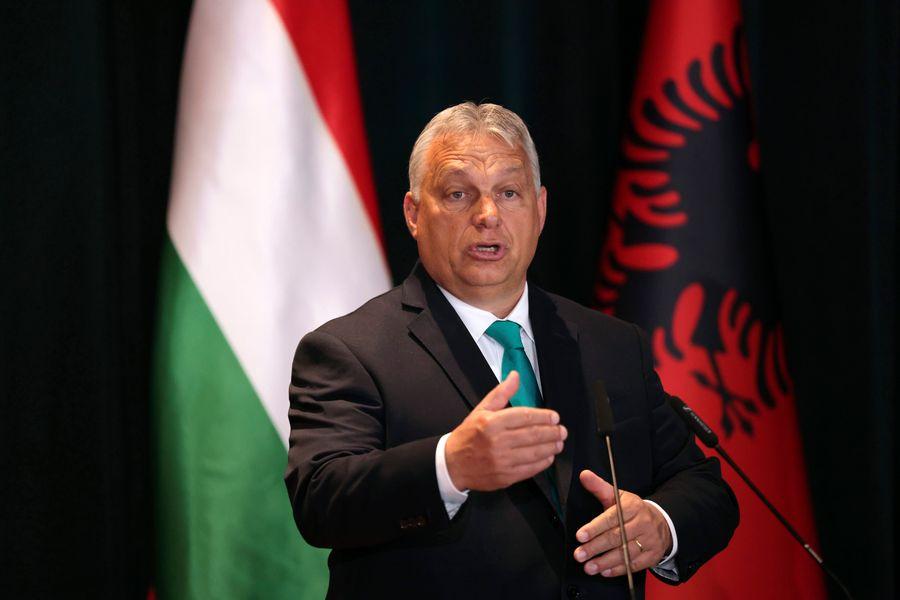
Albania Hungary
Hungary: The Lone Star State of Europe?
COMMENTARY
Published July 11, 2023 • Read time: 10m
Speaking to an enthusiastic crowd in Dallas during the 2022 Conservative Political Action Conference, Hungarian Prime Minister Viktor Orban proclaimed his nation “the Lone Star State of Europe.” Refusing to apologize for his nationalistic views, Orban proclaimed, “The globalists can all go to hell. I have come to Texas.”
The following year, Orban did not need to travel to Texas. Instead, CPAC went to Hungary. The strength of Orban’s alliance with American conservatives is predicated on two main issues: immigration and gender identity.
Hungary, a country of 10 million, did not open its borders to immigrants during the 2015 Syrian refugee crisis. “We are not a mixed race … and we do not want to become a mixed race,” Orban said days before his speech at CPAC 2022. He added that countries where Europeans and non-Europeans mingle are “no longer nations.” Orban argues that it is not racist to preserve the racial identity of one’s nation, and last year he proudly dubbed himself Europe’s “only anti-migration political leader.”
Hungary has also adopted policies banning the discussion of gender and sexual diversity in schools, the media, and advertising. Orban says “family policy” is at the “heart of our politics” and that he intends to protect kids from “the gender ideology that targets them.”
These policies are popular among many Western social conservatives who worry about illegal immigration and pro-LGBTQ classroom curriculums in their own country. In turn, they laud Hungary as an exemplary ally and the last bastion of conservatism in the European Union. In 2021, Fox News anchorman Tucker Carlson visited Hungary’s capital city, Budapest, and the country’s southern border to film a documentary that depicts Orban as a stalwart freedom fighter on a mission to combat European socialists.
Fix Europe or Lose It
Post-Jihad Gesture Theater: Je Suis Sick of It
The Dark Path to Brussels
Now Greeks Should Dump the Euro
The hagiographic publicity from Carlson’s film paid dividends for Orban and his Fidesz political party. But while right-wing Americans have increasingly celebrated Hungary for its gender and immigration policies, others – including some Hungarians – say Orban’s conservative branding strategy is tactical – and highly selective. It certainly isn’t economic conservativism.
Soviet Wistfulness
“When it comes to economic policies, Hungarians are pretty keen on state control.” From his home in Budapest, 27-year-old Mark Matusz spoke to RealClearPolitics via Zoom about his hopes that Hungarians will throw off “Soviet nostalgia” and demand a purer form of freedom from their government.
Matusz, the son of a working-class electrician and a Catholic mother, says he is “right of center” on the political spectrum but worries that Orban and the Fidesz party, which has maintained a majority in Hungary’s parliament since 2010, use migration policies and gender issues merely as “talking points that sell well in the international arena to groups like American conservatives.”
“In reality, I don’t think Hungary is a very conservative country,” he added. “
It all depends on one’s definition of conservatism. “My understanding of American conservatism is that it represents less state and more freedom for the people. It cherishes free markets,” Matusz said. “I don't think that kind of conservatism is happening in Hungary.”
He cites price caps on food, which the Hungarian government implemented in April, as an example of Hungary’s failure to promote free-market capitalism. Rather than allowing competition to dictate the price of goods, the government is forcing major grocery chains to offer mandatory discounts.
Matusz argues that these price caps do not “help the economy or the average Hungarian citizen” in the long run but rather reinforce the state’s image as a protector of the people. “For the government, it’s about communicating a message instead of implementing a sound economic policy,” Matusz said. “It’s about showing people that there is a state caring about them. This appeals to many voters” – especially those who “were born and raised in a socialist society for 30 or 40 years.”
Hungary initially fought on the side of Nazi Germany in World War II and lost large parts of its army in Russia. After the defeat of the Axis powers, the Soviet Union incorporated Hungary into the Soviet Bloc. Hungarian Communists loyal to the Kremlin consolidated power through the nationalization of industry, collectivized agriculture, and mass terror. With the exception of the 12 heady days of the 1956 Hungarian Revolution, which was crushed by Russian tanks, Communist rule persisted until the collapse of the Soviet Union in 1989. And though free elections were held in 1990, “Soviet nostalgia” did not collapse as quickly as the Berlin Wall.
A Time for Choosing
Orban gained power in 2010 when his Fidesz party won a super-majority in parliament. Since then, the prime minister has almost single-handedly written a new constitution, appointed staunch loyalists to the court, and poured money into buying up media conglomerates to control messaging and shape public opinion.
The European Parliament passed a resolution last year stating that it no longer considers Hungary a full-fledged democracy. The EU has also withheld billions in funding from Hungary in efforts to reign in Orban. But nothing seems to convince Orban to cut ties with the Kremlin – not even Putin’s war on Ukraine.
Russia’s aggression has at least put Orban in a tight spot as he strives to appease his allies in the West and maintain his friends in Moscow. Orban, who once cited Vladimir Putin’s Russia as a model of good governance, spoke of Ukraine as the victim of Russian aggression at the outset of the war. “Ukraine is our neighbor,” he said last year. “We are in full solidarity with them.” Hungary has offered more than supportive words, sending over $195 million in financial aid to Ukraine and accepting over 1 million Ukrainian refugees into Hungary.
But things changed after Ukrainian President Volodymyr Zelensky challenged “Viktor” (calling him by his first name) to pick a side in the war. “It’s time to decide already,” Zelensky said. But Orban said it was not in Hungary’s best interest to do more. Orban later mentioned “the Ukrainian president” while listing the political opponents he had to overcome to win his reelection bid last year.
Orban has since called Ukraine a “no-man’s land” and recently played down the notion that Putin’s power has been weakened by the Wagner rebellion. “When it is managed in 24 hours, it’s a signal of being strong,” Orban said. Furthermore, he argued that “Ukraine is not a sovereign country anymore. They don’t have money. They don’t have weapons. They can fight only because we support them – I mean the West.”
However, as Orban continually refuses to condemn Putin, Western leaders are increasingly skeptical of Orban’s status as a democratic leader.
Hungarian diplomats find themselves playing Orban’s game as well. “Russia is probably at the very root of the aggression,” said Szabolcs Takacs, Hungary’s ambassador to the U.S., in an interview with RCP. Takacs said that Russia was “in violation of national law” when it “invaded the territory of another country” and that Hungary “would like to support Ukraine in whichever way that we find it … Financially, we are supporting Ukraine.”
But Hungary’s goal is not to help Ukraine regain all of its territory, he said. Instead, Hungary wants a ceasefire. “Unfortunately, we are immediately labeled as pro-Russia or pro-Putin” for taking this approach, Takacs said. “But it is in nobody’s best interest to lose more lives.” He admits, however, that “we have to be very clear who is the aggressor and victim of the conflict.”
Takacs speaks of the war more diplomatically than Orban, but critics say Hungary wants a ceasefire primarily because it is so economically reliant on Russia and would prefer to avoid international scrutiny.
Hungary gets 85% of its gas and 65% of its oil from Russia, and the Kremlin recently extended a $13 billion loan for construction of a nuclear plant in Hungary. Orban is also looking to protect wealthy Hungarian investors who have profitable fossil fuel holdings in Russia and are loyal to the Fidesz party.
Orban has made it clear that Hungary would not arrest Putin, an accused war criminal, if he were to enter Hungary. He has insinuated that the U.S. pushed Russia into a war with Ukraine. In May, Hungary blocked EU military funding to Ukraine, citing concerns that the funds are only being used for Ukraine rather than promoting “the EU’s interests in other areas.” And Hungary has enabled Russia to bypass some sanctions.
Takacs says by implementing sanctions, “sometimes we hurt ourselves more.”
Hungary’s decision to join Turkey in objecting to Sweden’s admittance into NATO has Western leaders particularly skeptical of Hungary’s status as a Western ally, all the more so after Turkey dropped its opposition on Monday.
What is Conservatism?
Meanwhile, many right-wing Americans continue to hold up Hungary as a shining example of social conservatism. In May, the Heritage Foundation invited Takacs to speak at a conference about Hungary’s pro-family policies.
“The radical liberals and the globalists” want to eradicate “family, marriage, the past, identity, and heritage,” Takacs said. “As a matter of fact, we Hungarians have been fighting this culture war for a couple of years now.” He spoke of protecting “children from harmful ideologies in schools” and said that the problem with people migrating from the southern hemisphere is that “they dissolve the fiber of traditional European identity and way of life.”
Mike Gonzalez, a senior fellow at the Heritage Foundation, told RCP that “we have to treat Orban as the ally and friend that he is.” While U.S. ambassadors are “dancing outside in the streets with furries and trans people,” Gonzalez said, Hungary is working to combat the “trans agenda.” He says Hungary also “understands that everything is based on national boundaries. You destroy that, and you’ve destroyed everything.”
When asked about Hungary’s efforts to help Russia bypass sanctions and Orban’s refusal to criticize Putin, Gonzalez said, “Well, look, I’m more comfortable commenting on Hungary’s conservatism.”
But conservatism is not monolithic. And what are the movement’s priorities? Is it about promoting free markets and liberty around the world? Or is it about winning culture wars? For those who answer “both,” the affinity for Hungary’s brand of “conservatism” reveals a troubling trend within the modern conservative movement: When a desire to win culture wars supersedes a commitment to democracy, authoritarians flourish.
To the right-wing Americans who praise Orban’s Hungary, Mark Matusz says, “I would advise them to listen to John McCain.” In 2014, just after Russia had annexed Crimea, McCain warned that Hungary “is on the verge of ceding its sovereignty to a neo-fascist dictator getting in bed with Vladimir Putin.”
“Even ten years ago, when he was alive, McCain could see Hungary for what it is,” Matusz said. “Hungary is not all that close to conservative ideas. On the surface, yes. They talk about doing everything to preserve core families. But that’s just talk. What the government is doing is actually closer to what socialist leaders have done in past times.”
As Orban consolidates more power in Hungary, he has made it clear that he wants Donald Trump back in the White House. The problem is when “liberals are in power in Washington,” Orban said. Echoing Trump, Orban also said that in regard to Ukraine, “The hope for peace is Donald Trump.” Trump says he could end the war in 24 hours but has not said how. Neither will he say that he prefers a Ukrainian victory.
Matusz loves his country. But as Orban’s grip on the media all but ensures Fidesz’s continued power in Hungary, Matusz says, “There has been a gradual degradation of my will to stay in Hungary. I’m going to possibly…” he paused. “No, not possibly. I’m going to move abroad.”
A young conservative in Hungary, seeing the lack of pro-democratic conservatism in his own government, has decided that he must leave the homeland he loves if he wants freedom.
“I think nowadays representative democracy is facing a very serious challenge globally,” said Gergely Karacsony, the mayor of Budapest who opposes Orban’s government. “Some people say if representative democracy is in trouble, you should choose heavy-handed leaders who tell you what you need and protect you from danger. You can see this in the politics of the Hungarian government.”

Democrats Won the Midterms. Common Sense Won, Too
Jordanne Kemper • RealClearPolitics
The 120th Congress Shapes Up
Carolina Lumetta • RealClearPolitics
Flooding GOP Primaries With Democrats
Robert Natelson • RealClearPolitics
Washington Keeps Rewarding Oracle—Veterans Keep Paying the Price
Darin Gaub • RealClearPolitics
The Seeds of Unrestricted Warfare
John Teichert • RealClearPolitics
The Primary System Is Losing the Next Generation
Sean Trende • RealClearPolitics
RCP Today
Top stories on RealClearPolitics
The Takeaway
Polling intelligence and analysis delivered to your inbox
World News
Featuring the latest world news
Policy
Featuring the latest policy news
Support Our Mission
As part of RealClearPolitics, authors aim to provide balanced, non-partisan analysis by presenting top reporting and commentary from all sides of the political spectrum.
Trusted by policymakers and citizens alike since 2000