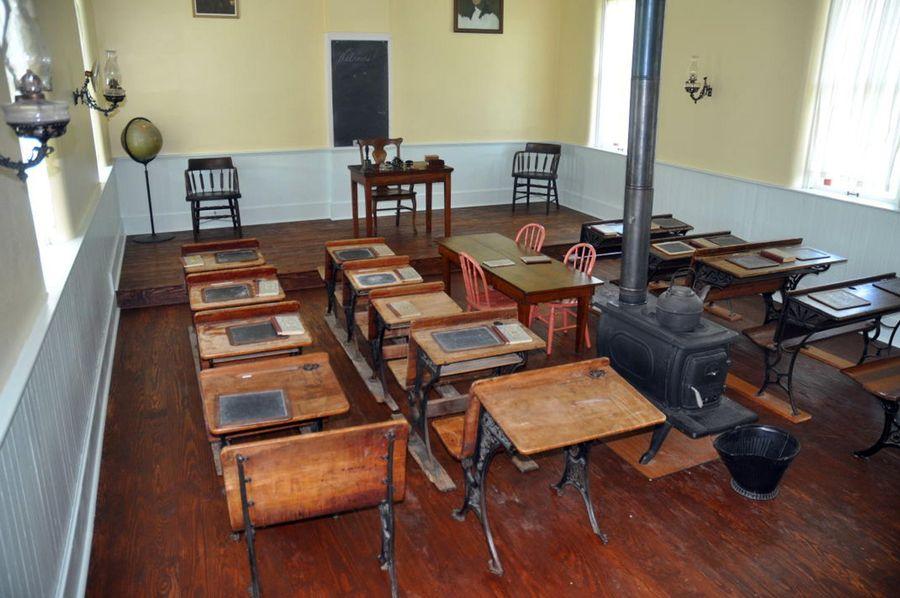
This Tuesday, Aug. 11, 2015, photo, shows the new flooring at the Homestead National Monument of America Freeman School in Beatrice, Neb., replicating what it looked like back in 1970, when the Homestead National Monument of America acquired the one-room schoolhouse. (Jory Schweers/Beatrice Daily Sun via AP) MANDATORY CREDIT
Pining for Old School America
Commentary
Published July 22, 2017 • Read time: 4m
Join the Conversation
0How do we make America great again? Returning to the curriculum and grading policies of much earlier generations might help. When was the last time you saw “thrift” as a subject taught in elementary school? Or “dependableness” and “housekeeping” — which encompassed “neatness of desk” and “care of books” — listed on a report card?
Probably not ever. But there they are, set forth for the 1931-32 public school year in Monroe County, Ohio. That’s where my mother-in-law got her education; by all indications, it was a solid one.
What brings this to mind is her first-grade report card, which my wife and I stumbled upon in advance of a family reunion last weekend in the Buckeye State. That’s where Loraine Bigler and her eight siblings grew up. Powhatan Point, to be specific. On a farm, to be even more precise. The Bigler kids and their widely spaced neighbors attended a one-room schoolhouse till they entered high school. Imagine that – a lone teacher instilling knowledge and character in charges ranging from age 6 (actually, 5 in Loraine’s case, thanks to a December birthday) to 14. Somehow, it worked.
Maybe there’s no mystery. Success took a skilled and tireless teacher, as it does today. And children whose lives were rooted in hard work and discipline, which may be less common. Still, it stands to reason that the focus of education in that era played a big part. Grades were given for reading and writing and ’rithmetic, of course, along with agriculture, civics and the aforementioned thrift. But the bulk of the report card – the two inside facing pages – measures growth both broader and more personal. Under the heading of “Citizenship” are nine focal areas, starting with “Manners” (“courtesy to teachers,” “kindness to associates” and something often missing in our public discourse today, “cleanliness and civility of speech”) and ending with “Punctuality.”
As Many as 1 Million Kids Will Have School Choice This Year
Hypocrisy Behind the Campus Renaming Craze
Can Our Colleges Be Saved?
Hillary's Federal Education Jackboot Squad
In between are what we might once have defined as all-American values: respect for law, order and authority; truthfulness and self-control; effort to do the best work; interest in community welfare; and, under “Reverence,” “attitude toward things sacred.”
Imagine the ruckus that last item would raise today in public school circles.
There are also seven grading areas that deal with purely personal matters. There’s neatness of dress (including “clothing clean” and “shoes clean”); neatness of person (“face clean,” “nails clean,” “hair brushed”); even posture, among others. The list ends with “weight.”
Again, imagine the uproar such grading areas would spark today, when unkempt appearance and childhood obesity are so commonplace. This is not to say anyone should ever be shamed if they fall short, only that there’s good reason to set — and meet — standards.
Does lamenting their disappearance make me an old fogy? I hope not. After all, I started first grade 29 years after my mother-in-law did; by the time I reached high school, in the late ’60s, “conformity” was a dirty word and “question authority” was a something of a mantra. As a journalist, holding those in power accountable is an article of faith. But toeing the line in those old-school ways seems like a worthwhile concept in young people’s formative years. Civics and thrift are worthwhile matters throughout our lives.
And here’s one more throwback concept on that yellowed report card that caught my eye: An "A” wasn’t earned on the cheap — one’s grades had to average between 95 and 100. In other words, getting an "A" meant something.
Come to think of it, so did high marks for “dependableness” and “workmanship” and even “punctuality.” It took more than just those things to make America great in the first place, but without them, it’s impossible to remain that way.

A RealClear Thanksgiving: Investing in a Better Future
David DesRosiers • RealClearPolitics
Trump’s Newsom Problem: Antagonist-in-Chief
Carolina Lumetta • RealClearPolitics
America’s Free Spirit
John Maxwell Hamilton • RealClearPolitics
The GOP Majority Should Go Out in Glory
Daniel McCarthy • RealClearPolitics
Republican Majorities Could Return Sooner Than Expected
J.T. Young • RealClearPolitics
The Danger Before the Attack
Leslie J. Sullivan • RealClearPolitics
RCP Today
Top stories on RealClearPolitics
The Takeaway
Polling intelligence and analysis delivered to your inbox
World News
Featuring the latest world news
Policy
Featuring the latest policy news
Support Our Mission
As part of RealClearPolitics, authors aim to provide balanced, non-partisan analysis by presenting top reporting and commentary from all sides of the political spectrum.
Trusted by policymakers and citizens alike since 2000