
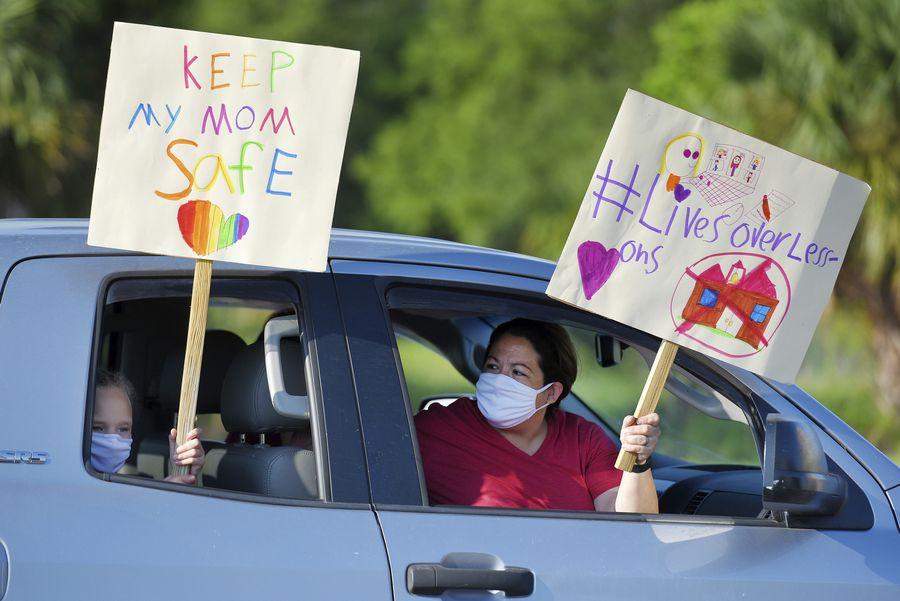
Story Collins, 9 and her mother Heather Correia show their support for teachers after arriving at the Duval County School Board building, Tuesday, July 14, 2020 in Jacksonville, Fla. Duval County teachers and their supporters gathered in a parking lot before they drove to the Duval County School Board Building and protest plans of starting the upcoming school year with the rate of COVID-19 infections hitting record rates in Jacksonville. (Bob Self/The Florida Times-Union via AP)
If Government Won't Protect Students, Teachers Unions Will
COMMENTARY
Published July 15, 2020 • Read time: 4m
They acted like they had no idea the school year was coming.
Earthquakes, fires, floods, and hurricanes can be difficult to plan for -- an event everybody knows begins in mid-August is not. Instead of the federal government implementing a responsible, science-based plan to reopen schools, President Trump, Senate Majority Leader Mitch McConnell, Education Secretary Betsy DeVos, and numerous conservative commentators have instead focused their ire on one of their favorite bugaboos – teachers unions.
“We're very much going to put pressure on governors and everyone else to open the schools,” vowed the president, while citing successful school reopening in four European countries. Yet while the United States has 10,312 coronavirus cases per million population, all four countries he cited have significantly fewer cases, including Germany (only 2,386 cases per million), Denmark (2,235), and Norway (1,656). Moreover, the United States now leads the world in new cases, and has over 400 times as many as Germany, which has one-fourth our population.
Yet, efforts by teachers unions to protect our students, their families, and yes, ourselves are being spun as either teacher greed or laziness. McConnell has pledged to refuse federal emergency pandemic aid to cash-short states such as California, New York, Illinois, and others. Instead, he floated the idea of having those states reduce their public employee pension costs and even suggested Detroit-style bankruptcy as an alternative. Manhattan Institute senior fellow Daniel DiSalvo urged “elected officials [to] drive a harder bargain with teachers unions,” warning against our “attempt to hold the economy hostage.”
As Many as 1 Million Kids Will Have School Choice This Year
Hypocrisy Behind the Campus Renaming Craze
Can Our Colleges Be Saved?
Hillary's Federal Education Jackboot Squad
Leaving aside that our pensions are modest, we pay a significant amount for them, and we very much earn what we get, what does one have to do with the other? What kind of society preconditions disaster relief based on the afflicted area’s fiscal policies?
Broadcaster and Presidential Medal of Freedom winner Rush Limbaugh claims teachers “have been doing nothing since March.” Jeffrey I. Barke, cofounder of the Orange County Classical Academy charter school, alleges dereliction of duty, claiming, “[W]hen the pandemic struck, union leaders simply directed teachers to abandon their classrooms.”
We did not stop working in March -- we worked through the end of the school year -- and we did not “abandon” our students, but rather converted to a different teaching model. Some set up a white board at home and taught a full class schedule the rest of the semester, without missing a day. Others relied on textbooks, assignments, and projects. Our union negotiated so teachers weren’t locked into a one-size-fits-all model in distance learning, just as academic freedom provides us the right to approach teaching in different ways within our classrooms.
Soon after we began distance learning, our union negotiated limits on hours – obviously, teachers with children at home could not be expected to teach a full school today, do lesson planning and grading, and also care for their children and supervise their schooling.
Teaching from March to June was challenging, for numerous reasons:
- We had to retool our lessons to make them online compatible.
- Paper and clerical work -- already a major problem in our field -- were made far worse, as we were cut off from accessing even the modest assistance we get with such tasks at school.
- We had to make constant, time-consuming exceptions and adjustments for students who did not have the computer equipment, online access, or quiet workspace they needed, or who faced numerous other issues.
- The enjoyable part of the job -- being with the students and teaching the subjects -- was greatly reduced, and the chores of the job, such as grading tests and assignments, reading essays, etc., were magnified.
This summer many of us are retooling the first six months of course content so it will be distance-learning compatible.
The teacher strikes of 2018-2019 were launched to give our students and schools the resources they need. In the face of the federal government’s threats and callousness, a regional or even a nationwide teachers’ job action before or during the upcoming school year is possible. If federal government leaders won’t act to protect children’s safety, our unions will.
The Danger Before the Attack
Leslie J. Sullivan • RealClearPolitics
Jon Finer’s Old and Dangerous ‘New Approach’ to Israel
Peter Berkowitz • RealClearPolitics
The President Deserves Better
John Ullyot • RealClearPolitics
Congress Doesn’t Need Another Blame Game. It Needs To Find What’s Broken
Jarrod Bernstein • RealClearPolitics
Democrats Won the Midterms. Common Sense Won, Too
Jordanne Kemper • RealClearPolitics
The 120th Congress Shapes Up
Carolina Lumetta • RealClearPolitics
RCP Today
Top stories on RealClearPolitics
The Takeaway
Polling intelligence and analysis delivered to your inbox
World News
Featuring the latest world news
Policy
Featuring the latest policy news
Support Our Mission
As part of RealClearPolitics, authors aim to provide balanced, non-partisan analysis by presenting top reporting and commentary from all sides of the political spectrum.
Trusted by policymakers and citizens alike since 2000