
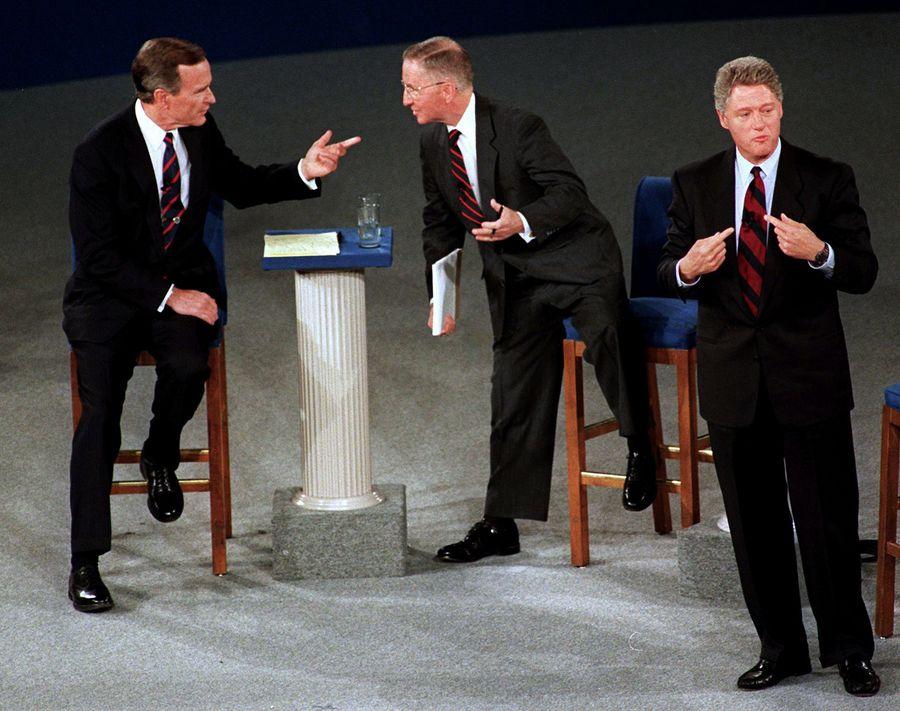
FILE - In this Oct. 15, 1992, file photo, President George H.W. Bush, left, talks with independent candidate Ross Perot as Democratic candidate Bill Clinton stands aside at the end of their second presidential debate in Richmond, Va. Bush died at the age of 94 on Friday, Nov. 30, 2018, about eight months after the death of his wife, Barbara Bush. (AP Photo/Marcy Nighswander, File)
Why Our Politicians Leave Americans Wanting
Published Jan. 30, 2020 • Read time: 6m
Second in a series
A generation younger, I never met the late Pat Caddell, though I knew of his legend. A mathematics wunderkind, Harvard-educated but self-taught as a pollster, Caddell was well known in our world for helping to engineer Jimmy Carter’s improbable 1976 victory and shaping the nascent craft of combining polling with political consulting. Late in his life, he was known, not always fondly, for turning on the establishment, becoming Fox News’s “Democrat,” and confidant to Trump team CEO Steve Bannon and benefactor Robert Mercer.
After advising Gary Hart, Joe Biden and Jerry Brown in the 1980s and 1990s, Caddell spent the latter part of his career preoccupied with the growing alienation of large swaths of the American electorate. Ultimately, he earned credit for foreseeing the populist rise of both Bernie Sanders and Donald Trump in 2016. He accurately divined the Republican losses in the 2018 midterms, famously calling out the GOP as a party of “wusses” unwilling to fight.
Caddell understood that the key to winning elections was about appealing to what he saw as an ever-growing group of mostly younger voters who are not easily identified as liberal or conservative and don't trust government, politicians, or the two major parties. He believed that the right candidate, a composite he had long dubbed “Mr. Smith” or “Sen. Smith,” could win national office. What he most cared about, however, was the people that the system was leaving behind. The exercise, for Caddell, was more about giving them a voice than winning an election.
To test and evolve a platform he designed a generation earlier, in 2013 he established the Smith Project and poll. Inspired by Jimmy Stewart’s 1939 portrayal of a newly appointed U.S. senator hellbent on fighting corruption in Frank Capra’s “Mr. Smith Goes to Washington,” the Smith poll regularly poses scores of questions to Americans about the state of discourse, division, and isolation in our country. Central to its mission has been inviting voters to indicate whether they agree or disagree with statements such as:
Sanders Seeks Caucus Trifecta Win to Close Delegate Gap
Sanders Fighting Perception He Can't Overcome Clinton Edge
Clinton Targets Trump as Sanders Circles
Sanders, Clinton Differ Sharply at Flint Debate
The country is run by an alliance of incumbent politicians, media pundits, lobbyists and other powerful money interest groups for their own gain at the expense of the American people.
Some 84% of Americans agree. Continuing to divine these aspirations is an important mission, rightfully offering a voice to millions of good people let down by powerful, and often corrupt, public and private institutions. So, I regard it as an honor to be trusted with the responsibility of conducting the first Smith Project poll after its founder’s sudden death from a stroke early last year.
Near the end of a 100-plus-question survey drafted by Caddell, which outlined almost every political grievance a Democrat, Republican or independent might imagine, we introduced voters to Candidate Smith. He was independent in every sense of the word. He was a candidate tied to neither party with beliefs “not based on liberal or conservative ideas.” Poll respondents learned that Smith is committed to taking on special interests and reasserting the voice of ordinary Americans in our democracy.
After more than 2,000 interviews, we learned that voters like Candidate Smith -- a lot. Not exactly surprising, or a hot take, I realize. But important to consider as another presidential election takes place. Smith’s favorable rating topped 80%. In hypothetical matchups with real-life Democratic candidates and President Trump, Smith was often competitive -- sometimes winning a tight three-way contest.
As a social scientist, I recognize that the poll is long on alienation questions, thereby priming respondents to be inclined to support an alternative to our two-party system. Nonetheless, the overwhelming response by a large, representative sample of the American electorate suggests that our current politicians leave Americans wanting. We found government corruption and ethics to be the issue – more than health care, the economy, national security and climate change – that is most important in the eyes of voters today.
Caddell knew the strings to pull, the issues to raise, the questions to ask, and the generic candidate to offer lasting salvation and a little bit of muscle. He was both pollster and advocate on this subject, encouraging a movement of well-intentioned people transfixed on dismantling and transforming the political-industrial complex.
Since Jimmy Carter’s successful journey to Washington in 1976, American voters were introduced to numerous independent or third party movements -- John Anderson in 1980, Ross Perot in 1992 and 1996, Ralph Nader in 2000 -- advised by a pantheon of former Democratic and Republican party consultants such as Roger Craver, Doug Bailey, Ed Rollins, Hamilton Jordan, With the exception of Perot, before he dropped out of the race in July 1992, none of these candidates adequately channeled the discontent that Caddell tapped into.
While some may say that Donald Trump represented the Mr. Smith that Caddell envisioned, I’m told that Caddell was no fan of the current president. In 2016, he described the election as representing a crisis of legitimacy in our country with two deeply flawed, self-interested candidates.
As the baby boomer generation begins to cede political influence to their millennial and post-millennial children and grandchildren, this wave of Smith polling indicates that it may well be time for a Candidate Smith makeover from Caddell’s original vision. That’s to be expected.
In the survey, a majority of Democrats and Republicans across every generation tell us they are dissatisfied with the state of our two-party system.
In fact, 72% of those in our recent poll said they would vote to replace every single member of Congress, including their own, if there was a place on the ballot where they could do so. This is the highest number ever record in the Smith survey.
Voters of most every demographic or ideological bent today say they deserve more than they get from the traditional political establishment that ignores them for three out of every four years. They seek leaders who not only identify the structural roadblocks to freedom and prosperity, but also develop prescriptions to overcome them, thus restoring trust in failing public and private institutions. The American electorate is discontented with its choices and constrained by conventional wisdom into thinking there’s not much they can do about it. But their hopes remain.

Democrats Won the Midterms. Common Sense Won, Too
Jordanne Kemper • RealClearPolitics
The 120th Congress Shapes Up
Carolina Lumetta • RealClearPolitics
Flooding GOP Primaries With Democrats
Robert Natelson • RealClearPolitics
Washington Keeps Rewarding Oracle—Veterans Keep Paying the Price
Darin Gaub • RealClearPolitics
The Seeds of Unrestricted Warfare
John Teichert • RealClearPolitics
The Primary System Is Losing the Next Generation
Sean Trende • RealClearPolitics
RCP Today
Top stories on RealClearPolitics
The Takeaway
Polling intelligence and analysis delivered to your inbox
World News
Featuring the latest world news
Policy
Featuring the latest policy news
Support Our Mission
As part of RealClearPolitics, authors aim to provide balanced, non-partisan analysis by presenting top reporting and commentary from all sides of the political spectrum.
Trusted by policymakers and citizens alike since 2000