
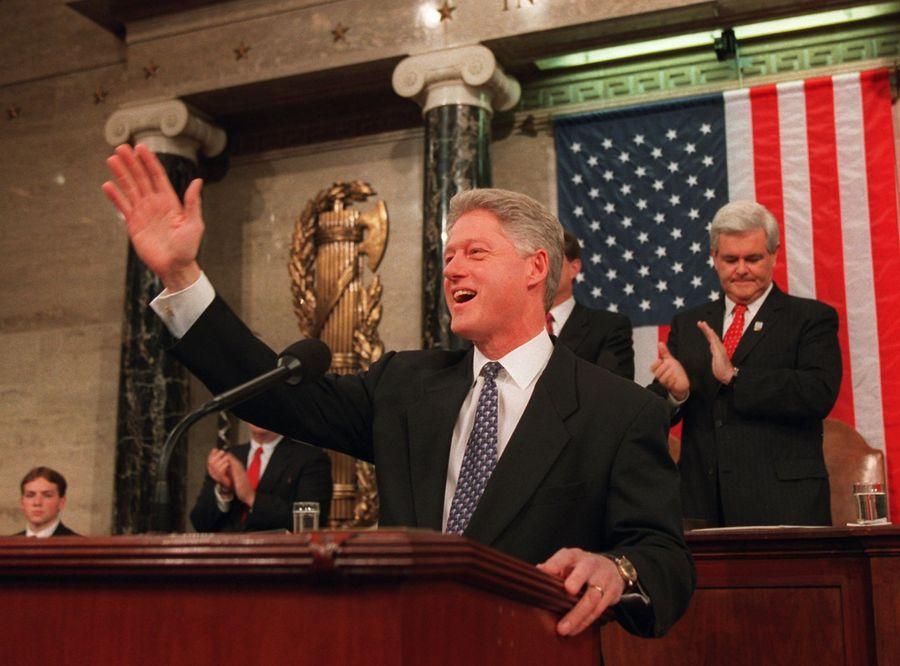
CLINTON STATE OF THE UNION
Time for Congressional Dem Leadership To Step Up – and Step Aside
PURPLE NATION
Published June 24, 2026 • Read time: 7m
Despite President Trump’s low job approval ratings and well-documented (and in my view well-deserved) political problems, the Democratic Party hasn’t closed the deal with voters. Democrats have a negative brand, according to all the polls. (And just because NYC Democrats love a popular and personable socialist Mayor Zoram Mamdani doesn’t change the thesis). But we don’t need a Democratic National Committee autopsy to figure out why – or what to do about it.
The reasons are hiding in plain sight. So are the solutions – and it’s not a new formula. It was articulated flawlessly three decades ago in President Bill Clinton’s 1995 State of the Union Speech. He called it the “New Covenant.” (In his 1992 presidential campaign, Clinton called it the “third way – neither left nor right, but reformed liberalism based on principles where most American voters are.”)
This approach to governance was given as an assist by the 1994 midterms in which Democrats lost both houses of Congress. Instead of seeing this as a rebuke, Bill Clinton saw it as an opportunity – to buck ideologues in his own party – on Capitol Hill and, yes, in his White House – and get back to first principles. President Clinton’s “Third Way” approach to policies and governance, without a doubt, was a political success. On the last day of his second term, according to the Gallup Poll, he received a 66% job approval rating, which remains the highest job approval rating in U.S. history for an outgoing second-term president.
Clinton’s 1995 State of the Union Speech did not seek a middle position in the “mushy center.” Instead, he offered specific policy principles that blended an ideological mix former English Prime Minister Tony Blair called “reformed liberalism.”
Sanders Seeks Caucus Trifecta Win to Close Delegate Gap
Sanders Fighting Perception He Can't Overcome Clinton Edge
Clinton Targets Trump as Sanders Circles
Sanders, Clinton Differ Sharply at Flint Debate
At the risk of oversimplification, here are the three examples of “Third Way” policy initiatives, all outlined in his 1995 SOTU:
- Conservative on fiscal policy – meaning balanced budgets. Clinton inherited a huge deficit when he began his first term in 1993. By the time he left office, he had left behind a multi-billion-dollar budget surplus. No president since then has come close. Republican presidents, not even the sainted Ronald Reagan, simply don’t match their own fiscal rhetoric with action. Democratic presidents are loath to buck their liberal base. The upshot – trillions of dollars added to the federal debt each presidency – is neither real conservatism nor responsible liberalism, and it leaves the burden to our children and grandchildren. Clinton was willing to work with Newt Gingrich to find a better way to balance the budget and leave behind a surplus of $126 billion in FY 2001. (I ask my fellow progressives: What is “progressive” about using credit cards to spend on social programs today, increasing our national debt today at $39.2 trillion – meaning $114,650 per person in America – and then tell our children and grandchildren (and probably great grandchildren, too), “You pay our credit cards.” In my view, it is not progressive at all – it is immoral. (Another footnote: Even socialist NYC Mayor Zoram Zomdani has to balance his budgets!)
- Progressive on social programs. In 1992, the Clinton/Gore campaign released a manifesto called “Putting People First.” It increased support for Medicare, Medicaid, and Head Start, raised the minimum wage, allocated more money for childcare, and ushered in guaranteed parental leave. Yet – and important “BUT” – and this was the “New Covenant” part of the equation – in 1995, Clinton re-re-emphasized that, in return for accepting taxpayer assistance, the beneficiary must take personal and community responsibility. That translated into work requirements for those on assistance, streamlining and time-limiting the shackling system of permanent welfare payments, and reforming the tax code by greatly expanding the Earned Income Tax Credit to help the working poor take their place in the middle class. The Clinton administration also poured resources into various forms of national service.
- Moderate on cultural issues. President Clinton never saw his election (or his reelection by a near-landslide margin) as a mandate for the federal government to engage in great schemes of social engineering. He was a progressive, by today’s definitions, to be sure, but for him, politics practiced at the highest levels was always the art of the possible. He found common cause with the late-great former Rep. Barney Frank, one of the most progressive men in Congress.
But a key “progressive” leader of his generation, Barney Frank, a month before his death, put it this way: “You should not take the most unpopular parts of your agenda and make them litmus tests. And that’s what my friends on the left have been doing.” The astute CNN political commentator said this about the late Rep. Frank’s advice: Progressives must learn how to patiently “sequence” the most drastic cultural changes.
Bill Clinton always operated with that principle in mind. It’s more relevant now than ever. Democrats stand for tolerance, as we should, but channeling my inner Bill Clinton and Barney Frank, I would advise my fellow Democrats that tolerance goes both ways. We favor acceptance of transgender people, but if we wrongly dismiss as bigots Americans who don’t believe biological males should compete athletically against girls or women or must access female bathrooms (rather than provide private dual-gender restrooms) or insist that everyone must use “they” or “it” rather than “he’ or she” on all occasions, we risk alienating more than half the country. This is not only risking alienating average Americans. It is an example of intolerance.
Changing or at least patiently “sequencing” our most drastic progressive cultural policies would be a good start. But we also need new leadership, and it can’t come from Washington, which is too often dominated by entrenched special interest groups that insist on “labeling” or “identity” politics, and an older generation in both branches of Congress.
We need to develop leaders to speak for the party nationally from the 24 incumbent Democratic governors, not just or primarily from the leaders of the Senate or House.
We have a corps of 24 Democratic governors who are younger, charismatic, and most importantly, perhaps, have proven the ability to win Trump voters and former working-class Democrats who voted for Trump.
The policies of these Democratic governors, whether they know it or not, resemble the Clinton Third Way mix; after all, all governors by law (sometimes by the state constitution) must balance their budgets, not use massive credit cards to pay for current programs, as U.S. Congress – Democratic and Republican leaders alike – does every year when they enact spending programs that balloon the immense national debt.
Other governors, including Gavin Newsom and JB Pritzker, have large followings and the ability to raise enormous sums of money. But they, too, would be better served by highlighting their own moderate “Third Way” policies that worked in California and Illinois, respectively. Trolling Mr. Trump is the Democratic way these days, but there’s little evidence it’s enough to win a national presidential election. They should follow the example of Bill Clinton and Barack Obama, both of whom ran successful aspirational, positive “new” reformist campaigns, and not the zero-sum game being played on Capitol Hill these days.
Unfortunately, Democratic congressional leaders in the House and the Senate are great at attacking Trump but proposing a new positive message neither left nor right but focusing on working family real solutions – not so much. Instead, Democratic congressional leadership needs to step aside and, instead, empower Democratic governors to take the lead as national party spokespersons – on TV cable shows, on Sunday morning shows, as go-to spokespersons when the media is looking for quotes. And the current Democratic National Committee leadership – spectacularly inept in its rollout of the 2024 “autopsy” – should implement a program of putting these Democratic governors forward as the party’s national spokespersons, focused on enhancing the national media role of Democratic governors with a message of a “new generation of leadership” and the “party of change.” At every opportunity.
Support Our Mission
The Internet provides an endless stream of content. Not all of it is worth your time. That's why, every day, RealClearPolitics curates the most essential news and information—from all sides and across mediums. The links, videos, and podcasts curated here are the product of human judgment, not algorithms or AI. Please help power our mission of presenting a thoughtful, balanced public discourse through a tax-deductible donation.
Would you consider supporting us today?
Democrats Won the Midterms. Common Sense Won, Too
Jordanne Kemper • RealClearPolitics
The 120th Congress Shapes Up
Carolina Lumetta • RealClearPolitics
Flooding GOP Primaries With Democrats
Robert Natelson • RealClearPolitics
Washington Keeps Rewarding Oracle—Veterans Keep Paying the Price
Darin Gaub • RealClearPolitics
The Seeds of Unrestricted Warfare
John Teichert • RealClearPolitics
The Primary System Is Losing the Next Generation
Sean Trende • RealClearPolitics
RCP Today
Top stories on RealClearPolitics
The Takeaway
Polling intelligence and analysis delivered to your inbox
World News
Featuring the latest world news
Policy
Featuring the latest policy news
Support Our Mission
As part of RealClearPolitics, authors aim to provide balanced, non-partisan analysis by presenting top reporting and commentary from all sides of the political spectrum.
Trusted by policymakers and citizens alike since 2000