
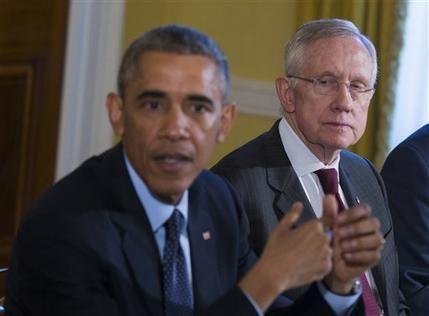
Obama, Congressional Dems Show Cracks in Unity
Published Dec. 7, 2014 • Read time: 5m
WASHINGTON (AP) -- It used to be that Democrats would mutter under their breath about President Barack Obama and the White House.
Now, with the midterm elections behind them, some leading members of the president's own party are airing their frustrations with little restraint and charting their own course.
In speeches, negotiations and congressional hearings, several high-profile Democrats are disregarding the White House in ways large and small. The White House has responded with an extraordinary veto threat while Obama has made a round of calls to liberal Democrats urging them to stand up against their own leadership.
Consider that in just a week's time:
-Sen. Harry Reid, the Senate's Democratic leader, was on the verge of cutting a deal with Republicans with a 10-year price tag of more than $400 billion in tax breaks without White House input.
-Sen. Chuck Schumer, a prominent member of the Senate Democratic leadership, raised new doubts about the timing of Obama's 2010 health care law.
-Sen. Robert Menendez, the outgoing chairman of the Senate Foreign Affairs Committee, began work with Republicans against the Obama administration's wishes on new penalties against Iran.
"There is always going to be some friction between somebody who's never going to run again and a bunch of people who are," said Sen. Claire McCaskill, D-Mo. "There's going to be a natural rub there - the president never has to worry about his approval rating again."
Put differently, many senators have served a long time; presidents come and go. With two years left in his two-term presidency, Obama's time is running out.
Sanders Seeks Caucus Trifecta Win to Close Delegate Gap
Sanders Fighting Perception He Can't Overcome Clinton Edge
Clinton Targets Trump as Sanders Circles
Sanders, Clinton Differ Sharply at Flint Debate
That doesn't mean Obama necessarily wields a weaker hand. The deal by Reid, D-Nev., to permanently extend certain tax breaks failed after the White House rallied liberals and issued a veto threat. Menendez, D-N.J., has yet to put together a veto-proof majority on his Iran plan.
What's more, Obama also appears to be setting his own postelection path, distinct from Democrats. In remarks to corporate executives Wednesday, Obama expressed his wish to complete trade deals before the end of his presidency and urged Democrats drop their opposition to pending deals with Europe and Pacific Rim countries.
"Don't fight the last war," he said. "Those who oppose these trade deals ironically are accepting a status quo that's more damaging to American workers."
No episode laid bare the competing interests between the White House and senior Democrats more than the move by Reid for a deal on tax breaks and exemptions, and the White House's remarkable veto warning shot.
White House and congressional officials acknowledge that the White House was not in the loop during Reid's talks with House Republicans. Reid's lead negotiator was aide David Krone, who had already angered the White House by publicly blaming the administration for Democratic losses in the November elections.
On Nov. 25, two days before Thanksgiving, the White House learned that the contours of a deal were coming together fast.
Obama was traveling to Chicago to talk about his immigration executive actions. While aboard Air Force One, he called Democratic senators notifying them he was going to make the veto threat. Back in Washington, Treasury Secretary Jack Lew and Obama chief of staff Denis McDonough reached out as well.
The White House considered, but then rejected, the idea of having Obama himself announce the threatened veto at the start of his remarks on immigration. But he was already going to address the grand jury verdict in the police shooting case in Ferguson, Missouri.
So shortly after Obama landed and before any deal was announced, the White House rushed out its veto threat in a statement.
Reid's office and Republicans continued to talk over the holiday, but by then it was evident no deal would emerge.
"You learn things all the time," Reid later said. "It's hard to veto something that doesn't exist."
The administration said the deal would not have made permanent expanded provisions in the Earned Income Tax Credit and the Child Tax Credit, while making permanent billions of dollars in tax breaks to businesses. But the package did have important Democratic priorities as well, including making the American Opportunity Tax Credit for college-related costs permanent and indexed for inflation.
Democratic congressional aides familiar with Reid's talks suspect the White House did not want the tax breaks extended permanently so it could use the business credits to help negotiate a broader corporate tax overhaul next year.
White House aides deny those motivations. They note Republicans insist on a tax overhaul that is "revenue neutral," one that does not generate more tax money for the government. Making tax breaks permanent now would lower the government's revenue threshold over 10 years, they say, and would give Republicans an advantage in a "revenue neutral" tax negotiation.
In the end, the House passed a simple one-year extension of the tax credits. The Senate could take up the House bill this coming week.
But the disagreement, and how it unfolded, signals potential difficulties ahead. Obama wants to shed his lame-duck status and work with the Republicans who will control Congress, and congressional Democrats are setting out on their own paths and trying to distinguish themselves from their GOP rivals.
"The distance between Capitol Hill and the White House is a lot farther than 16 blocks. It can strain party relationships," said Charles Brain, who served as White House director of legislative affairs in the last year of President Bill Clinton's administration. "Ultimately, people pursue their own interests regardless of party, especially as you get toward the end."
© 2014 The Associated Press. All rights reserved.

The Danger Before the Attack
Leslie J. Sullivan • RealClearPolitics
Jon Finer’s Old and Dangerous ‘New Approach’ to Israel
Peter Berkowitz • RealClearPolitics
The President Deserves Better
John Ullyot • RealClearPolitics
Congress Doesn’t Need Another Blame Game. It Needs To Find What’s Broken
Jarrod Bernstein • RealClearPolitics
Democrats Won the Midterms. Common Sense Won, Too
Jordanne Kemper • RealClearPolitics
The 120th Congress Shapes Up
Carolina Lumetta • RealClearPolitics
RCP Today
Top stories on RealClearPolitics
The Takeaway
Polling intelligence and analysis delivered to your inbox
World News
Featuring the latest world news
Policy
Featuring the latest policy news
Support Our Mission
As part of RealClearPolitics, authors aim to provide balanced, non-partisan analysis by presenting top reporting and commentary from all sides of the political spectrum.
Trusted by policymakers and citizens alike since 2000