
Election 2024 DNC
Influencers at the Convention: Pioneers of the Digital Frontier
Published Aug. 21, 2024 • Read time: 7m
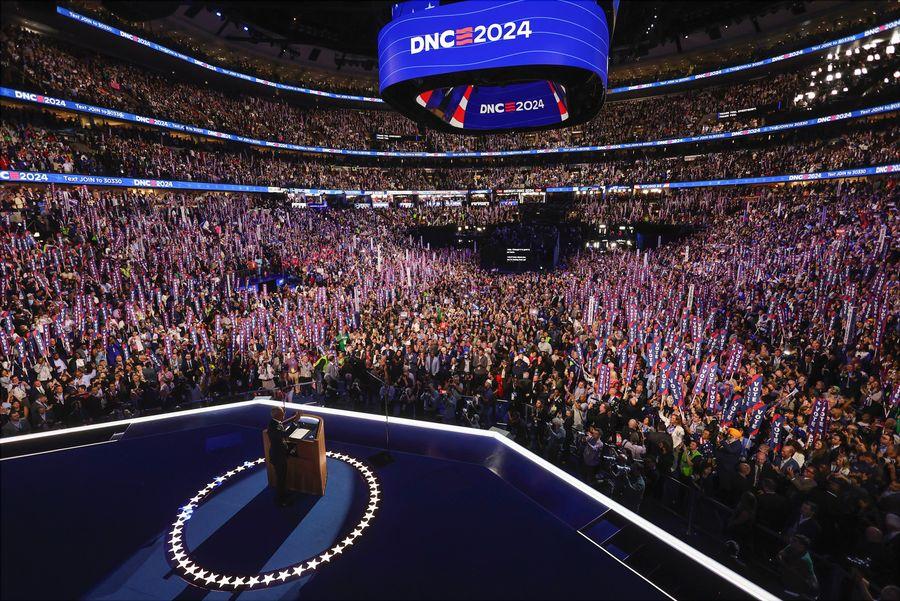
CHICAGO — Behind black curtains in United Center lies “Creator Lounge,” lit by the flattering glow of ring lights and teeming with social media influencers big and small. Charmed with free coffee and readily available charging stations, hundreds of content creators enjoy the Democrats’ hospitality as they remind traditional media that in 2024, digital dominates.
When convention planners used the Democrats’ own social media accounts to encourage content creators to apply for access to the 2024 convention, they were embracing a changing media landscape. A 2023 Pew Study showed that 86% of U.S. adults “sometimes” or “often” consume news on a digital device. Comparatively, just 37% of Americans say they consume print publications. There are those who visit traditional media sources on the Internet, making up a fair portion of that 86% – but there are also the 50% of Americans who say they get their news from social media in particular.
Russell Ellis, AKA the Jolly Good Ginger, is one of the influencers who applied on the Democratic National Convention website to receive credentials for the convention. His access badge describes him as a “DNC Content Creator Reporter,” and the self-proclaimed “redneck with a phone” thinks of himself and his fellow creators as press.
“We are the new media. We are the digital frontier,” said Ellis, who has over 6 million followers across three platforms and juxtaposes a frontiersman look with progressive politics. “I just give the news from my perspective. I think that’s why so many people get their news from content creators: It feels number one, more real, and number two, more personal.”
Sanders Seeks Caucus Trifecta Win to Close Delegate Gap
Sanders Fighting Perception He Can't Overcome Clinton Edge
Clinton Targets Trump as Sanders Circles
Sanders, Clinton Differ Sharply at Flint Debate
Creators believe that in an oversaturated information market full of false narratives and fake news, they offer authenticity – be it real or a convincing performance.
“I know a lot of journalists who would never be on camera, but you are neglecting a part of your audience that now, needs to see your face,” said Brian Arya, a TikTok creator known as “The Motel Guy” for his content about the detrimental effects of the housing crisis. “They need to see who you are, they need to look into your eyes and make sure you’re telling the truth.”
Here in Chicago, the Democrats are offering some 200 influencers access to events and people historically provided only to traditional media. The Democratic National Committee has a team specifically dedicated to catering to creators. These handlers guard doors to the creator platform – a VIP box directly above the arena floor – and guide creators to the convention floor so they can record content.
Some traditional journalists think of influencers as puppets for the Democratic Party, and creator Jess Anderson agrees that “even without them saying anything to us, we are talking up their messages.” But these social media gurus push back against the idea that their credentials came with a caveat.
“Nobody told us what we had to shoot, nobody told us, ‘You have to get X amount of content, you have to post immediately,’” said Juan Acosta, a California-based activist with 13,000 followers on Instagram. “They’re really trusting us with delivering information the way we want.”
While party officials may not have given content creators strict instructions, they have offered guidance on how influencers might make the most out of their time in Chicago.
“They’re saying, here’s an avenue you can take, here’s people you can interview. They’ve been really nice like that, almost like travel agents, like ‘Here’s the excursion you can go on. If there’s time for you to interview the senator, we’ll help you do that,’” said Arya.
There have been some grumblings among the traditional media about this shift in priorities. The Standing Committee of Correspondents, the nonpartisan representative of journalists on Capitol Hill that represents the media to political conventions, is frustrated at the lack of workspace offered to journalists.
“We are concerned that the decision to reduce dedicated and accessible workspace by hundreds compared to prior conventions will hinder journalists’ ability to cover the historic nature of this convention,” the committee wrote in a statement shared with Semafor.
Daily press gallery organizations were given 35 seats, as well as 90 unassigned stadium seats, a significantly lower number than in past conventions. It is a striking comparison: Print journalists huddle over their laptops in cramped arena seats while content creators loaf on sofas and select the perfect song to accompany their latest 60-second design. When asked for comment, convention spokesperson Emily Soong brushed off concerns about favoritism.
“We’ve prioritized making sure members of the media have the resources they need to bring the story of our convention to their communities from both inside and outside of the convention hall,” Soong said. “We look forward to working with members of the media and content creators alike as we bring the story of our convention, our party, and the Harris-Walz ticket to the American people.”
Some journalists find it offensive that they would even be mentioned in the same breath as content creators. Arya shared a story with RCP in which he was setting up his tripod to film content at the Women’s Caucus event on Tuesday. A journalist asked him who he was with, and when he explained that he was a TikTok creator, the journalist told him he needed to leave. Reflecting on this event later in the day, Arya wondered, “Doesn’t my audience want to know about this too?”
“Content creators are just an addition to the media. It’s just another way to deliver information,” argued Acosta. “If people are watching TV, they’re getting their information through TV and that’s perfectly fine, and if people are reading the paper, that’s great. It’s really about being more inclusive. They can all coexist.”
Coexist they may, but influencers are being highlighted at the Democratic National Convention in a way traditional journalists would never dream of: Five content creators with a combined following of 24 million are slated to speak across four nights in Chicago. Deja Foxx and Nabela Noor spoke on Monday and Tuesday respectively, while Carlos Eduardo Espina, Olivia Julianna, and John Russell are expected to deliver remarks on the same stage as three presidents.
These mega influencers have spent their time in Chicago filming question-and-answer videos with Democratic Party royalty, including Vice President Kamala Harris, President Joe Biden and former House Speaker Nancy Pelosi. They often pose for selfies afterwards.
To stand behind such a podium will inevitably increase the follower counts of the chosen five. But these creators will also be propping up the DNC and its message to an audience who might not otherwise tune in. Speakers will be able to post clips of their speeches to their feeds, where videos frequently get millions of views.
“I think the DNC uplifting content creators is a true testament to the fact that content creators are a big part of society in today’s day and age,” said Acosta. “They understand that the younger generation of voters is online, that they’re not as actively consuming the traditional media, they’re finding information online.”
Young people will be a key voting bloc in November, and the Democratic Party is laser-focused on connecting with America’s youngest voters. The Harris campaign recently announced a $370 million media buy, of which $200 million is directed toward digital media. It is a fortification of the Harris campaign’s social media gameplan, which has made headlines for its emphasis on memes and vibes.
“Harris and the people who surround her know what’s going on currently. They’re looking at everything that’s happening in our society, including pop culture. And they’re using it to talk to voters,” said Acosta. By inviting himself and other content creators to the Democratic convention, the DNC has effectively “opened up a method of communication to more voters.”
It is a fact of presidential campaigns that they must incorporate new technology to thrive. The 2024 Chicago convention’s innovation is not an app or a platform but walking, talking advertisements for Democratic Party policies. It is this development that requires traditional media to make room on the convention floor for a new kind of news hound: the social media influencer.

Democrats Won the Midterms. Common Sense Won, Too
Jordanne Kemper • RealClearPolitics
The 120th Congress Shapes Up
Carolina Lumetta • RealClearPolitics
Flooding GOP Primaries With Democrats
Robert Natelson • RealClearPolitics
Washington Keeps Rewarding Oracle—Veterans Keep Paying the Price
Darin Gaub • RealClearPolitics
The Seeds of Unrestricted Warfare
John Teichert • RealClearPolitics
The Primary System Is Losing the Next Generation
Sean Trende • RealClearPolitics
RCP Today
Top stories on RealClearPolitics
The Takeaway
Polling intelligence and analysis delivered to your inbox
World News
Featuring the latest world news
Policy
Featuring the latest policy news
Support Our Mission
As part of RealClearPolitics, authors aim to provide balanced, non-partisan analysis by presenting top reporting and commentary from all sides of the political spectrum.
Trusted by policymakers and citizens alike since 2000