
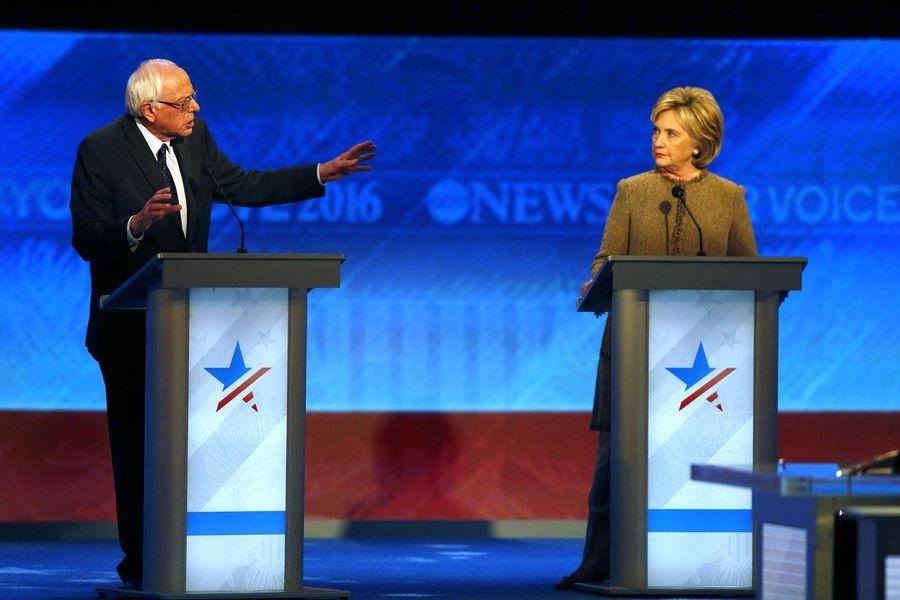
Clinton, Sanders Expected to Clash in S.C. Debate
Published Jan. 17, 2016 • Read time: 8m
CHARLESTON, S.C. – Since October, the Democratic presidential contenders have contrasted their positions with powder-puff niceties during televised debates. But Hillary Clinton and Bernie Sanders may bring some new weaponry to their fourth face-off Sunday as they eye a narrow contest that could scramble Democratic Party expectations after Iowa’s first-in-the-nation caucuses Feb. 1 and the New Hampshire Primary Feb. 9.
The South Carolina debate takes place as progressives confront a serious, two-person contest at the start of 2016. Democrats who support Clinton said she has work to do in Iowa as independent voters shift into the state’s “uncommitted” column and Sanders emerges as a persuasive contender with an organization and funding to compete for months. Recent poll results sent chills through Clinton’s Brooklyn headquarters but electrified the Sanders campaign. The result: both candidates abandoned their air kisses and traded barbed assertions last week using paid ads, a flurry of media interviews, surrogates and endorsers, and frenetic barnstorming in key states.
The RealClearPolitics polling average heading into the holiday weekend showed the Vermont senator leading Clinton by six points in New Hampshire, while trailing the former secretary of state by four points in a dead heat in Iowa. Nationally, Clinton retains a nearly 13-point lead, down from more than 20 points last year. The former New York senator, who has campaigned vigorously in South Carolina and hopes to tap decades of Clinton support among African-American voters here, is counting on the Palmetto State to be a firebreak Feb. 27 in the Democratic primary if she loses in Iowa or New Hampshire. Over the weekend, Clinton dispatched a diverse cast of female lawmakers and progressive activists to campaign for her in the Charleston community.
Sanders Seeks Caucus Trifecta Win to Close Delegate Gap
Sanders Fighting Perception He Can't Overcome Clinton Edge
Clinton Targets Trump as Sanders Circles
Sanders, Clinton Differ Sharply at Flint Debate
Although Republicans dominate South Carolina politics, Clinton's gun control arguments have a special resonance in Charleston. The debate site is within walking distance of Emmanuel AME, the historically black church where a young gunman shot and killed nine worshipers in June. Clinton advocates closing the so-called "Charleston loophole" in the federal firearms background check system, which benefited the killer. Licensed firearm dealers can sell guns to buyers after three days if FBI background checks are not complete, and Dylann Roof got a gun under those circumstances. Clinton assails Sanders for voting to create the loophole as a National Rifle Association-backed amendment to the 1993 Brady background check bill. Her assertion against Sanders has been deemed correct by the Washington Post’s fact-checker, and Clinton will skewer Sanders on the subject.
Helping to lead the legislative charge in Washington to close the loophole is South Carolina Rep. Jim Clyburn, a power player in the state’s Democratic Party. In October, he said he believed Clinton had the best chance to win the White House against a GOP nominee. Clyburn told the Washington Post last week that if Sanders exits Iowa and New Hampshire with big wins over the former secretary of state, “it could very well be a new day.”
Whether jousting over differences when it comes to gun control, universal health care, economic fairness, Wall Street, or the optimal way to defeat the Islamic State, Clinton and Sanders are expected to use Sunday’s debate to magnify their contrasts. Whether exaggerated and negative attacks shrink or enlarge their reputations is a question mark. They want to give voters reasons to trudge through snow to caucus in Iowa in two weeks, and then participate in contests in balmier South Carolina and Nevada next month. But they need to be sure their brickbats and laments accrue in the hoped-for direction.
Also on the stage Sunday will be former Maryland Gov. Martin O’Malley, whose low-single-digit showing in national and state polls could mean the January debate will be his last as a presidential hopeful this year. O’Malley, a long shot, plans to compete in Iowa. His campaign qualified Friday for nearly $3 million in federal matching funds for use in the primaries.
NBC News and YouTube will broadcast the event at 9 p.m. EDT. Clinton last week popped up on the network and its cable cousin, dialing in for telephone interviews on MSNBC news programs and appearing on NBC’s “The Late Show with Jimmy Fallon.”
Sanders’ campaign advisers believe the 74-year-old Democratic socialist is just beginning to be introduced to the broader electorate. They predict his following will grow, particularly among independent voters. He has run radio ads in South Carolina since November, but he has not campaigned extensively in South Carolina. Following the debate, Sanders will appear on the Martin Luther King Jr. holiday in Columbia, the state capital, at a rally to champion education “equity.”
“The momentum that comes from an early victory is huge, and I believe that Bernie’s campaign is in a position to take advantage of that momentum,” Tad Devine, chief strategist, told The Washington Post in a Q&A published Friday. He said Sanders “can compete and win” in states such as Massachusetts, Colorado, Minnesota and Vermont on Super Tuesday, March 1, and in Michigan, Illinois and Ohio. Sanders’ team believes the senator can build the kind of coalition, including younger voters, which propelled Barack Obama into the Oval Office in 2009.
Sanders hopes to come out of the South Carolina debate sounding tough, substantive, electable and in sync with America’s economic anxieties in ways he argues Clinton is not.
The former first lady and her team last week ramped up their rebuttals, blasting Sanders for his positions on liability protections for gun manufacturers and for championing a "Medicare for All" single-payer health coverage for all Americans, which she argues would do away with the Affordable Care Act and raise taxes on the middle class to fund the hefty price tag, estimated by some analysts at $15 trillion. “Now if that’s the kind of revolution he is talking about, I am worried, folks," Clinton said in Iowa.
Sanders on Thursday repeated his pledge to unveil details of his universal health proposal before the Iowa caucuses.
Chelsea Clinton, during her first solo campaign swing on behalf of her mother last week, invited media controversy by lobbing criticisms about Sanders’ health plan, later judged by PolitiFact to be "mostly false.”
The Clinton team objected when Sanders released an ad that implicitly suggested the former New York senator is too protective of financial industry donors and supporters to take on the big banks and Wall Street. The Clinton campaign protested that Sanders and his advisers broke their own promise never to use an attack ad.
Sanders, to his advisers’ chagrin, has for months been shy about slicing into Clinton when standing beside her on debate stages. He prefers to use the valuable national TV time to explain his own approach to an economy he claims is “rigged” to bolster the wealthy and powerful. But Sanders is starting to show his appetite for competition, and he knows how to defend his record and pivot back to his economic message. His performance Sunday may provide clues about whether the senator, who urges a “revolution” in America’s governance and politics, can turn his fiery rhetoric into an Iowa victory.
The race has shifted following the Democratic debate in New Hampshire in December. Revelations that Sanders’ campaign personnel breached Clinton campaign voter records maintained by the Democratic National Committee and its data vendor blew up in the media, and died. Sanders quickly apologized to his chief rival on the debate stage, and Clinton accepted. During the first debate in Las Vegas, Sanders stunned Clinton when he let her off the hook, saying he and most Americans were sick "of your damn emails." The controversy he brushed off has simmered nonetheless, and monthly releases of Clinton’s emails and retroactive classification of select communications keep alive questions about her decision-making and her veracity.
The candidates will not debate again until Feb. 11 -- after the Iowa and New Hampshire results are in. The broadcast will be on PBS, based in Milwaukee. Sanders and O’Malley have criticized the DNC’s timing of the debates -- on weekends and before Christmas and the Martin Luther King holiday, and after the Iowa and New Hampshire votes -- as tilted to bolster Clinton. They suggested the intent was to help Clinton maintain her dominance as the presumed nominee by keeping audiences from getting to know the two of them as viable alternatives.
As the race between Clinton and Sanders has narrowed, the schedule may not end up benefitting Clinton. The first debate on CNN broke Democratic records with 15.3 million households watching. The second debate, on CBS News on a Saturday, attracted 8.5 million viewers. Last month on ABC News on a Saturday, the audience numbered 6.7 million.
Republican presidential candidates, whose lively dust-ups attract mammoth TV audiences, are scheduled to meet again during two more debates in coming weeks -- one before Iowa and another before New Hampshire. As was clear during the GOP’s South Carolina debate Thursday, conservative presidential candidates rhetorically revel in dragging Clinton on stage with them. They present her as the likely Democratic nominee, lashing her to the deeply unpopular President Obama and also to Sanders, whom Donald Trump has disparaged as a communist.
Clinton and Sanders may be running out of debate dates, but during the next two weeks, each will be debated plenty.

The Danger Before the Attack
Leslie J. Sullivan • RealClearPolitics
Jon Finer’s Old and Dangerous ‘New Approach’ to Israel
Peter Berkowitz • RealClearPolitics
The President Deserves Better
John Ullyot • RealClearPolitics
Congress Doesn’t Need Another Blame Game. It Needs To Find What’s Broken
Jarrod Bernstein • RealClearPolitics
Democrats Won the Midterms. Common Sense Won, Too
Jordanne Kemper • RealClearPolitics
The 120th Congress Shapes Up
Carolina Lumetta • RealClearPolitics
RCP Today
Top stories on RealClearPolitics
The Takeaway
Polling intelligence and analysis delivered to your inbox
World News
Featuring the latest world news
Policy
Featuring the latest policy news
Support Our Mission
As part of RealClearPolitics, authors aim to provide balanced, non-partisan analysis by presenting top reporting and commentary from all sides of the political spectrum.
Trusted by policymakers and citizens alike since 2000