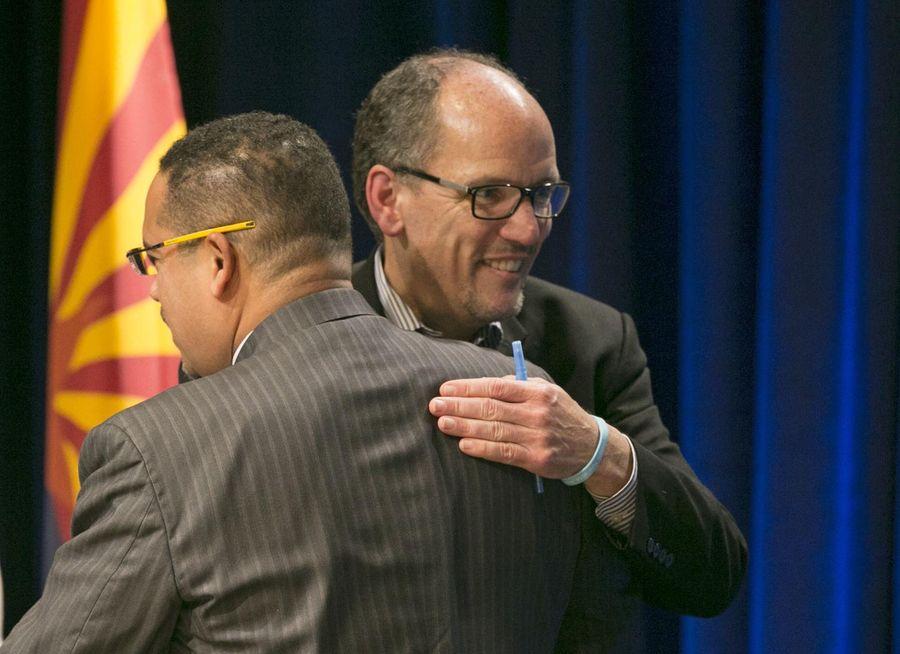
U.S. Secretary of Labor Tom Perez, right, a candidate for the Democratic National Committee chair hugs U.S. Representative Keith Ellison, MN-5, also a candidate also for the DNC chair, during the DNC Future of the Party Forum at the Sheraton Grand Phoenix Hotel, Saturday, Jan. 14, 2017, in Phoenix. (David Wallace/The Arizona Republic via AP)
As DNC Chair, Perez Must Harness Trump 'Resistance'
Analysis
Published Feb. 26, 2017 • Read time: 7m
Join the Conversation
0ATLANTA — As the Democratic National Committee gathered here to select its new leader, members invoked the phoenix, the symbol of the city's reconstruction after being burned to the ground during the Civil War. Given the party’s defeat in November and the uphill road ahead with GOP control of the White House and Congress, it seemed an apt image.
Former Labor Secretary Tom Perez was chosen to lead that rebuilding effort as chairman of the DNC. Immediately after securing the majority tally needed in the second round of voting Saturday, Perez named rival Keith Ellison as deputy chairman, a move intended to unite the Barack Obama and Bernie Sanders coalitions they represent.
The new chairman told those assembled that when historians look back on this moment in time, they will ask, “Where were you in 2017, when we had the worst president in the history of the United States? We will be able to say that the Democratic Party led the resistance, and made sure this was a one-term president.”
While characterized as an establishment candidate because of endorsements from the former president and vice president, Perez has well-established progressive credentials. In his confirmation vote to lead the Labor Department in 2013, no Republican senator supported him, a rarity then for executive appointments. But with his inclusion of Ellison, Democrats hope to avoid potential controversies that the Minnesota congressman could have brought.
Though some Ellison supporters walked out when the 235-200 vote count was announced, the runner-up warned that “we don’t have the luxury to walk out of this room divided.”
Sanders Seeks Caucus Trifecta Win to Close Delegate Gap
Sanders Fighting Perception He Can't Overcome Clinton Edge
Clinton Targets Trump as Sanders Circles
Sanders, Clinton Differ Sharply at Flint Debate
After the 2016 election left Democrats without power in Washington, and exposed how decimated their ranks were in state and local offices across the country, the race for DNC chair became one to determine a new national direction for the party. But in the intervening months, a highly energized opposition to President Trump has emerged, bringing into question the relevance of the party committee.
For a party out of power, the head of the DNC plays an outsized role as its face, along with serving as chief organizer, fundraiser, and a strategist for the short and long term. But in the era of nearly weekly protests, raucous town-hall meetings, and new organizing groups springing up, the job description has the added challenge of keeping up with a restive base and converting its energy into electoral results.
"It's not merely about organizing and building the party, it’s about positioning the party within a broader movement of people who are energized in a way that hasn’t happened in my lifetime," said Peter Buttigieg, the 35-year-old mayor of South Bend, Ind., who dropped out of the chairmanship race and is considered a rising star in a party struggling to retain both young voters and older ones in the Rust Belt.
Buttigieg was often described as a dark-horse candidate, representing the "fresh face" the party might need to successfully rebuild. But he dropped out of the running shortly before ballots were cast, a move taken to ensure a smoother process for his chief rivals, Ellison and Perez. Buttigieg's decision will likely elevate his profile, since he did not endorse anyone in the race and won't have to explain a low vote tally for himself had he stayed in. Indeed, Democratic operatives and strategists immediately praised him as the future of the party.
On paper, the immediate future remains bleak. "We are in this mess not just because we lost … one election, but a thousand elections," Ellison said before the vote, referring to nearly 1,000 state and local seats taken over by Republicans during Obama's tenure.
Democrats face a challenging electoral map in the 2018 midterms, where 10 incumbent senators will face re-election in states that Trump won. While the party points to nearly two dozen GOP congressional districts where Hillary Clinton won, Democrats will still need to convert voters who supported Trump.
“Now’s the time to restructure the whole party,” said Anthony Long, a DNC member from Indiana. Long said the party shouldn’t lose focus on voters it once attracted while also aiming to expand. “I don’t think they are Trump Democrats,” he said, suggesting that those who supported the now-president aren’t lost forever. “I think they are disenchanted with the party because we have not listened to their message, and we’ve allowed our friends in the GOP to define us.” Long noted that the Democratic candidate for governor in Indiana ran a few hundred thousand votes ahead of the national ticket.
While the party has prided itself on becoming increasingly progressive, there is some debate within the ranks about whether a leftward pull would further alienate voters it needs to attract, particularly those who don't identify with any party. Of the many lessons of the 2016 election, Democrats’ focus on identity politics and a relentless bashing of Trump didn't meld with voters’ economic concerns. Democrats are also craving an accessible message to share.
"We over-think things," said California Attorney General Xavier Becerra, who left Congress last year to return to his home state. Becerra said Democrats focus too much on "the secret sauce quadratic equation" and 10-point plans.
"It’s not a matter of being progressive or conservative, red or blue," he told reporters. "The reality is, Americans can’t eat that stuff, they can’t put that in the gas tank."
While meeting in Atlanta, they spotlighted Jason Kander, who came within three points of defeating incumbent Republican Sen. Roy Blunt in Missouri last November and is considered another face of the party’s future. “I did not do it by pretending to be a moderate Republican or hugging the middle,” Kander said of his near upset.
The most immediate challenge, however, involves harnessing the new opposition activism.
“The DNC and everyone inside the Beltway is far behind our voters,” said former party Chairman Howard Dean, who had endorsed Buttigieg. Dean said the Women’s March on Washington last month, protests at the airports after the president’s executive order on immigration, and protests at town halls throughout the country last week were organized by the grassroots, not by the official party apparatus.
“We need them to be Democrats,” Dean said of those participating in the so-called resistance movement. “They don’t need us right now and they're not interested in us right now. … We have a problem connecting with the people who are organizing, and that’s going to be the job of the next DNC chair.”
Basil Smikle, executive director of the New York Democratic Party, says the new chair should be more of a strategist and tactician than the face of the party.
“The moms and dad showing up at town halls and young people marching against Trump are not thinking about the DNC or waiting for direction,” the Progressive Change Campaign Committee, which supported Ellison, said in a statement after the vote. “It’s not a given that they will vote, donate, or volunteer for Democrats – their support must be courted and earned.”
Perez will also have to strike a balance between opposing Trump’s agenda and coming up with something positive to sell.
For now, however, Donald Trump remains a galvanizing force for Democrats.
“If Donald Trump has done anything good, he’s gotten a lot more people involved in politics than used to be,” said Michael McHale, a DNC member from Louisiana. McHale said his local parish party meetings usually attract 30 participants. Recently, more than 80 people showed up. The Democrats’ brand is toxic in the South, he said, but Trump is presenting them an opportunity to rebrand.
“We may still be a minority, but from now on we will be a much more vocal minority,” he said. “Now it’s not time to whisper anymore.”
But there is also concern about whether this energy could backfire, and whether activists will challenge other Democrats in primaries and potentially further their losses.
“Any opportunity to express your voice through the democratic process is good,” Becerra countered. “We’re Democrats, big D, but democrats, little d, as well. And we would like to see democracy in action.”

A RealClear Thanksgiving: Investing in a Better Future
David DesRosiers • RealClearPolitics
Trump’s Newsom Problem: Antagonist-in-Chief
Carolina Lumetta • RealClearPolitics
America’s Free Spirit
John Maxwell Hamilton • RealClearPolitics
The GOP Majority Should Go Out in Glory
Daniel McCarthy • RealClearPolitics
Republican Majorities Could Return Sooner Than Expected
J.T. Young • RealClearPolitics
The Danger Before the Attack
Leslie J. Sullivan • RealClearPolitics
RCP Today
Top stories on RealClearPolitics
The Takeaway
Polling intelligence and analysis delivered to your inbox
World News
Featuring the latest world news
Policy
Featuring the latest policy news
Support Our Mission
As part of RealClearPolitics, authors aim to provide balanced, non-partisan analysis by presenting top reporting and commentary from all sides of the political spectrum.
Trusted by policymakers and citizens alike since 2000