
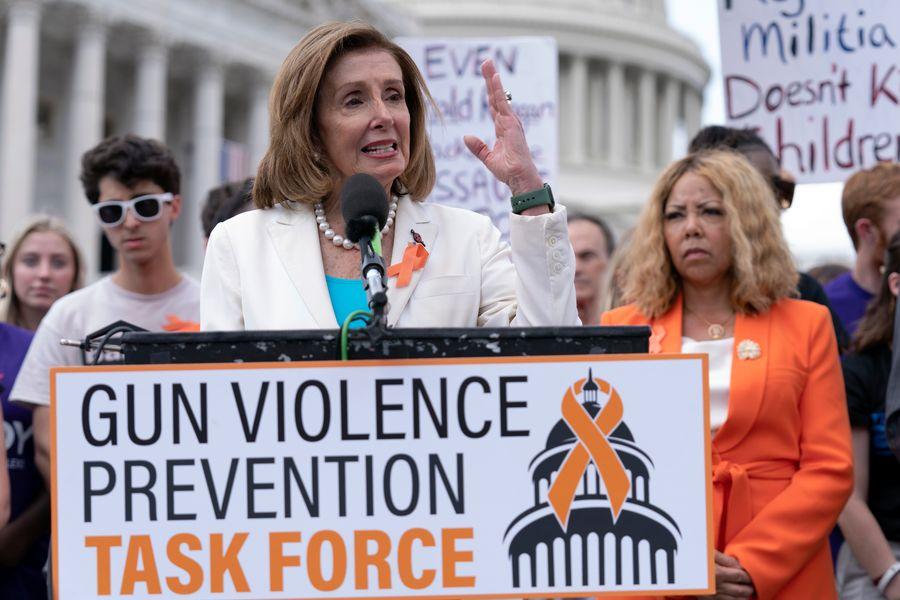
Congress Gun Violence
Gun Rights Advocates Ignore Data on Children's Deaths
COMMENTARY
Published July 12, 2023 • Read time: 5m
For most of our nation’s history, disease was the number one killer of children, only to be surpassed by motor-vehicle crashes in the 1960s. But, over time, elected officials and community leaders called on the car industry to make their products safer, resulting in seat belts, shatterproof windshields, laws requiring children to be kept in booster seats, and more.
Lawmakers sprang into action, the industry innovated, and in turn, mortality rates decreased.
As motor vehicle crashes became less deadly, a pernicious new killer infiltrated our families and communities: guns. Since 2020, guns have been the leading killer of American teens and children, and the reason is clear: Only in America do children and teens have easy access to guns.
But, while the car industry adapted and transformed to prevent tragedy, the gun industry has done the opposite, innovating their products to be more and more deadly.
It also can’t be ignored that the gun lobby has been given a blank check by Congress to focus on profits rather than safety. In 2005, Congress passed a federal law shielding the gun industry from civil liability. Since the law passed in 2005, not a single gun manufacturer accused of negligence has gone to trial.
Not only does the gun industry enjoy near-total immunity, but the gun lobby also looks to cloud the reality of our gun violence crisis with baseless claims that guns aren’t the number one killer of American children and teens. But the data doesn’t lie.
Whether we look at children (in America, you’re a minor until 18) or children and teens (through 19, the age of some high school seniors), firearms lead when it comes to death. No matter how you cut the data, whether it’s looking at children and teens aged 1 to 17, 1 to 18, or 1 to19, guns are killing our children and teens more than anything else.
Donald Trump's Useful Idiots
The Campus Affluenza Epidemic
Are Today's Millennials a New Victorian Generation?
A New Voice for Sexual Assault Victims in Uniform
And it goes without saying that for the gun industry-backed researchers who try to find any possible means to dispute these facts, if you need to squint and cherry-pick data just to find a way to prove your point, you don’t have a leg to stand on.
Every year, nearly 4,000 children and teens are shot and killed in America, and another 15,000 are shot and wounded. That equates to 11 children and teens shot and killed every day, with an additional 42 shot and wounded.
Now, let’s break this data down further. Of the nearly 4,000 children and teens who are killed by guns each year in America, one-third of these deaths are suicide and two-thirds are homicide.
Gun suicide rates among adolescents have been on the rise. CDC data shows us that for young people aged 10-24, the firearm suicide rate has increased by 53%. Alarmingly, for children aged 10-14, the rate of firearm suicide has increased by 146% from 2011 to 2020. In this same time period, the rate of non-firearm suicides increased by 25%.
The reality of our gun violence crisis is even more stark when you compare the United States to other high-income countries: In the United States, children and teens aged 5 to 14 are 21 times more likely to be killed with guns than in peer nations.
Exposure to gun violence has a direct impact on the lives of the children and teens who experience it, leaving behind psychological, mental, and sometimes physical scars as well as impacting their ability to learn and concentrate in school and sleep at night.
Our gun violence crisis is shaping the lives of our children, and the impacts don’t end when the shooting stops – the effects of gun violence ripple far beyond the children and teens struck by a bullet. They also shape the lives of the children and teens who witness the violence, know someone who was shot, or live in fear of the next shooting.
But there is good news: A majority of these deaths and injuries are preventable. Gun safety laws work, and we have the research to prove it.
Requiring gun owners to store their guns safely can help to prevent children and teens from accessing guns – lowering suicide rates, homicide rates, unintentional shootings, and school shootings.
Community violence intervention programs are another evidence-based solution in our toolbox to protect children and teens from gun violence. Violence intervention programs work with those who are at the highest risk of gun violence to reduce violence through support, mentorship, and access to opportunities. A study of a Baltimore program over 15 years found that homicides were 22% lower because of the program. These local programs are especially effective in communities that face disproportionate rates of gun violence.
We don’t have to live like this, and we don’t have to accept this level of gun violence as our reality. We can reverse this trend and save lives, but that means that we need to stop looking for excuses from gun lobby researchers like John Lott, who has a long history of publishing misleading research and cherry-picking data to ignore the harsh realities of our gun violence epidemic.
It’s time to stop burying our heads in the sand. Our children and teens are dying. We must act.

Democrats Won the Midterms. Common Sense Won, Too
Jordanne Kemper • RealClearPolitics
The 120th Congress Shapes Up
Carolina Lumetta • RealClearPolitics
Flooding GOP Primaries With Democrats
Robert Natelson • RealClearPolitics
Washington Keeps Rewarding Oracle—Veterans Keep Paying the Price
Darin Gaub • RealClearPolitics
The Seeds of Unrestricted Warfare
John Teichert • RealClearPolitics
The Primary System Is Losing the Next Generation
Sean Trende • RealClearPolitics
RCP Today
Top stories on RealClearPolitics
The Takeaway
Polling intelligence and analysis delivered to your inbox
World News
Featuring the latest world news
Policy
Featuring the latest policy news
Support Our Mission
As part of RealClearPolitics, authors aim to provide balanced, non-partisan analysis by presenting top reporting and commentary from all sides of the political spectrum.
Trusted by policymakers and citizens alike since 2000