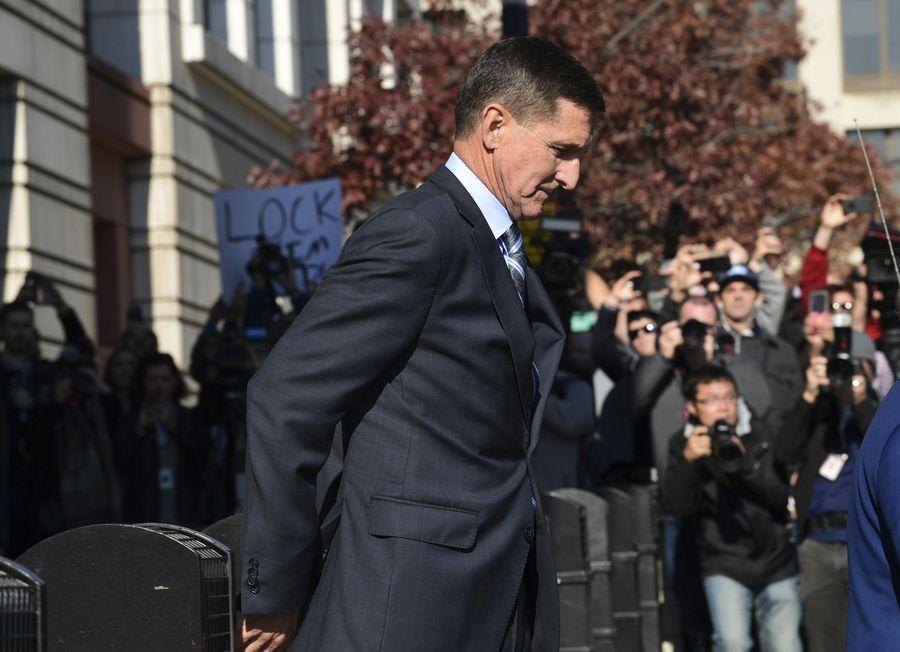
Former Trump national security adviser Michael Flynn leaves federal court in Washington, Friday, Dec. 1, 2017. Flynn pleaded guilty Friday to making false statements to the FBI, the first Trump White House official to make a guilty plea so far in a wide-ranging investigation led by special counsel Robert Mueller. (AP Photo/Susan Walsh)
Why Has Trump Been So Desperate to Protect Flynn?
Published Dec. 3, 2017 • Read time: 4m
WASHINGTON -- And so the special counsel's probe inches ever closer to the White House, and President Trump.
It is not possible for those on the outside to know just how close. But the move by former National Security Adviser Michael Flynn to plead guilty to lying to the FBI is an ominous sign for Trump and his circle. We knew this day was coming, and yet the news that Flynn is cooperating with Special Counsel Robert S. Mueller III feels earth-shaking, for good reason. It may be the moment that everything changed.
Do not believe White House spin to the contrary. A few weeks ago, after the indictment of Paul Manafort, Trump's former campaign chairman, the White House had an easier time of it. "Sorry, but this is years ago, before Paul Manafort was part of the Trump campaign," the president tweeted.
The guilty plea by former foreign policy adviser George Papadopoulos posed a bit more of a challenge, what with the fact that he admitted lying to the FBI about his dealings with Russia during the campaign, and had informed campaign officials about some of those contacts. But still Trump could argue, with some basis, that "few people knew the young, low level volunteer named George."
Not so, with Flynn. The White House tried gamely to make it look as if there was nothing new to see here, and that Flynn had been charged only with doing what had already precipitated his firing by the Trump White House.
"Nothing about the guilty plea or the charge implicates anyone other than Mr. Flynn," White House lawyer Ty Cobb said. That is untrue. The plea documents make clear not only that Flynn lied, but that he lied with the full knowledge of senior Trump transition officials, who allowed his misstatements to stand unchallenged.
Charge Against Trump Campaign Manager Eclipses Wisconsin Race
Arizona's Voting Rights Fire Bell
Judge Garland and the Left's Disdain for Truth
Military Has Wide Discretion on Bergdahl Charges
Oh, and by the way, nice try on portraying Flynn as a "former Obama administration official," given that the Obama administration fired Flynn as Defense Intelligence Agency director, and that the Trump administration dawdled in acting on Flynn for 18 days after then-acting Attorney General Sally Yates warned officials that Flynn was lying about his phone calls with Russian Ambassador Sergey Kislyak during the transition.
Friday's court documents offer some clues to what underlies the White House's reluctance to act. As much as the White House wants us to think of Flynn as a rogue freelancer, and itself as the victim, the court papers indicate that Flynn was not acting alone in his dealings with Kislyak. To use the most loaded of words, he was colluding with others in the Trump transition.
According to the documents, even as Flynn and Kislyak had each other on speed dial the day the sanctions were announced, Flynn was phoning back and forth with the Trump transition team at Mar-a-Lago. Flynn asked an unnamed "senior official" what to tell Kislyak; reported back to the senior official after the phone call; and, several days later, when Kislyak informed Flynn that Russia would not retaliate, informed "senior members of the Presidential Transition Team" about the conversation.
They all stood mute in mid-January, after The Washington Post's David Ignatius reported on the Flynn-Kislyak calls, as Vice President Pence dutifully trooped to "Face the Nation" with assurances that the calls "had nothing whatsoever to do with those sanctions." Which somewhat undercuts Trump's assertion that Flynn was fired for lying to Pence. If Trump wasn't aware of the calls as they took place, did no one tell him later?
Even more tantalizing, as the United Nations prepared to vote on a Security Council resolution on Israeli settlements, "a very senior member of the Presidential Transition Team" -- all the other references in the document are to senior officials -- "directed Flynn to contact officials from foreign governments, including Russia" to press them to oppose the resolution. News organizations are reporting that this very senior official is Trump's son-in-law Jared Kushner. If so, could this have happened without Trump's knowing that his transition team was lobbying to undermine the position of the incumbent White House? Why did Flynn feel compelled to lie about this episode to the FBI?
And that gets to the biggest unanswered question about Flynn: Why has Trump, a man for whom loyalty is a distinctly one-way street, been so desperate to protect him? "I hope you can see your way clear to letting this go, to letting Flynn go," Trump urged James Comey last February, a few months before firing the FBI director. "He is a good guy."
A good guy -- or, from Trump's perspective, a very dangerous one. With Friday's events, the latter seems far more likely.
(c) 2017, Washington Post Writers Group

A RealClear Thanksgiving: Investing in a Better Future
David DesRosiers • RealClearPolitics
Trump’s Newsom Problem: Antagonist-in-Chief
Carolina Lumetta • RealClearPolitics
America’s Free Spirit
John Maxwell Hamilton • RealClearPolitics
The GOP Majority Should Go Out in Glory
Daniel McCarthy • RealClearPolitics
Republican Majorities Could Return Sooner Than Expected
J.T. Young • RealClearPolitics
The Danger Before the Attack
Leslie J. Sullivan • RealClearPolitics
RCP Today
Top stories on RealClearPolitics
The Takeaway
Polling intelligence and analysis delivered to your inbox
World News
Featuring the latest world news
Policy
Featuring the latest policy news
Support Our Mission
As part of RealClearPolitics, authors aim to provide balanced, non-partisan analysis by presenting top reporting and commentary from all sides of the political spectrum.
Trusted by policymakers and citizens alike since 2000