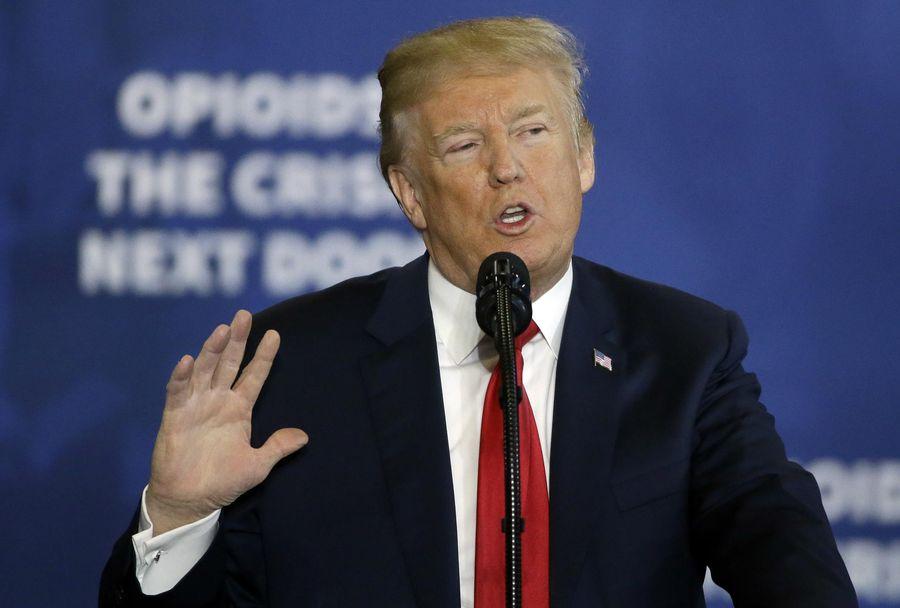
President Donald Trump speaks about his plan to combat opioid drug addiction at Manchester Community College, Monday, March 19, 2018, in Manchester, N.H., even as more Republicans are telling Trump in ever blunter terms to lay off his escalating criticism of special counsel Robert Mueller and his Russia probe. But party leaders are taking no action to protect Mueller from possibly being fired, embracing a familiar strategy with the president _ simply waiting out the storm. (AP Photo/Elise Amendola)
The Trump Team's Chilling Message to Mueller
Published June 4, 2018 • Read time: 4m
WASHINGTON -- L'etat, c'est Trump.
For months we've heard President Trump's TV lawyers, as he calls them, bandy about the argument that he -- or any president, for that matter -- couldn't have obstructed justice because justice is what he says it is.
In other words, that because, they claim, a president possesses absolute power to cut short a criminal investigation, he cannot by definition be guilty of obstructing it. Or, in the famous Nixonian formulation, as Richard M. Nixon told David Frost, "Well, when the president does it, that means that it is not illegal."
But as much as the president's legal team foreshadowed this contention, it was nonetheless breathtaking to see it spelled out, in uncaveated black and white, in a letter from Trump's legal team to special counsel Robert S. Mueller III.
"A President can also order the termination of an investigation by the Justice Department or FBI at any time and for any reason," the lawyers, John Dowd and Jay Sekulow, wrote in the January letter, obtained by the New York Times. "Such an action obviously has an impact on the investigation, but that is simply an effect of the President's lawful exercise of his constitutional power and cannot constitute obstruction of justice."
At any time and for any reason. The precise context involved the president's discussion with then-FBI Director James B. Comey in which, according to Comey's testimony, Trump cleared the Oval Office of other witnesses before discussing his just-fired national security adviser, Michael Flynn. According to Comey, Trump expressed his "hope you can see your way clear to letting this go, to letting Flynn go."
Charge Against Trump Campaign Manager Eclipses Wisconsin Race
Arizona's Voting Rights Fire Bell
Judge Garland and the Left's Disdain for Truth
Military Has Wide Discretion on Bergdahl Charges
The letter disputes Comey's version of events but says it wouldn't matter if Trump had made those statements. And then, in a magnificently gaslighting move, the letter claims that Trump is actually the hero of any obstruction story, because he fired Flynn: "Far, far, from obstructing justice, the only individual in the entire Flynn story that ensured swift justice was the President."
Of course the president oversees the executive branch, including the Justice Department. Of course he gets to set broad contours of policy. But there is a long and wise tradition of presidential reticence to interfere in individual criminal matters -- no less in a criminal matter that affects himself. And the notion that the president could peremptorily call off any prosecution for any reason whatsoever -- no matter how corrupt -- would be laughable if it weren't so scary.
As Daniel Hemel and Eric Posner write in the California Law Review, "No one thinks that … the president should be able to commit a crime and then call off the investigation of it. What if he murdered his valet?"
That is a fanciful hypothetical, but the more reality-based one also underscores the extreme nature of the Trump lawyers' claim. "It is obvious enough that it would be wrong for the president to order spurious investigations of his political opponents in order to harass them," Hemel and Posner write. "But it would seem to follow that the president should not call off investigations of his political aides and allies (and of himself) in order to protect them (and himself) from legal jeopardy. If he could, then he or his aides could engage in criminal activity in order to harass their political opponents -- as the Watergate burglary, a spy operation against the Democratic National Committee, illustrates -- without fear of legal liability."
Indeed, during Watergate, the articles of impeachment against Nixon included the charge that he obstructed justice by "interfering or endeavouring to interfere with the conduct of investigations by the Department of Justice of the United States, the Federal Bureau of Investigation, the office of Watergate Special Prosecution Force, and Congressional Committees."
At any time and for any reason. The context was Comey, but the implications are chilling: that Trump asserts the right to terminate the Russia probe altogether. Or the investigation into his lawyer Michael Cohen.
This is a scary vision of the power entrusted to any president, but especially this one.
(c) 2018, Washington Post Writers Group

A RealClear Thanksgiving: Investing in a Better Future
David DesRosiers • RealClearPolitics
Trump’s Newsom Problem: Antagonist-in-Chief
Carolina Lumetta • RealClearPolitics
America’s Free Spirit
John Maxwell Hamilton • RealClearPolitics
The GOP Majority Should Go Out in Glory
Daniel McCarthy • RealClearPolitics
Republican Majorities Could Return Sooner Than Expected
J.T. Young • RealClearPolitics
The Danger Before the Attack
Leslie J. Sullivan • RealClearPolitics
RCP Today
Top stories on RealClearPolitics
The Takeaway
Polling intelligence and analysis delivered to your inbox
World News
Featuring the latest world news
Policy
Featuring the latest policy news
Support Our Mission
As part of RealClearPolitics, authors aim to provide balanced, non-partisan analysis by presenting top reporting and commentary from all sides of the political spectrum.
Trusted by policymakers and citizens alike since 2000