
The Responsibilities of Civilian and Military Leaders
Published July 23, 2013 • Read time: 4m
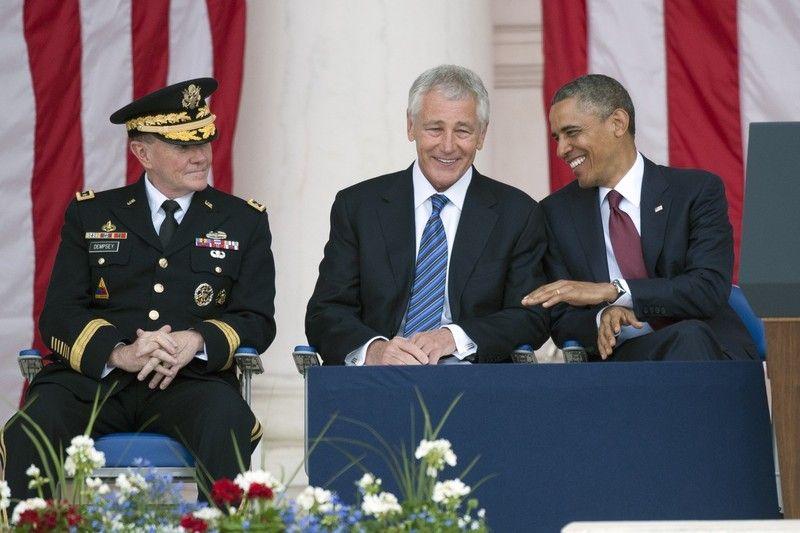
The chairman of the Joint Chiefs of Staff is being raked over the coals by the Senate's most prominent military expert for not disclosing in congressional hearings the advice Gen. Martin Dempsey gave the president about intervening in Syria. Peter Feaver is, of course, to blame for this, he having argued in these electronic pages for grilling Dempsey. Let those who've doubted that Shadow Government controls Washington now quail.
Commentary less thoughtful than Peter's has narrowed in on the exact wording of the U.S. code regulating the chairman's responsibility in order to debate how fully obligated the chairman is to advise Congress. This approach takes the issue in unhelpful and legalistic directions when common sense provides a practical solution that has long been successfully employed by other senior military leaders.
That solution is for the chairman to provide his best military advice to Congress, affirm that he has given his advice to the president, and respectfully decline to be specific about the counsel he gives the president. When pressed by members of Congress, deference and humor in acknowledging that Congress is placing said general in an untenable position are often effective as deflection (see ref: Colin Powell).
Barack Obama's administration does the U.S. military leadership no favors by trying to make those leaders take responsibility for its political choices -- but again, this is neither without precedent nor without time-honored defense, which is for military leaders to answer that what is being asked is above their pay grade.
Charge Against Trump Campaign Manager Eclipses Wisconsin Race
Judge Garland and the Left's Disdain for Truth
Military Has Wide Discretion on Bergdahl Charges
Was Sierra Pacific Victim of Government Shakedown?
There are many good arguments for intervening in Syria, which is what Sen. John McCain was pressing Dempsey about. The best argument for staying out is that Obama is not invested in solving the problem. The president may intone that Bashar al-Assad must go, but he has no strategy for achieving that end, is clearly unwilling to commit the national effort to attain that objective, has made no attempt to convince the American people of the importance of doing so, and therefore has no business putting America's sons and daughters in harm's way, no matter how worthy the objective.
That we are having such a tangled-up conversation about the chairman's responsibilities suggests that public discourse could use a refresher course on civil-military issues. The president deserves to receive military advice in private and has every right to disregard that advice because he has been elected to balance the country's competing priorities and determine how much effort, treasure, and risk to apportion. It is the president who is responsible for winning or losing the country's wars. To place the responsibility on the military's shoulders both gives the military too wide a latitude in the country's affairs and removes from the political leadership its proper accountability for national outcomes.
I myself have always been partial to the Powell doctrine as the starting point for understanding civilian and military responsibilities when using force. Critics often construe its meaning in a strictured way as advocating overwhelming force, but the guidelines actually delineate what the military needs to do (bring properly trained and equipped military force decisively to bear to achieve political objectives) and what tasks rest with the political leadership (identify the vital national security objectives, determine they are attainable, analyze the costs and benefits, exhaust nonmilitary means to attain the objectives, and build public and international support). The country has allowed too many of these responsibilities to migrate to the military, when they properly belong to the civilians to whom the military is subordinated.
The Powell approach has been much criticized as constraining the president's freedom of action as commander in chief; in fact, what it does is give the civilian leadership a template for asking questions that will lead to the successful use of force. And the debate over Dempsey's testimony shows that the country is in need of political leaders -- both in the executive branch and in Congress -- who will do more than advocate tactical military approaches and actually advance strategies for achieving outcomes in the U.S. national interest that they have convinced their fellow Americans are worth the risk and effort.
This article is reprinted from Foreign Policy with permission from the Hoover Institution.
Jon Finer’s Old and Dangerous ‘New Approach’ to Israel
Peter Berkowitz • RealClearPolitics
The President Deserves Better
John Ullyot • RealClearPolitics
Congress Doesn’t Need Another Blame Game. It Needs To Find What’s Broken
Jarrod Bernstein • RealClearPolitics
Democrats Won the Midterms. Common Sense Won, Too
Jordanne Kemper • RealClearPolitics
The 120th Congress Shapes Up
Carolina Lumetta • RealClearPolitics
Flooding GOP Primaries With Democrats
Robert Natelson • RealClearPolitics
RCP Today
Top stories on RealClearPolitics
The Takeaway
Polling intelligence and analysis delivered to your inbox
World News
Featuring the latest world news
Policy
Featuring the latest policy news
Support Our Mission
As part of RealClearPolitics, authors aim to provide balanced, non-partisan analysis by presenting top reporting and commentary from all sides of the political spectrum.
Trusted by policymakers and citizens alike since 2000