
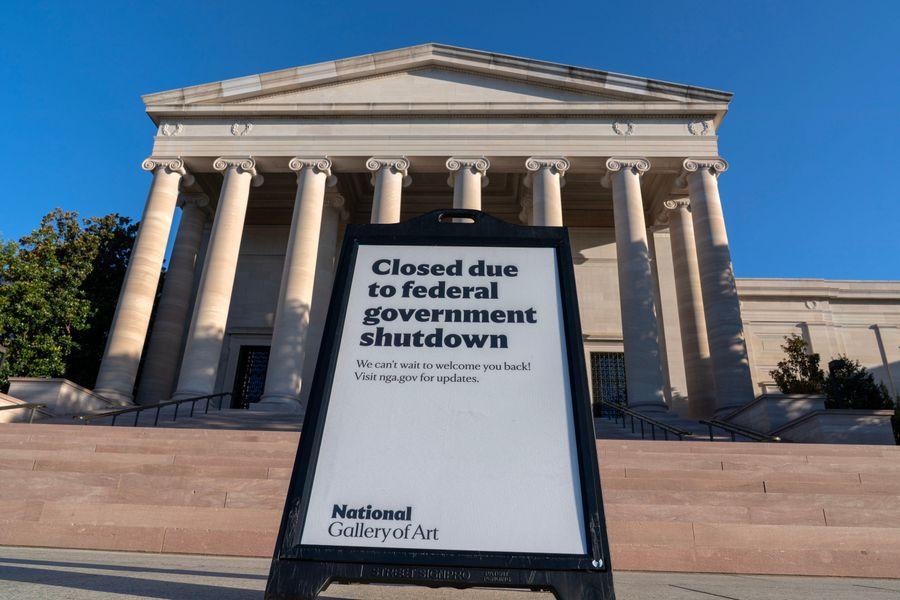
EEUU CIERRE GOBIERNO EMPLEADOS FEDERALES
To My Fellow Democrats: A 'Third Way' To Reopen the Government
PURPLE NATION
Published Oct. 16, 2025 • Read time: 7m
I understand that congressional Democrats think they have the upper hand, albeit by a narrow margin, showing that voters blame the GOP more than them for the current government shutdown. Their talking point – that the Republicans control the White House and majorities of both chambers – apparently has resonance, at least so far.
The margin is not great, however. And the public may start to catch up on the disingenuousness of our party’s constant use of the word “majority” to describe Congress. Every elected Democrat in Washington knows that it takes 60 votes to break their own filibuster in the Senate, and the Republicans only have 51.
Sooner or later, the average voter may figure this out, meaning that the poll numbers could swing against the Democrats. And as the shutdown starts to cause pain at home, that is when voters may conclude that the congressional leadership of my political party is at least partially responsible for the shutdown.
Partisan politics aside, the need to address the real pain felt by government workers and those depending on public services, including airplane travelers, should compel Democratic leaders to find a compromise solution – something between the usual binary “we win-you lose” two options they now are seeing.
Bill Clinton gives Democrats a model and a pathway. He often saw a “third way” that allows parties to come together on common principles where no one wins or loses, but both sides share some victory laps.
In the run-up to this shutdown, Republicans insisted on some “work requirement” to modify Medicaid as an entitlement program. Democrats are not willing to go there – especially as a condition to reopening the government. But Democrats could look at the Clinton approach to welfare reform and his use of some type of “work requirement” that proved acceptable to liberal reformers in the Clinton era.
McCain to Code Pink Protestors: Get Out of Here You Low Life Scum
AG Nominee Lynch Deflects Cruz Missile
Senate to Begin Hearings on Obama Attorney General Nominee
Democrats, Republicans Spar Over Benghazi Investigation
In his 1992 presidential campaign, Clinton had pledged to “end welfare as we know it.” This was a cornerstone of his vow to govern as a “New Democrat,” a template that envisioned a reformed liberalism that rewarded individual responsibility and accountability in return for government assistance to those genuinely in need.
Welfare reform proved elusive, however, especially after the drubbing Democrats took in the 1994 midterms. Congressional Democrats on Clinton’s left flank had never been willing to budge on welfare reform. Emboldened House Republicans, led by Speaker Newt Gingrich, wanted to go too far. Clinton vetoed the first two Republican versions on the grounds that they were too draconian. But by 1996, leaders in both parties had incentives to meet in the middle. Gingrich wanted to show that he could deliver on his “Contract with America.” The Clinton campaign didn’t want to face the voters during his 1996 campaign without having delivered on his earlier promise to “end welfare as we know it.”
Ultimately, Gingrich and Clinton painstakingly found common ground on welfare reform: The compromise legislation they forged continued to fund those who needed welfare, while adding a work requirement as part of an attempt to break the cycle of generations of the poor stuck on the dole.
At the risk of oversimplification, the reform measure abolished welfare as an automatic “entitlement” program (called “Aid to Families with Dependent Children”). It was replaced by the “Temporary Assistance to Needy Families” program, which added a reasonable “effort to find a job” requirement. Drafted by Rep. John Kasich of Ohio, to his credit, then and in the future as a practitioner finding compromises, the legislation was officially titled the Personal Responsibility and Work Opportunity Reconciliation Act, but dubbed the “Welfare to Work” law by headline writers. It was signed into law by President Clinton on Aug. 22, 1996.
“This act honors my basic principles of real welfare reform,” Clinton said that day. “It requires work of welfare recipients, limits the time they can stay on welfare, and provides childcare and health care to help them make the move from welfare to work. It demands personal responsibility, and puts in place tough child support enforcement measures. It promotes family and protects children.”
“The best antipoverty program is still a job,” Clinton added. “Combined with the newly increased minimum wage and the Earned Income Tax Credit – which this legislation maintains.”
There were strong pockets of opposition in the progressive base of the Democratic Party and the arch-conservative GOP base, but over time, the results proved successful: a reduction of those trapped in the welfare cycle, expanded jobs through the Clinton administration’s economic policies, and, yes, the ending of welfare as we knew it. So it can be done.
So here is the compromise plan for Democrats to publicly propose to Republican congressional leaders to place the onus on them of a continuing shutdown if they ignore the proposal:
We Democrats will vote for a continuing resolution to reopen the government and will commit to adding a “work requirement” in the future to Medicaid if you Republicans commit to an up-or-down vote in both chambers within 60 days to restore all the pre-“BBB” Medicaid cuts and enact an extension of Obamacare insurance subsidies and support.
Democrats will also commit to supporting a bipartisan commission to frame the work requirement for Medicaid, similar to the Clinton welfare reform plan, and agree to an up-or-down vote on the commission’s recommendations within six months.
Of course, liberals like me would worry that Republicans who favored Medicaid cuts will try to influence the commission to impose draconian work requirements that amount, de facto, to severe Medicaid cuts.
But there is evidence that red-state members in both chambers recognize the pain caused to their own constituents by the lack of Medicaid funding. And Democrats want an up-or-down vote on extending the Obamacare health insurance subsidies since the MAGA voters are already alarmed by the increase in such premiums without extending Obamacare subsidies – witness Rep. Marjorie Taylor Greene’s recent salvos about the increases in health care costs and insurance premiums if the extension of Obamacare insurance subsidies is not reenacted.
This compromise proposal to reopen the government, or something like it, is based on the requirements of an “up and down” vote by both parties on both sides of the issue: on Medicaid and Obamacare funding, and on work requirements associated with Medicaid modeled after the Clinton welfare reform law.
In politics (as in business disputes, litigation, and even marital relations), “winning” need not be a zero-sum game. Republicans once knew this: Their great champion was Ronald Reagan, who often reminded his lieutenants that the purpose of a negotiation is to get a deal. The current Republican president prides himself on “the art of the deal.” It’s true that in the current era, there is a lack of mutual trust between Democrats and Republicans, but this truism is still relevant: Both sides need to come away with something approaching a win – that’s the nature of a compromise solution.
In other words, a binary “I win-you lose” attitude won’t reopen the government. It also won’t allow us to be a nation that can govern ourselves through making concessions, as a democracy must, and civil discourse finding common ground in the public interest.
There is actually more bipartisan common ground in the current Congress than meets the eye. Majorities of both parties want the government shutdown to end. I suspect the majority of Republicans want restoration of some level of Medicaid funding.
President Trump should remember that five years and five months after the welfare reform bill was enacted – on Jan. 20, 2001, his last day in office, President Clinton enjoyed a 65% job approval rating – that’s right, 65%.
President Trump has shown he relishes ending a stalemate – as he did in the Middle East, where the stakes between Israel and Hamas were ever so much higher. Perhaps he can summon the same “art of the deal” chops to end the impasse in Washington.
I’m not saying that Donald Trump’s job approval will jump overnight from the 40s at present to the mid 60s into Bill Clinton territory – but it would be a start.
Then, I hope he will invest the same energy and stubbornness he showed in the Middle East into demanding that Russian troops withdraw from Ukraine and end that tragic war, too. And if he succeeds at that important task, he will deserve a place in history as a peacemaker who brought the Israeli hostages home and rolled back Putin’s naked aggression against Ukraine.
Democrats Won the Midterms. Common Sense Won, Too
Jordanne Kemper • RealClearPolitics
The 120th Congress Shapes Up
Carolina Lumetta • RealClearPolitics
Flooding GOP Primaries With Democrats
Robert Natelson • RealClearPolitics
Washington Keeps Rewarding Oracle—Veterans Keep Paying the Price
Darin Gaub • RealClearPolitics
The Seeds of Unrestricted Warfare
John Teichert • RealClearPolitics
The Primary System Is Losing the Next Generation
Sean Trende • RealClearPolitics
RCP Today
Top stories on RealClearPolitics
The Takeaway
Polling intelligence and analysis delivered to your inbox
World News
Featuring the latest world news
Policy
Featuring the latest policy news
Support Our Mission
As part of RealClearPolitics, authors aim to provide balanced, non-partisan analysis by presenting top reporting and commentary from all sides of the political spectrum.
Trusted by policymakers and citizens alike since 2000