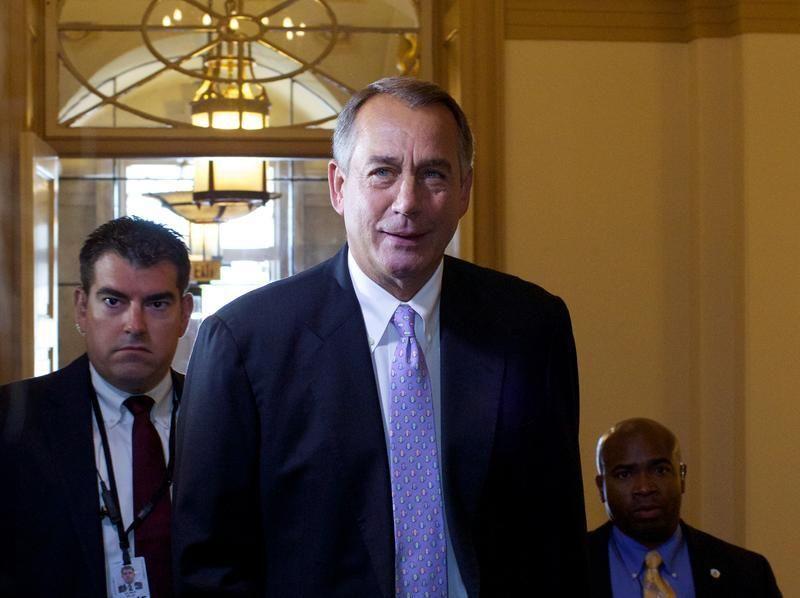
In Budget Fights, Boehner's Role Has Evolved
Published Sept. 30, 2013 • Read time: 8m
Join the Conversation
0Entering the Capitol at the start of what would be a long Saturday session, John Boehner told reporters he felt like a "happy warrior."
Perhaps the House speaker was just putting the best face on a bad situation. Or maybe he meant it. Boehner certainly appeared to be in good spirits over the weekend, despite the government’s precarious perch at the brink of a shutdown -- something the country hasn’t seen in nearly two decades. Boehner’s tenure leading the House has been marked by other budget showdowns, but this time is different: With both sides dug in, the government (or at least its nonessential services) is unlikely to open for business on Tuesday. And Republicans admit they will probably get the lion's share of the blame.
Over the weekend, Boehner was cheered by his conference for bringing to the floor a spending bill that would postpone Obamacare for a year; he knew this bid would be futile given the Democratic Senate’s opposition, but it was what a majority of his members wanted.
One thing has become clear over the past three years of divided government and so-called crisis governing: As speaker, Boehner is changing the definition of a representative government. Some observers, including ranking House Democrat Nancy Pelosi, have questioned his leadership abilities, but the 11-term lawmaker from Reading, Ohio, apparently views his role as different from that of previous speakers. Put bluntly, he leads a majority caucus that doesn’t necessarily consider its primary function to be making governmental levers work.
McCain to Code Pink Protestors: Get Out of Here You Low Life Scum
AG Nominee Lynch Deflects Cruz Missile
Senate to Begin Hearings on Obama Attorney General Nominee
Democrats, Republicans Spar Over Benghazi Investigation
“He was elected to present the position of the Republican conference,” says Steve LaTourette, a former congressman from Ohio who retired last year and is a close to the speaker.
Rep. Raul Labrador, who did not support Boehner’s re-election as speaker in January, likes what he now sees coming from the man at the top now. “They’re listening. I think that’s fantastic,” he told RCP when asked how GOP leaders have handled the latest funding showdown. “Sometimes leadership is about telling people what to do, and sometimes leadership is about listening to what the people you’re leading want to do.”
Boehner showed signs of the latter approach just before taking the gavel in December 2010. “First and foremost, this is not going to be about me,” he told CBS.
If he has redefined the speaker’s role, he has done so largely from a state of frailty, not of strength. After all, he has a president unwilling to negotiate with him, congressional Democrats taunting him, and a rowdy and impatient conference that seems to constantly threaten him with his job.
“He’s like the Maytag repairman,” says LaTourette (who, like Boehner, was in Washington during the government shutdowns of the 1990s). “There’s nothing he can do.” The former lawmaker described the goal of the restive conference as “more about the creation of bumper stickers than policy.”
While Democrats often pity Boehner, they aren’t eager to help him out. Instead, they take the route Boehner himself might choose, LaTourette says: When you opponent seems to be committing suicide, get out of the way.
Others are less sympathetic, and think the speaker has fanned the flames of his potential demise. “At every juncture, when he has had to either exert leadership or kowtow to the far right, he has ended up throwing a bone to the far right,” Rep. Chris Van Hollen, the ranking Democratic member of the House Budget Committee, said Monday at a breakfast gathering with reporters. “He’s been feeding the beast the whole time here.”
In the past showdowns, Boehner was the guy who sat down with the president and did things the old-fashioned way. While contentious, these past deals did squeeze President Obama and Democrats to concede some on tax breaks and spending levels. But they also created some distance between the leader and his conference, and added to the overall distrust between the GOP and the president. The 2011 deal to avert a government shutdown left conservatives wanting more than the $38 billion in spending cuts it got. Boehner’s task in the next crisis, the “fiscal cliff,” became more complicated after Obama won re-election, the House lost a handful of seats and Democrats increased their Senate majority by netting two new members. Divided government was one thing, but divisions within Boehner’s own party threatened him.
Senate Minority Leader Mitch McConnell and Vice President Joe Biden struck the New Year’s Day fiscal cliff deal, as Boehner had been unable to drum up enough support to pass his plan and had to pass the baton. When he brought the McConnell-Biden compromise to his chamber floor, only 85 Republicans backed it. (Majority Leader Eric Cantor and Whip Kevin McCarthy did not.) Later that month, a small, unorganized group from his conference tried to overthrow Boehner.
McConnell, facing his own re-election in 2014, won’t likely be at the deal-making table this time. And the political stakes are higher this time for the speaker: Public backlash could threaten the majority he is trying to preserve heading into 2014. (Indeed, Democrats batted out fundraising emails before and after this past weekend’s House vote, painting Republicans as hostage takers.)
While most rank-and-file Republicans loathe the days of backroom deals, where they say Obama moved the goal posts and misled the speaker, the fact that the president has negotiated in crises before has emboldened them this time -- though it seems to have stiffened the spine of the administration and congressional Democrats.
Boehner tipped his hat to his right flank last week by letting through a funding bill that would have defunded Obamacare. After the Senate rejected it, Boehner returned with the delay package. Conservatives described the move as a “compromise” they were willing to make.
In essence, Boehner might be risking a government shutdown, and the backlash it could produce, in exchange for a united GOP conference -- a unity he hasn’t been able to achieve before.
“Every time we vote for conservative principles, the conference is united. Every time we move away from what are the conservative principles, we actually divide the conference,” Labrador said.
Boehner has been educating members on the Clinton-era repercussions of a shutdown, according to several lawmakers. “It’s very risky. He’s been very direct that it’s politically very risky,” said ally Tom Cole, a five-term congressman.
But those concerns don’t stick with members like Tim Huelskamp, who argues that while Clinton won re-election in 1996, he did so with just 49 percent of the vote. Republicans gained two Senate seats, and, though they lost House seats, they maintained a majority. Still, Huelskamp may forget that Clinton's take was sizable compared to Republican nominee Bob Dole's 41 percent.
Boehner “has an opinion, based on his experience in the last century,” Huelskamp said. But in 2012, “when they were saying ‘no shutdown; it’s going to bad,’ we lost seats in the House and Senate, and the current president got 51 percent,” the Kansas lawmaker argues. “It didn’t work out nearly as bad in 1996 as it did in 2012.”
Others think the party would shoulder most of the blame for a shutdown this time. “I think everybody agrees that this is a loser for us if the government shuts down,” Raul Labrador told “Meet the Press.” “That’s why I think the president and the Democrats want to shut down the government.”
Nonetheless, Cole insists Boehner is in a “very strong” position: “He is awfully adroit and very tough and he’s in a fight. He promised us a long time ago that this is going to be a whale of a fight. He’s trying to achieve the objectives of our conference when we don’t have the Senate and we don’t have the presidency. I think it’s a pretty remarkable effort on his part to keep us unified under very trying political situation.”
Boehner originally wanted to hold that “whale of a fight” on raising the debt ceiling next month. But he was unable to convince his conference. “I have told my leadership that the fight on the debt ceiling should be on the debt, not on Obamacare,” Labrador said.
McCarthy, the GOP whip, broadly previewed what might be the House’s next steps. “The House will get back together in enough time, send another provision not to shut the government down but to fund it, and it will have a few other options in there for the Senate to look at again,” he told Fox News on Sunday
Boehner remained steadfast Sunday evening. He endorsed a group of GOP members who stood on the Capitol steps to call on the Senate to return to work Sunday. Boehner issued a simple warning: “If the Senate stalls until Monday afternoon instead of working today, it would be an act of breathtaking arrogance by the Senate Democratic leadership.”
Time will tell whether Boehner’s gambit was a savvy move or a sign of surrender to extreme elements in his party. Regardless, this is far from the last of these showdowns. The House spending bill only funds the government through mid-December, when another fight is almost certain to occur. But more important battle is the debt ceiling deadline in less than three weeks and its high-stakes risk of default.

A RealClear Thanksgiving: Investing in a Better Future
David DesRosiers • RealClearPolitics
Trump’s Newsom Problem: Antagonist-in-Chief
Carolina Lumetta • RealClearPolitics
America’s Free Spirit
John Maxwell Hamilton • RealClearPolitics
The GOP Majority Should Go Out in Glory
Daniel McCarthy • RealClearPolitics
Republican Majorities Could Return Sooner Than Expected
J.T. Young • RealClearPolitics
The Danger Before the Attack
Leslie J. Sullivan • RealClearPolitics
RCP Today
Top stories on RealClearPolitics
The Takeaway
Polling intelligence and analysis delivered to your inbox
World News
Featuring the latest world news
Policy
Featuring the latest policy news
Support Our Mission
As part of RealClearPolitics, authors aim to provide balanced, non-partisan analysis by presenting top reporting and commentary from all sides of the political spectrum.
Trusted by policymakers and citizens alike since 2000