
Congress Plays Increasing Role in Presidential Campaign
Published April 25, 2012 • Read time: 7m
With the presidential race now having entered the general election phase in earnest, Congress is taking a bigger role in it -- and not just via surrogates for the candidates.
Proposed legislation is providing President Obama with an opportunity to pit himself against unpopular congressional Republicans and forcing Mitt Romney to take tough positions. But even if those Republicans find themselves at odds with their likely standard-bearer on issues like student loans, they are still driving attack messages against the president that may help Romney.
Obama is on a college campus tour this week to tout what congressional Democrats introduced on Tuesday: the Stop the Student Loan Interest Rate Hike Act of 2012. If legislation isn’t passed before July 1, an interest rate subsidy will expire and rates will double. This proposed House bill would keep interest rates “on need-based student loans at 3.4 percent next year for the more than 7 million borrowers,” according to Democratic leadership in the lower chamber.
Indeed, both presidential campaigns are focusing this week on the youth vote. (Obama even appeared on Jimmy Fallon’s late-night TV show and “performed” his case in front of a collegiate audience with Fallon’s band providing backup music.) For a few weeks the target group for both campaigns was women, then Latinos. Each of the demographic blocs has favored Obama in recent polling, but Romney has stepped up his effort to cut into those leads by pressing the point that the White House has failed them economically.
McCain to Code Pink Protestors: Get Out of Here You Low Life Scum
AG Nominee Lynch Deflects Cruz Missile
Senate to Begin Hearings on Obama Attorney General Nominee
Democrats, Republicans Spar Over Benghazi Investigation
Romney has no choice but to paint the president’s flaws with each group in bold colors. A new survey out Tuesday by Harvard University’s Institute of Politics, for example, shows the president beating him among 18- to 29-year-olds by 17 percentage points. The poll, conducted March 23 through April 9, surveyed 3,096 Americans in that age range; 38 percent identified as independents, compared with 37 percent who called themselves Democrats and 24 percent who said they were Republicans.
What may be good news in the survey for Romney is that 58 percent said the economy is the most important issue in the election. The next highest issue registered just 7 percent, and that was health care. And the president’s approval ratings with the age cohort aren’t much higher than they are nationally, at 52 percent approving and 46 percent disapproving. On the economy, the numbers are worse: Fifty-eight percent said they disapprove of Obama’s handling of it vs. 41 percent who approve.
And yet, 43 percent said they would vote to re-elect him vs. 26 percent who said they would vote for Romney (30 percent said they weren’t sure). If Ron Paul were to run as an independent, the president’s support would be largely unchanged at 41 percent, but Romney would drop to 18 percent with 13 percent supporting Paul.
Enter the Romney campaign’s Tuesday morning “infographic”: “Youth and the Obama Economy.” In the memo disseminated to reporters, the campaign cited a series of statistics to describe how “Under President Obama, ‘hope and change’ has failed the youth of America.”
From the Bureau of Labor Statistics, the Romney campaign notes: “Under President Obama, 258,000 more young Americans are unemployed, an increase of 1.5 percentage points.” It also noted that the unemployment rate for youth is 16.4 percent, or double what it is for all Americans; that the number of young Americans living in poverty has jumped more than 23 percent; and that the average cost of tuition and fees for four-year state schools is at an all-time high.
With the campaign narrative moving into this new terrain, the Republican congressional leadership is jumping to back its standard-bearer, underscoring that the general election is now fully activated. Witness the GOP’s congressional leadership teams’ parallel messaging on Tuesday:
The Senate Republican Communications Center, a press arm of Senate Minority Leader Mitch McConnell’s office, issued a document titled “The Obama Economy: A Tough Time to Be Young.” There are no mentions of student loan programs anywhere in it; rather, the document cites several statistics intended to counter the narrative emerging from those recent polls that the president is building momentum among young voters.
The document notes that, according to the Associated Press, more than half of recent college graduates with a bachelor’s degree under the age of 25 are unemployed or underemployed. And it noted this finding from the Pew Research Center in February: “The gap in employment between the young and all working-age adults -- roughly 15 percentage points -- is the widest in recorded history.”
Also noted in the document from three different sources is that 25 million young adults live at home with their parents.
House Speaker John Boehner’s office trotted out some of the same stats, and even added that college tuition and fees at public universities have risen 21.5 percent since the president took office, and that there has been a 10 percent decrease in starting salaries for college graduates vs. those in 2006 and 2007.
But nowhere in either of the congressional leadership teams’ messages were mentions of the student loan extension, which is the thrust of the president’s latest push.
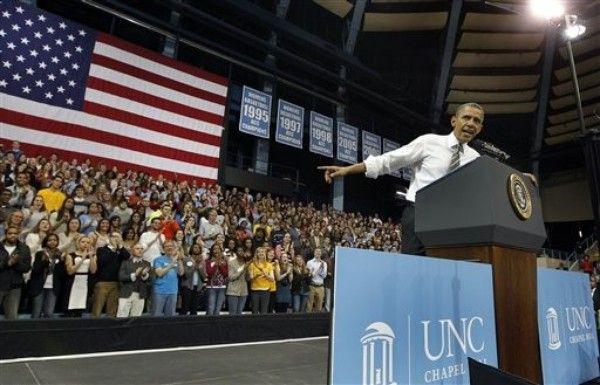
Obama traveled to the University of North Carolina at Chapel Hill on Tuesday to promote the newly introduced measure, telling cheering students that he understands the burden of student loans because he and the first lady didn’t pay off theirs until just eight years ago. Empathy for those struggling economically is a point the president often makes, but this time he has the luxury of relating personally to the congressional action he’s pushing, which sets up a clear contrast with his wealthy Republican opponent in November.
“To give you some sense of perspective -- for each year that Congress doesn’t act, the average student with these loans will rack up an additional $1,000 in debt -- an extra thousand dollars,” Obama said Tuesday. “That’s basically a tax hike for more than 7 million students across America -- more than 160,000 students here in North Carolina alone.”
Channeling some of his 2004 convention speech rhetoric, the president said that keeping student loan interest rates low isn’t a partisan issue, just an American one.
“The Stafford loans we’re talking about, they’re named after a Republican senator,” he said. “The Pell grants that have helped millions of Americans earn a college education, that’s named after a Democratic senator. When Congress cut those rates five years ago, 77 Republicans in the House of Representatives voted for it -- along with a couple hundred Democrats.”
Despite this bipartisan language, he went on to say that some Republicans would only support keeping the lower rates if they were offset by aid cuts for low-income students. He complained, “The Republicans who run Congress right now have not yet said whether or not they’ll stop your rates from doubling.”
This congressional proposal, then, is designed to boost the president with voters who could help lift him over Romney in a handful of critical swing states, including North Carolina.
But Romney made a surprise move in the chess match this week by saying he, unlike many congressional Republicans, supports the loan rate extension (despite saying in March that he wanted to open up student loans to the private sector). So while his fellow party members in Congress are helping him pile on the president, he might not be helping them. And that could create an even more interesting role for this unpopular body as the presidential election heats up.

Democrats Won the Midterms. Common Sense Won, Too
Jordanne Kemper • RealClearPolitics
The 120th Congress Shapes Up
Carolina Lumetta • RealClearPolitics
Flooding GOP Primaries With Democrats
Robert Natelson • RealClearPolitics
Washington Keeps Rewarding Oracle—Veterans Keep Paying the Price
Darin Gaub • RealClearPolitics
The Seeds of Unrestricted Warfare
John Teichert • RealClearPolitics
The Primary System Is Losing the Next Generation
Sean Trende • RealClearPolitics
RCP Today
Top stories on RealClearPolitics
The Takeaway
Polling intelligence and analysis delivered to your inbox
World News
Featuring the latest world news
Policy
Featuring the latest policy news
Support Our Mission
As part of RealClearPolitics, authors aim to provide balanced, non-partisan analysis by presenting top reporting and commentary from all sides of the political spectrum.
Trusted by policymakers and citizens alike since 2000