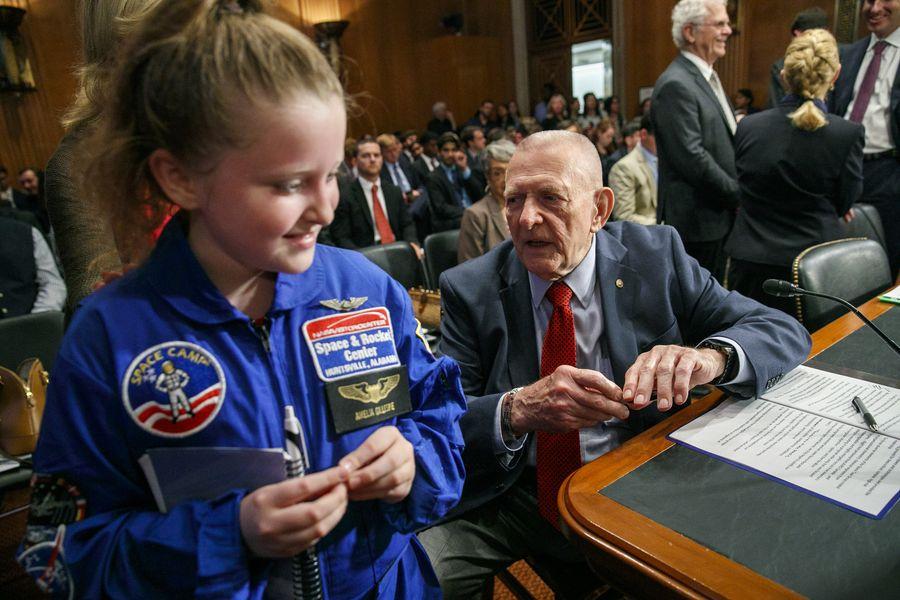
Amelia Gillespie, 9, of Arnold, Md., asks Apollo 11 flight director Gene Kranz is he will sign her Space Camp jumpsuit, before he testifies before a Senate subcommittee on Aviation and Space, about NASA exploration, Tuesday, July 9, 2019, on Capitol Hill in Washington. (AP Photo/Jacquelyn Martin)
At Senate Hearing, Space Advocates Shoot for the Moon
Published July 11, 2019 • Read time: 5m
“Because of you,” President Nixon told the crew of Apollo 11 as they fearlessly traversed moon’s surface, “the heavens have become a part of man’s world.”
Nixon’s poignant observation was true, at least for a while. Ahead of the 50th anniversary of the first human setting foot on the moon, the Senate Commerce Subcommittee on Aviation and Space met this week with an accomplished panel to discuss the progress made since that historic day -- and what Americans can anticipate in the future of spaceflight.
Although American involvement in the final frontier has remained constant, much has changed. “As we look at the space landscape today, we can see it is far different than 1969,” Chairman Ted Cruz said at the hearing. No longer is the United States pitted solely against the Soviets, he said, but instead both occupy a multipolar environment where numerous countries and private enterprises are vying for control of space.
What remains the same? The primacy of geopolitics and security, panelist Mary Lynne Dittmar, the president and chief executive officer of the Coalition for Deep Space Exploration, told the committee.
Tuesday’s hearing took place amid rekindled interest in space exploration -- and in the context of an emerging consensus on geopolitical space threats. In a recent podcast, CNN Chief National Security Correspondent Jim Sciutto, author of “The Shadow War: Inside Russia’s and China’s Secret Operations to Defeat America,” discussed military buildups in space. Sciutto said that China and Russia have developed space-based weaponry with dangerous capabilities. “These weapons are already up there, at every level in the space domain,” he told the Lawfare podcast. “They can already today cripple the U.S. military.”
McCain to Code Pink Protestors: Get Out of Here You Low Life Scum
AG Nominee Lynch Deflects Cruz Missile
Senate to Begin Hearings on Obama Attorney General Nominee
Democrats, Republicans Spar Over Benghazi Investigation
In response to this threat, President Trump issued an executive order for the creation of a Space Force, and current military institutions are reorienting their strategies. Recently confirmed head of the U.S. Space Command, Gen. John Raymond, wrote in his congressional testimony that American readiness in space requires “shifting our efforts to measure against a contested warfighting domain” -- as opposed what was once considered a more “benign” one.
With these military efforts comes a push in the Senate to boost funding for research and development, as well as increased private sector interest in deep space travel. These efforts are being supplemented by NASA’s Artemis program, which aims to have the first woman on the moon by 2024, and a sustainable outpost there by 2028.
Cruz applauded the program’s “bold vision,” asserting that increasing the allocation of resources to moon-based programs could lead to further exploration. “The first foot that will set foot on Mars will be that of an American astronaut,” he proclaimed.
Despite these ambitious plans, roadblocks stand in the way of progress, Apollo 11 Flight Director Gene Kranz told the committee. Having spent 34 years at NASA in a highly decorated career, Kranz (pictured) noted that “unity is necessary for great effort” in space, something he says the nation lacks both culturally and politically. Sen. Kyrsten Sinema, the ranking Democrat on the subcommittee, wondered aloud whether an institutional confidence gap might exist at NASA, noting that the agency has an aging workforce and that it’s now been eight years since Americans even managed to launch a space shuttle.
A lack of public awareness also may be an issue. Sen. Shelley Moore Capito expressed dismay that she had not heard of the Artemis program until a recent event she attended with NASA’s administrator, Jim Bridenstine, in early July.
Absent clear messaging from the government about this program, it may not achieve the national unity requisite for success, testified former NASA Engineer Homer Hickam, author of the famous memoir-turned-movie “Rocket Boys.”
“I applaud Artemis, but what we do on the moon must make sense to American people,” he said. “Minerals on the moon should be gathered to boost the economy and benefit all.” Apropos of this vision, Hickam hopes to see a space economy that unlocks the moon’s natural resources in the future.
If it becomes clear that there’s growing support for returning to the moon and expanding the space program, the question then becomes how to do so in a cost-effective way that can overcome fiscal obstacles.
The answer might be through private sector investment. Increasing competition among space contractors such as SpaceX, Virgin Galactic and Boeing has led to the development of new technologies at a significantly less expensive cost than in the past. “We’ve unleashed America’s private pioneers to cultivate the vast expanses of low-Earth orbit,” Vice President Mike Pence said in March. SpaceX and other private firms’ competition and innovation have slashed costs for their clients, with a 10% to 15% drop in launch costs since 2010, Bloomberg reports.
Others have stressed that while controlling costs, defining the purpose of the mission, and protecting the country from space-based military forces, it’s also important to harness the national trait that made space travel possible: American ingenuity. Christine Darden, a NASA mathematician and engineer of “Hidden Figures” fame, observed that as a “child of the Space Race,” her generation sent and returned 12 men to the moon safely, “inspiring thousands of young engineers and space enthusiasts.”
Despite facing great odds as a professional woman of color during the 1960s, Darden was an integral part of NASA’s great success at that time. Sen. Cory Gardner took this inspiration to heart. “You didn't just change history, you changed the world,” he told the panelists testifying on Tuesday.
Now, Darden says, it is time for the next generation to make its mark. “The Artemis generation will push the boundaries of human knowledge,” she predicted. “They will dream about and eventually pave the way for reaching new worlds and unlocking the mysteries of the universe.”

A RealClear Thanksgiving: Investing in a Better Future
David DesRosiers • RealClearPolitics
Trump’s Newsom Problem: Antagonist-in-Chief
Carolina Lumetta • RealClearPolitics
America’s Free Spirit
John Maxwell Hamilton • RealClearPolitics
The GOP Majority Should Go Out in Glory
Daniel McCarthy • RealClearPolitics
Republican Majorities Could Return Sooner Than Expected
J.T. Young • RealClearPolitics
The Danger Before the Attack
Leslie J. Sullivan • RealClearPolitics
RCP Today
Top stories on RealClearPolitics
The Takeaway
Polling intelligence and analysis delivered to your inbox
World News
Featuring the latest world news
Policy
Featuring the latest policy news
Support Our Mission
As part of RealClearPolitics, authors aim to provide balanced, non-partisan analysis by presenting top reporting and commentary from all sides of the political spectrum.
Trusted by policymakers and citizens alike since 2000