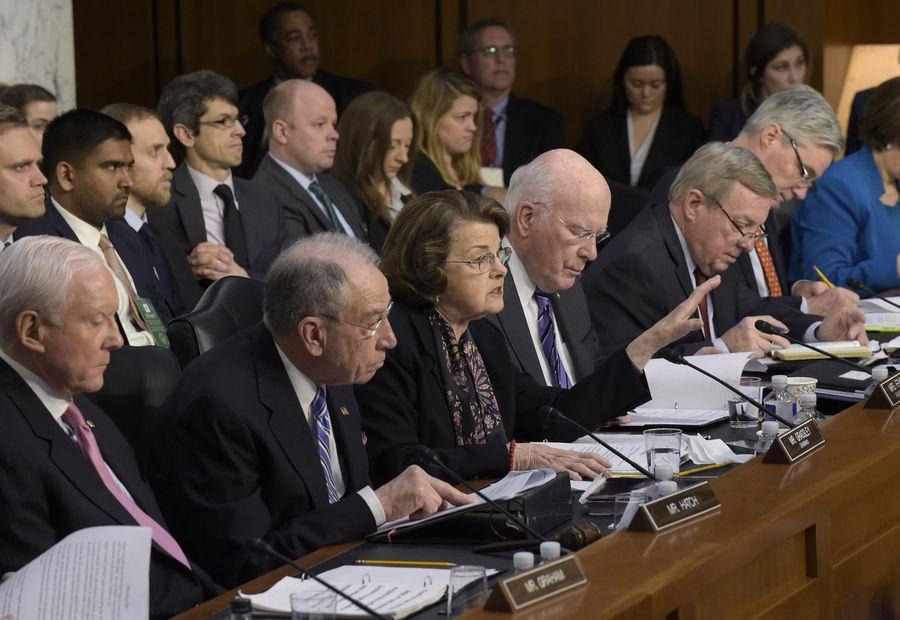
The Senate Judiciary Committee ranking member Sen. Dianne Feinstein, D-Calif., center, asks a question of Supreme Court Justice nominee Neil Gorsuch as he testifies on Capitol Hill in Washington, Tuesday, March 21, 2017, during his confirmation hearing before the committee. From left are, Sen. Orrin Hatch, R-Utah, committee chairman Sen. Charles Grassley, R-Iowa., Feinstein, Sen. Patrick Leahy, D-Vt., Sen. Richard Durbin, D-Ill., and Sen. Sheldon Whitehouse, D-R.I. (AP Photo/Susan Walsh)
A Senate Trend That's Getting Old
COMMENTARY
Published April 26, 2018 • Read time: 6m
The United States Senate has a problem that is complicating life in the “the world’s greatest deliberative body.”
That would be: the age of its members.
At present, seven of the nation’s 100 U.S. senators are octogenarians (in the Senate’s first 100 years, not a single member served into his 80s). Ten were born before the attack on Pearl Harbor, which was 77 years ago this December.
Twenty-two U.S. senators were born before Jackie Robinson broke major-league baseball’s color barrier 71 years ago this month.
Forty-three U.S. senators – nearly half of the chamber – are eligible for Medicare Part A (Missouri’s Claire McCaskill and West Virginia’s Shelley Moore Capito will make it 45 by year’s end).
Seventy-four U.S. senators – nearly three-quarters of the chamber – were born before John. F. Kennedy became the first president since Warren Harding 40 years prior to go directly from the Senate to the Oval Office (only Barack Obama has done it since, 48 years after JFK).
The median age in America in 2016? 37.9 years.
The tipping point, age-wise, in the Senate? Virginia Sen. Mark Warner, at 63 years and four months, is the chamber’s 50th oldest senator.
Should this be a concern to fans of democracy?
On the one hand, senators are elected and unseated by popular vote. If age is a legitimate concern with constituents, they’ll decide. We’ll see a test of this in California, where Dianne Feinstein is up for re-election (soon to turn 85, she’s the oldest sitting senator). And keep an eye on Utah and the race to succeed the retiring Sen. Orrin Hatch, the chamber’s third-eldest member. The odds-on-favorite: Mitt Romney, who turned 71 in March just 10 days before Hatch turned 84.
McCain to Code Pink Protestors: Get Out of Here You Low Life Scum
AG Nominee Lynch Deflects Cruz Missile
Senate to Begin Hearings on Obama Attorney General Nominee
Democrats, Republicans Spar Over Benghazi Investigation
The flip side to the argument: Age makes the Senate seem out of touch and unable to make its trains run on time.
Earlier this month, Facebook CEO Mark Zuckerberg testified before a joint panel of Senate Commerce and Justice Committee members. A couple of exchanges:
Sen. Orrin Hatch: “How do you sustain a business model in which users don’t pay for your service?”
Zuckerberg: “Senator, we run ads.”
Sen. John Kennedy (at age 66, a second-year senator): “Are you willing to give me the right to take my data on Facebook and move it to another social media platform?”
Zuckerberg: “Senator, you can already do that.”
Facebook’s CEO survived what had been pre-sold as an inquisition thanks in no small part to some senators’ lack of Information Age know-how. Blame it on shoddy staff work, if you like. Then again, that’s a problem with aging senators: They become too dependent upon their aides to carry the load.
As for speed and efficiency, let’s go back to last December and a compromise tax-reform deal poised to receive passage by both chambers.
The House voted first, but not out of deference to the lower chamber. Two Republican senators – Thad Cochran and John McCain – were sideline by health concerns and not present to vote.
As The Washington Post reported, that schedule change was “at least the third time [in 2017] that Senate leaders paused action to accommodate ailing colleagues. It is now clear that the large number of older senators in positions of power is taking a toll on the operations of Washington.”
For Mitch McConnell, the election year could offer similar headaches. If Senate Democrats choose to be obstructionist, the majority leader can lose only one Republican senator and still muster 50 votes (in the event of a 50-50 the, Vice President Mike Pence would cast the deciding vote). With an ailing McCain in Arizona for the foreseeable future, McConnell has no latitude within his own caucus.
And should McConnell experience dissension within the GOP ranks? Plan B would be shopping for support among 10 red-state Democrats in difficult races this fall. At least three such senators have indicated they’ll support Mike Pompeo’s State Department nomination.
However, in a higher-stakes fight such as confirming a replacement for Supreme Court Justice Anthony Kennedy (should he suddenly retire this summer), McConnell would need all Republican hands on deck – plus at least nine Democrats – to end a filibuster. In that scenario, McCain’s presence is invaluable.
When in doubt, the Senate turns to protocol. But in a chamber steeped in process and procedure, there’s no one set of rules for dealing with a senator’s failing health other than what might be called “watchful waiting.” (Members didn’t intervene while Strom Thurmond, living out of Walter Reed Hospital following a fainting spell on the Senate floor, not always with it in committee hearings and having to be told by aides how to vote on a bill, stayed in office through his 100th birthday.”)
The simplest solution is a senator voluntarily stepping aside in favor of an interim successor. That’s what Cochrane did in retiring at the beginning of the month.
Should McConnell approach McCain about doing the same – stepping aside for someone who would be a more reliable vote? It’s a delicate question complicated by McCain’s increasing heroic status. And it makes for tricky state politics. At present, Arizona lawmakers are looking at ways to keep a Senate special election off the November ballot should McCain leave office early.
Absent volunteers willing to step aside, the Senate could start a conversation about forced retirement. In Canada, senators cannot serve beyond the age of 75 (curiously, the Canadian government is under attack for not having enough young senators). Apply that age-75 cutoff to the U.S. Senate and 15 members couldn’t come back to Washington next year.
Otherwise, senators aren’t likely to leave a job they discover they quite like, despite the trash-talking involved in initially running against the institution. At present, Florida Gov. Rick Scott is trying to oust three-term Sen. Bill Nelson with this televised buy calling for a two-term limit for “career politicians.” The list is long of members who sought a first term promising to serve no more than two, only to break that pledge. Sen. Susan Collins, a supporter of term limits as a candidate, is a good example.
Politicians not keeping their word? That may be the oldest problem of all in Congress.

A RealClear Thanksgiving: Investing in a Better Future
David DesRosiers • RealClearPolitics
Trump’s Newsom Problem: Antagonist-in-Chief
Carolina Lumetta • RealClearPolitics
America’s Free Spirit
John Maxwell Hamilton • RealClearPolitics
The GOP Majority Should Go Out in Glory
Daniel McCarthy • RealClearPolitics
Republican Majorities Could Return Sooner Than Expected
J.T. Young • RealClearPolitics
The Danger Before the Attack
Leslie J. Sullivan • RealClearPolitics
RCP Today
Top stories on RealClearPolitics
The Takeaway
Polling intelligence and analysis delivered to your inbox
World News
Featuring the latest world news
Policy
Featuring the latest policy news
Support Our Mission
As part of RealClearPolitics, authors aim to provide balanced, non-partisan analysis by presenting top reporting and commentary from all sides of the political spectrum.
Trusted by policymakers and citizens alike since 2000