
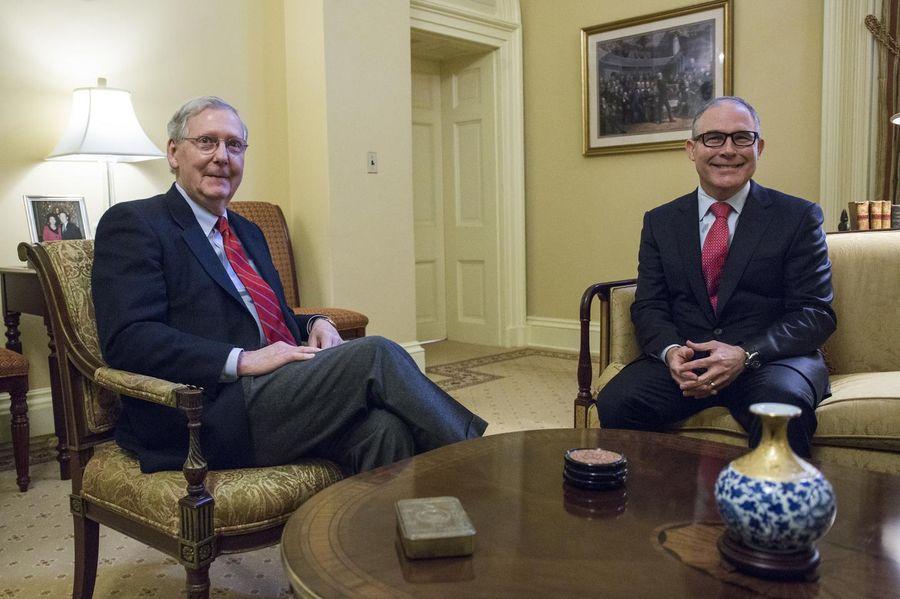
Senate Majority Leader Mitch McConnell, R-Ky., left, meets with Environmental Protection Agency (EPA) Administrator-designate Scott Pruitt, right, on Capitol Hill in Washington, Thursday, Jan. 6, 2017. (AP Photo/Zach Gibson)
Heated Exchanges Likely at Pruitt's EPA Hearing
Published Jan. 18, 2017 • Read time: 4m
Verbal fireworks are expected in the Capitol during Wednesday’s confirmation hearing for Scott Pruitt, Donald Trump’s nominee to run the Environmental Protection Agency.
Few areas of the government deal with issues as polarizing as environmental policy, and Pruitt’s record as one of the most outspoken critics of President Obama’s environmental plans is expected to be questioned aggressively by many Democratic members of the Senate’s Environment and Public Works Committee.
Pruitt, as Oklahoma’s Republican attorney general, has filed or joined over 25 lawsuits against the EPA since 2011, including ones against the Clean Power Plan, an airborne mercury rule, and regulations designed to keep air pollution from crossing state lines. Pruitt has also voiced controversial positions on climate change, arguing that the science “is far from settled” and that he has doubts over “the degree and extent of global warming and its connection to the actions of mankind.”
Given his positions, it’s no surprise the criticism coming out of the country’s environment community has been forceful.
The nominee “has an unbroken record of filing lawsuits against the EPA that in no instance seeks less pollution or greater health benefits than the EPA rules he wants to overturn,” said John Walke, clean air director with the Natural Resources Defense Council. “He wanted to overturn clean air standards that the EPA projected would save up to 45,000 lives every year.”
In his appearance before the committee, Pruitt’s likely defense, given his past arguments, will be that the federal government has dramatically “overreached” in its authority to regulate economic activity during Obama’s time in office. He is expected to anchor this assertion with a call to allow states greater regulatory power, a position that will likely find friendly listeners among the 11 Republican members of the committee.
The panel includes 10 Democrats and tends to attract members who are more partisan than those on other committees. Expect harsh rhetoric from Sens. Bernie Sanders of Vermont and Sheldon Whitehouse of Rhode Island, both of whom view climate change as a major threat to Americans.
“When members join these committees, they chose … and are at times chosen because they have strong views,” said Kevin Book, a principal with the energy-focused public policy firm ClearView Energy Partners. Sanders and Whitehouse are likely “going to argue that Pruitt cannot responsibly administer the EPA if he doesn’t believe in what the EPA does.”
In Pruitt’s corner will be more than 90 percent of the Republican caucus, as well as most of Trump’s inner circle, who are seen as skeptical of climate change and have been agitating for more than two decades to lessen the scope of federal environmental oversight.
If confirmed by the full Senate, Pruitt won’t be the first Republican to try and cut the EPA down a notch or two. Early in the Reagan administration, EPA administrator Anne Gorsuch slashed the agency’s enforcement budget by 45 percent and allowed voluntary compliance by industries.
But federal agencies have shown enormous staying power in the face of small-government conservatism. Gorsuch resigned in 1983 after less than two years in office after a congressional investigation charged that the EPA had misappropriated funds. Gorsuch became the first agency director in U.S. history to be cited for contempt of Congress.
While some similarities exist between the incoming Trump administration and past GOP administrations, clear control of both Houses of Congress has increased fears within the federal workforce that a concerted effort by Republicans could target some agencies in new, more aggressive ways.
Earlier this month, Congress re-established the Holman Rule, an arcane 19th century House of Representatives standing rule that allows stronger control of the federal workforce. Under the rule, lawmakers can target individual employees or programs and slash paychecks down to $1 per year.
The rule was in existence for over a century but was dropped in 1983. Its re-emergence in the current Congress’ has many observers wondering if the new administration is signaling a more aggressive posture toward federal workers, a major Democratic Party constituency, and in particular toward the EPA.
Hence, the increased chances of verbal fireworks at the Pruitt hearing.


RCP Today
Top stories on RealClearPolitics
The Takeaway
Polling intelligence and analysis delivered to your inbox
World News
Featuring the latest world news
Policy
Featuring the latest policy news
Support Our Mission
As part of RealClearPolitics, authors aim to provide balanced, non-partisan analysis by presenting top reporting and commentary from all sides of the political spectrum.
Trusted by policymakers and citizens alike since 2000