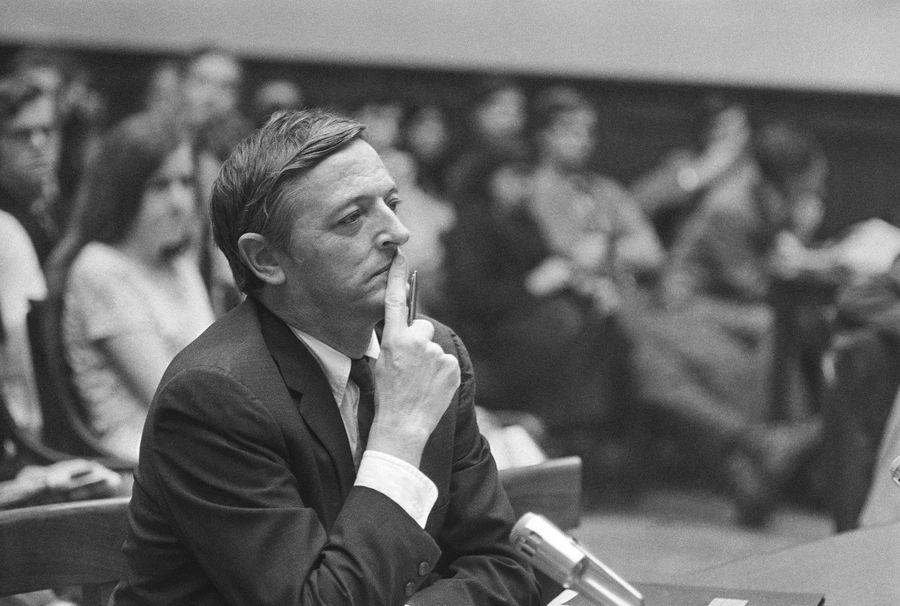
William F. Buckley
Right-Wing Antisemitism, the New Right, and the Buckley Blend
Published Nov. 9, 2025 • Read time: 9m
Join the Conversation
0Tucker Carlson’s cozying up to Holocaust downplayers, Nazi apologists, Stalin enthusiasts, and rank antisemites – along with Heritage Foundation President Kevin Roberts’ October 30 insistence that conservatism’s big tent is big enough to embrace those who hate Jews and fawn over murderous tyrants – widened a parlous rift on the right. (Roberts apologized to Heritage colleagues on November 5.) Much is at stake because Carlson is not some obscure crank but rather host of one of America’s top-ranked right-wing podcasts. And the Heritage Foundation is not a rinky-dink, fly-by-night operation but the nation’s largest, wealthiest, and most influential conservative think tank.
Consequently, it is incumbent on President Donald Trump and Vice President JD Vance, who lead the Republican party and captain the American right, to intervene. The situation might be different if they were men of few words operating quietly, behind the scenes, and above the fray. But both are avid social-media users, online warriors, and rapid responders to progressive critics as well as to fellow right-wingers who deviate from the party line. Accordingly, the president and vice president should explain to backers and all citizens that the Republican Party has no place for bigots, purveyors of vile conspiracy theories, and sycophants of blood-stained anti-American dictators. Such types and opinions, the president and vice president ought to state clearly, stand in irreconcilable opposition to the nation’s founding principles and best constitutional traditions, which conservatives cherish and seek to conserve.
Cruz's Path to Nomination
Trump Stands by His Manager
With Tweets on Heidi Cruz, Trump Sinks to New Depths
A Vote for Kasich Is a Vote for Trump
Meanwhile, prominent conservatives directed stiff criticism at Carlson and Roberts. Of Carlson’s amiable interview with white-nationalist Nick Fuentes, Sen. Ted Cruz declared, “If you sit there with someone who says Adolf Hitler was very, very cool and that their mission is to combat and defeat ‘global Jewry,’ and you say nothing, then you are a coward, and you are complicit in that evil.” Rep. Dan Crenshaw and U.S. Ambassador to Israel Mike Huckabee offered similarly stringent assessments. Daily Wire co-founder Ben Shapiro and National Review Senior Political Correspondent Jim Geraghty rebuked Carlson and Roberts for spotlighting Fuentes.
To understand the present divisions within the right, it is useful to recall the major camps that have marked the American conservative movement from the beginning, and the blend that came to be known as fusionism.
Following the Allies’ victory in World War II, major factions contended – sometimes respectfully, often belligerently – for supremacy within the emerging conservative movement. In this respect, Trump world is not so different. Moreover, prominent Trump-world factions jockeying for preeminence bear resemblances to the factions out of which William F. Buckley forged a new right beginning with the 1955 founding of National Review.
Buckley assembled under one big tent libertarians or limited government conservatives and traditionalists or social conservatives and blended the best ideas of both. Together, he believed, they reflected America’s exceptional political heritage. His efforts culminated in 1980 in Ronald Reagan’s election as president of the United States.
Beyond uniting the conservative movement, Reagan amassed formidable accomplishments during his eight years in the White House. He rehabilitated a severely ailing economy and launched decades of substantial growth. He led the United States to the edge of decisive victory – over which his vice president and successor in the White House, George H.W. Bush, presided – in the Cold War. And he restored pride at home and respect abroad for the American experiment in ordered liberty.
Nevertheless, prominent members of today’s new right – national conservatives, common good conservatives, and postliberals – many of whom are eminent members of the MAGA movement, regard Reagan’s legacy not as a precious inheritance but rather as an onerous burden. They assert that the nation faces an unprecedented crisis stemming from progressives’ high-handed indoctrination of citizens in left-wing orthodoxy through the left’s seizure of the education establishment, most mainstream media, Hollywood, Wall Street, corporate HR divisions, and the federal bureaucracy. This orthodoxy, the new right argues, promotes open borders, which flooded the nation with illegal immigrants who suppress the wages and take the jobs of working-class Americans. It espouses globalization, which hollowed out America’s manufacturing base and shipped high-paying working- and middle-class jobs overseas. And it underwrites the Justice Department’s and FBI’s lawfare against Trump, his associates, and his voters. Dealing with a crisis of such proportions, the new right maintains, demands unprecedented federal-government intervention in law enforcement, the economy, culture, education, and, not least, religion.
Even if the contemporary new right were correct that the nation confronts an unprecedented crisis that demands unprecedented interventions, the answer would not involve replacing the Buckley blend that informed Reagan’s accomplishments with a Trump-inspired populism. The proper path forward, rather, is to combine the Buckley blend with action to address the people’s discontents springing from elite arrogance, ineptitude, and abuse of power.
It is wrong to suppose that the Buckley blend was determined by the two great post-World War II threats to freedom – the growth of the state at home and the Soviet Union’s war against the free world – and hence relevant only to its era. Rather, Buckley’s new right determined that recovery of the nation’s founding principles and constitutional traditions was relevant to meeting the challenges at hand because those principles and traditions were always essential to the nation’s freedom and flourishing.
Nevertheless, influential national-conservative theoretician Yoram Hazony has excited the new right’s propensity to dismiss the Buckley blend as fatally flawed. Hazony maintained in a 2022 National Conservatism Conference speech that Buckley’s conservatism rested on an ill-conceived distinction – articulated authoritatively by National Review Senior Editor Frank Meyer in his account of “fusionism” – between “public” and “private.” According to Hazony, fusionism obliges conservatives “to support freedom – economic, social freedom, individual liberties – everywhere we can almost across the boards” while confining “traditionalism, nation, God, scripture, the traditional family” to the private sphere. This separation, Hazony insisted, fails as a matter of theory because public and private are inseparably intertwined, and damages the nation by allowing a toxic “public liberalism” to seep into “private conservatism.”
Hazony’s tendentious account distorts Buckley’s blend and Meyer’s restatement.
The distinction central to fusionism is not, as Hazony asserts, between public and private, but rather between freedom and virtue. Far from treating them as disconnected, Meyer argued that the nation’s founders saw freedom and virtue as inseparably intertwined in American constitutional government. The question for Meyer was not which belonged to which sphere but rather what were the proper purposes for wielding government power.
Meyer followed the signers of the Declaration of Independence and the drafters of the Constitution in maintaining that government’s primary aim was to secure individuals’ basic rights and fundamental freedoms. At the same time, and in the founders’ spirit, he insisted that human beings’ highest aim was to exercise virtue in pursuit of a just and good life. Since virtue coerced is not virtue, government must be limited to permit citizens to cultivate it. By establishing freedom as the highest political good, American constitutional government creates a broad civil society in which individuals, families, communities, and houses of worship can pursue their highest human duties and callings.
That constitutionally protected freedom provides ample room – and establishes essential safeguards – for democratic self-government in America to deal with the challenges of the moment. It also enables the United States to meet the diverse challenges of different moments – from unlimited government at home and adversarial dictatorships abroad to reweaving the fabric of civil society and rededicating the nation to the common enterprise of securing equal rights under law, fostering shared prosperity, and advancing the flourishing of all citizens.
A crucial difference between the old new right and the new new right concerns government and religion. In line with America’s founders, political freedom in the Buckley blend is just as crucial to faith as it is to virtue, and separation of church and state is especially vital in a nation of many faiths and many variants on its many faiths. Conversely, the new right believes that separation weakens virtue and faith, leaving both defenseless against the protracted onslaught driven by classical liberalism, enlightenment, and secularism. To beat back this concerted assault, they contend, requires an activist government that legislates morals and bolsters religion. National conservatives go so far as to argue that in the United States, government should uphold Christianity and root public life in it though they do not specify which of Christianity’s many denominations would guide law and policy.
The Buckley blend’s dedication to and sound understanding of America’s founding principles and constitutional traditions better equips it to make responsible decisions about big-tent American conservatism’s boundaries than does a movement that casts aside America’s founding principles and constitutional traditions.
In the 1960s, at some risk to the magazine’s stature and solvency, Buckley took a firm stand against conspiracy theories tinged with antisemitism, severing NR’s ties to the John Birch Society. In 1990, he told the Washington Post that “the magazine’s most important accomplishment was ‘the absolute exclusion of anything antisemitic or kooky’ from the conservative movement.”
In contrast, in his September 2025 National Conservative Conference speech, Hazony equivocated on antisemitism and conspiracy theories. With evident discomfort he noted “the depth of the slander of Jews as a people that there’s been online the last year and half.” Many on the right, he observed with dismay, have come to “think Jews are a big problem.” He solemnly warned that dishonoring and driving Jews from the right will destroy Vance’s prospects, Secretary of State Marco Rubio’s prospects, and America’s prospects. Instead of showing antisemites and conspiracy theorists the door, however, he pleaded with natcon coalition members to honor one another because “mostly we’re on the same side.”
President Trump and Vice President Vance should reject Hazony’s apologetics and embrace Buckley’s principles. By forthrightly telling their supporters and all Americans that dedication to the best in the nation requires breaking with antisemites and conspiracy theorists, they can stabilize, fortify, and enlarge conservatism’s big tent and advance the public interest.
Support Our Mission
The Internet provides an endless stream of content. Not all of it is worth your time. That's why, every day, RealClearPolitics curates the most essential news and information—from all sides and across mediums. The links, videos, and podcasts curated here are the product of human judgment, not algorithms or AI. Please help power our mission of presenting a thoughtful, balanced public discourse through a tax-deductible donation.
Would you consider supporting us today?

A RealClear Thanksgiving: Investing in a Better Future
David DesRosiers • RealClearPolitics
Trump’s Newsom Problem: Antagonist-in-Chief
Carolina Lumetta • RealClearPolitics
America’s Free Spirit
John Maxwell Hamilton • RealClearPolitics
The GOP Majority Should Go Out in Glory
Daniel McCarthy • RealClearPolitics
Republican Majorities Could Return Sooner Than Expected
J.T. Young • RealClearPolitics
The Danger Before the Attack
Leslie J. Sullivan • RealClearPolitics
RCP Today
Top stories on RealClearPolitics
The Takeaway
Polling intelligence and analysis delivered to your inbox
World News
Featuring the latest world news
Policy
Featuring the latest policy news
Support Our Mission
As part of RealClearPolitics, authors aim to provide balanced, non-partisan analysis by presenting top reporting and commentary from all sides of the political spectrum.
Trusted by policymakers and citizens alike since 2000