
Election 2022 Senate Georgia
Libertarians Analyze Election Underperformance, Plan for Future
Published Nov. 27, 2024 • Read time: 6m
The 2024 presidential election was an unusual one for third parties. The most influential third-party candidate, Robert F. Kennedy Jr., first ran to try to primary Democratic incumbent Joe Biden. He then decided that would be fruitless and switched to running as an independent in October 2023. After almost a year of campaigning and attempting to gain ballot access in all 50 states, he changed course again and endorsed President Trump on the Friday after the Democratic National Convention and attempted to remove his name from the ballot in swing states. Now, Trump has said he will nominate Kennedy as secretary of the Department of Health and Human Services, with the goal of “Making America Healthy Again.”
In the third-party world, this saga dominated the conversation, leaving minimal airtime for other third parties. While they knew they had no real chance of winning, they still underperformed compared to previous elections.
This underperformance was especially clear in the Libertarian Party, which in 2016 received 3.3% of the popular vote and 1.2% in the 2020 election. Even in 2020, if all Libertarian votes had gone to Trump, it would have flipped the election results in Arizona, Wisconsin, and Georgia, resulting in a 269-269 split in the Electoral College.
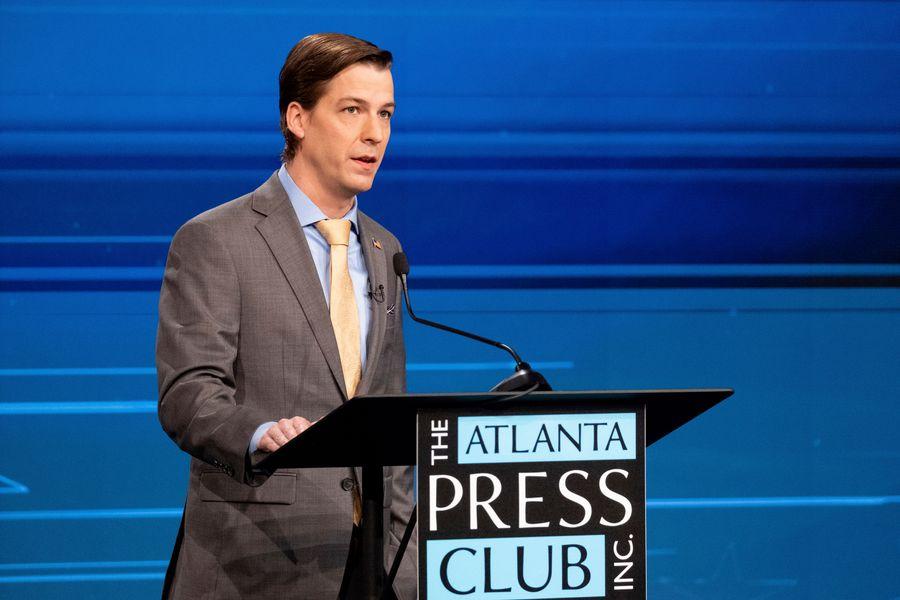
The Libertarian Party’s impact was absent in the 2024 election. Libertarian presidential candidate Chase Oliver and his running mate, Mike ter Maat, only received 0.4% of the popular vote. This was less than Kennedy, who had dropped out of the race but remained on many state ballots, and Green Party presidential candidate Jill Stein.
A Better Choice
A Third Party Emerges
Idea of Third-Party Option to Trump Loses Steam
Libertarian Lite
While all Libertarians acknowledged that a large part of Oliver’s underperformance in this year’s election stemmed from Kennedy’s prominence, some within the party blamed Oliver’s social liberalism. One state libertarian party, the Libertarian Party of New Hampshire, even endorsed Trump for president instead of Oliver, stating, “There is, technically, a Libertarian on the ballot. This Libertarian spends his time supporting tax-funded trans surgery for prisoners, advocating for literal murderers, and trying to kick our members out of the Libertarian Party entirely.”
Michael Rectenwald, who ran against Oliver in the Libertarian presidential primary, said Oliver’s focus on social issues hurt his performance compared to previous Libertarian candidates. “What he was really doing was using the Libertarian Party as a parapet from which to promote his transgender and LGBTQIA+ agenda. He turned out to be basically a leftist with libertarian sprinkles,” Rectenwald told RealClearPolitics.
Oliver defended his support for transgender rights and parents’ ability to make medical decisions for their children. He expressed confidence that both the Libertarian Party and the country would move beyond their “trepidation and unease” on the social issues, akin to the cultural shifts on gay marriage and gay rights.
Instead, Oliver attributed the underperformance to fear within the electorate. “Many were voting for Trump because they didn’t want Harris, or voting for Harris because they didn’t want Trump. There was a great deal of fear in the electorate, and the more fearful an electorate is, the harder it is to get them to break out of the two-party conditioning,” he told RCP.
The Future of the Libertarian Party
Regardless of the exact reasons for the lower-than-average election numbers, Libertarians – much like Democrats, who also fell short of their goals – are now planning for the future.
A key future initiative originates from the Mises Caucus of the Libertarian Party, a faction dedicated to personal liberties, and the Austrian School of Economics, which champions free markets and minimal government interference in economic matters. Its plan for the future of the Libertarian Party: “Operation Decentralized Revolution.”
Perhaps less dramatic than the name implies, this plan focuses on recruiting and building a base of local candidates who can pursue libertarian policies at the local level. This approach stems from the reality that, outside of a few examples, such as former New Mexico Gov. Gary Johnson, Libertarians have been unable to win state elections, let alone national presidential elections.
“You’ve got to get proof of concept at the local level, and you have to start to build trust in the party, yeah, and then, and only then, will the Libertarian Party have any shot at winning a national election,” said Rectenwald, the 2024 Libertarian presidential candidate endorsed by the Mises Caucus, in an interview with RCP.
A key aspect of the project involves forming “issue coalitions,” where Libertarians collaborate with external organizations and political parties to promote their identified priorities. One example comes from New Hampshire, where the Libertarian Party says, “Over 100 Libertarians were elected in New Hampshire this year, entirely running as Republicans,” which led to policies like constitutional carry, school choice, and the elimination of the state income tax.
One potential coalition revolves around the incoming Trump administration’s Department of Government Efficiency, which is to be headed by Elon Musk and Vivek Ramaswamy and has garnered support from many Libertarians. Mike ter Maat told RCP that he believes Musk and Ramaswamy “are interested in paring back government, so I think there are reasons to be optimistic. I think the president-elect is interested in that as well.” Ron Paul, who ran for president as a Libertarian in 1988 and later as a libertarian-minded Republican in 2008 and 2012, said he has been asked to advise the Department of Government Efficiency as well.
Despite ter Maat’s agreement with the importance of winning at the local level, he also emphasized the need to run candidates in state and national elections. “I think that it should be said that part of what makes a political party successful is its ability to project the image of a brand, and that cannot be developed solely based on local elections,” ter Maat told RCP. “That brand centers on ideas all Libertarians agree on, namely small government, economic deregulation and free markets, a more limited scope of foreign policy, and an emphasis on personal liberties,” ter Maat continued.
“Over the next four years, I’m going to spend my time putting a bullhorn in front of libertarian policy issues across the country and helping to put eyeballs on these issues and bring renewed interest to them, so that way we can create more energy around libertarian policy in cities and towns and states across the country,” Oliver said.

Democrats Won the Midterms. Common Sense Won, Too
Jordanne Kemper • RealClearPolitics
The 120th Congress Shapes Up
Carolina Lumetta • RealClearPolitics
Flooding GOP Primaries With Democrats
Robert Natelson • RealClearPolitics
Washington Keeps Rewarding Oracle—Veterans Keep Paying the Price
Darin Gaub • RealClearPolitics
The Seeds of Unrestricted Warfare
John Teichert • RealClearPolitics
The Primary System Is Losing the Next Generation
Sean Trende • RealClearPolitics
RCP Today
Top stories on RealClearPolitics
The Takeaway
Polling intelligence and analysis delivered to your inbox
World News
Featuring the latest world news
Policy
Featuring the latest policy news
Support Our Mission
As part of RealClearPolitics, authors aim to provide balanced, non-partisan analysis by presenting top reporting and commentary from all sides of the political spectrum.
Trusted by policymakers and citizens alike since 2000