
Education School Cellphone Bans
Building Democracy, and Common Ground, Begins in School
COMMENTARY
Published March 2, 2024 • Read time: 5m
Many signs indicate U.S. democracy is in crisis. The public’s trust in U.S. government is at a record low. Partisan disagreement about fundamental policy, economic, and social issues is enormous, and Americans on both sides of the aisle worry about a potential 2024 presidential election electoral crisis. These are but a few of the systemic challenges spanning multiple public policy domains.
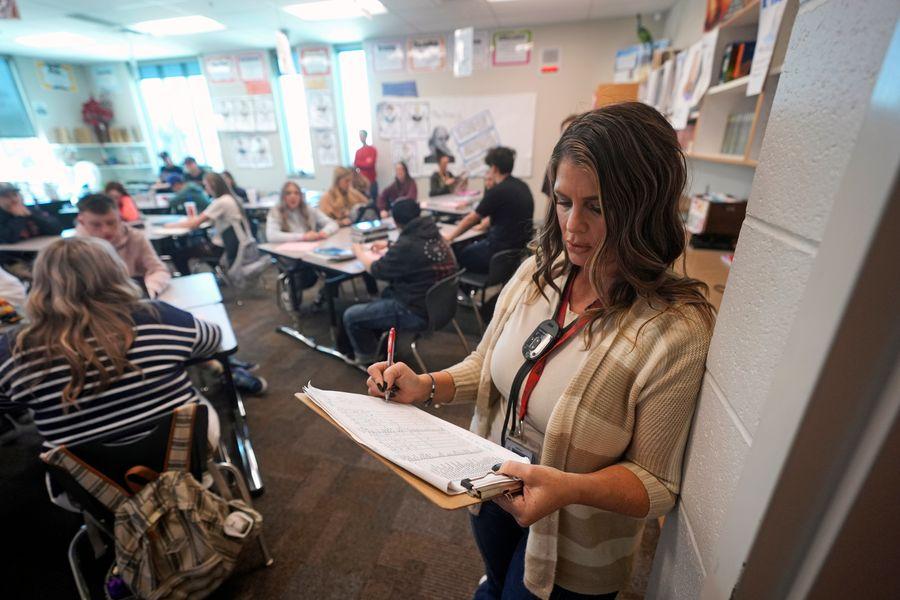
While these challenges are well beyond the capacity of public education to solve, our schools play a fundamental role in preparing the next generation for the responsibilities of upholding our democracy. Yet the realm of education also shows signs of a democratic crisis.
As we have found through polling a nationally representative sample of adults in 2022 and 2023, there are enormous partisan differences in attitudes toward what schools should be teaching, especially on issues related to LGBTQ identities and racial inequality. Debates over teaching about the history and consequences of slavery in the U.S. underscore this lack of a shared understanding of our national narrative.
Current and pending legislation has made teachers fearful of discussing potentially contested topics in their classrooms. Teachers also lack resources that could help them productively facilitate deliberation over differing perspectives. No wonder only a small fraction of students is capable of differentiating credible from fake news.
The reality is that across America, school districts are “purple” to some extent – even if primarily Republican or primarily Democrat – and so we should not be surprised to see disagreements about what students should learn in their public schools.
As Many as 1 Million Kids Will Have School Choice This Year
Hypocrisy Behind the Campus Renaming Craze
Can Our Colleges Be Saved?
Hillary's Federal Education Jackboot Squad
Beyond disagreement about what’s taught in schools is the challenge of managing differing opinions on parents’ rights over the curriculum. Together, these disagreements bring stress and acrimony to classrooms, school boards, and communities nationwide. Children suffer the consequences.
That our public schools have become contested terrain represents another fundamental test for democracy. Fortunately, one of the most surprising and promising results of our 2023 poll is clear bipartisan support for public schools and their most critical purposes: teaching students reading, writing, and mathematics; providing free education for all students; and preparing students for a secure financial future.
This is a positive common starting point from which we might hope to build greater consensus on the role our schools can and should play in our democracy. Research and experience give us several clear ideas for how communities, school boards, and local education leaders can build consensus.
First, across the aisle, adults need to acknowledge that their beliefs shape their views on what children should be learning. For example, we learned in our poll that Democrats think teaching children to embrace differences is a much more important purpose of education than do Republicans.
Among Democrats, 81% think children should learn how white people have been racist historically, even if that makes them feel guilty, compared to 33% of Republicans.
While Republicans are worried about children feeling guilty if they learn about racial injustices and LGBTQ issues, Democrats are not. In fact, Republicans, by a wide margin (35 percentage points for race, 48 percentage points for LGBTQ issues), are more worried than Democrats that learning about topics related to LGBTQ and race will detract from learning what they view as more important content and skills. And Republicans are more worried than Democrats that reading or learning about transgender or gay people might make children think about whether they are or want to be trans or gay.
Understanding another perspective is the first step toward compromise.
Second, the majority of adults, with bipartisan agreement, support children learning diverse perspectives through reading books by diverse authors – this is a promising avenue for teaching about topics including slavery, racial inequality, and LGBTQ.
These findings are indicative of what communities might do to reduce the level of disagreement in search of more common ground. For instance, communities could consider developing clear policies related to opting children out of classroom content with which parents disagree – and attempt to minimize the opt-out.
Our survey found that when adults learn about the advantages of children being exposed to diverse perspectives and the difficulties in exempting children from content parents oppose, they tend to be less inclined to support alternative activities for children. This is a simple and inexpensive way to discourage parental opt-out of children from classroom lessons, leading to greater exposure to diverse perspectives.
Communities could involve children early in consensus-building to teach valuable skills. While consensus-building is difficult, this approach models adult behaviors and instills “reflective patriotism.” That is, people with differing views aren’t evil; we’re all in this together, and we can collectively reach a higher standard of discourse and reconciliation. An extra benefit of reflective patriotism through community deliberation is actively teaching children to value their local democracy.
Beyond our poll’s implications, other policy levers for improving schools’ responsibility to develop citizens include equipping teachers (at all levels) with tools for facilitating discussion of potentially contentious topics, like Street Law, for example, does, and continuing to learn from public opinion polling about education.
Though there are many reasons for concern about the current crises, there are also a number of actions communities and educators can take to relieve the pressure and work towards more effectively realizing the democratic purposes of schools.
Support Our Mission
The Internet provides an endless stream of content. Not all of it is worth your time. That's why, every day, RealClearPolitics curates the most essential news and information—from all sides and across mediums. The links, videos, and podcasts curated here are the product of human judgment, not algorithms or AI. Please help power our mission of presenting a thoughtful, balanced public discourse through a tax-deductible donation.
Would you consider supporting us today?

Democrats Won the Midterms. Common Sense Won, Too
Jordanne Kemper • RealClearPolitics
The 120th Congress Shapes Up
Carolina Lumetta • RealClearPolitics
Flooding GOP Primaries With Democrats
Robert Natelson • RealClearPolitics
Washington Keeps Rewarding Oracle—Veterans Keep Paying the Price
Darin Gaub • RealClearPolitics
The Seeds of Unrestricted Warfare
John Teichert • RealClearPolitics
The Primary System Is Losing the Next Generation
Sean Trende • RealClearPolitics
RCP Today
Top stories on RealClearPolitics
The Takeaway
Polling intelligence and analysis delivered to your inbox
World News
Featuring the latest world news
Policy
Featuring the latest policy news
Support Our Mission
As part of RealClearPolitics, authors aim to provide balanced, non-partisan analysis by presenting top reporting and commentary from all sides of the political spectrum.
Trusted by policymakers and citizens alike since 2000