
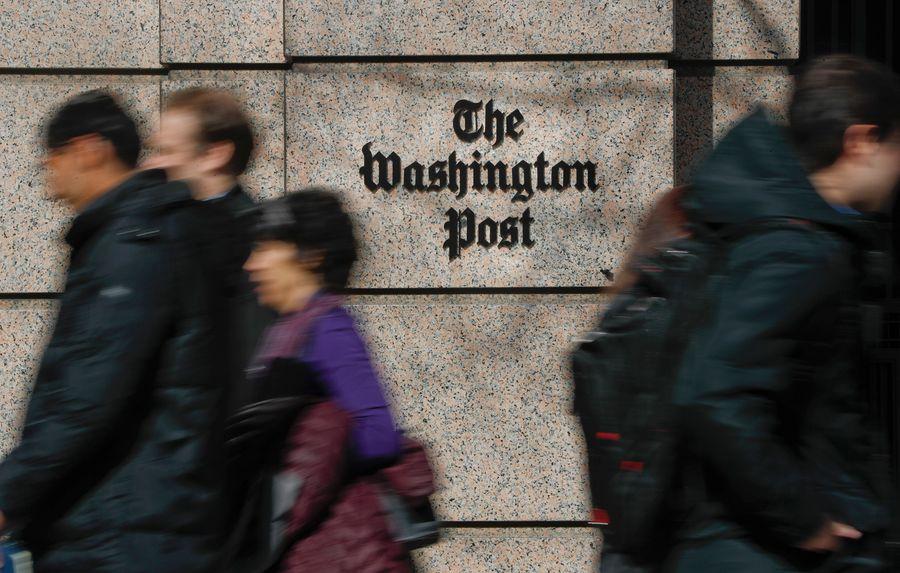
Washington-Post Cuts
Book Review: Martin Baron's 'Collision of Power'
Published Oct. 22, 2023 • Read time: 9m
From time to time, journalists write books that make young people want to be journalists. In my father’s generation, “The Autobiography of Lincoln Steffens” did that by recounting the author’s muckraking of political corruption and poverty. For my generation, the book was “All the President’s Men.” In it, Washington Post reporters Carl Bernstein and Bob Woodward pursued a story that began with a break-in in the Watergate office building and monumentally led to President Richard Nixon’s White House.
Amazon
Now comes a book that should inspire a new generation – and everyday readers – to see journalism as a high calling.
“Collision of Power” is Martin Baron’s memoir of his executive editorship of the Washington Post from 2013 to 2021. It is not written in Steffen’s quirky philosophical style. Nor is it the story of a single exciting journalism investigation like “All the President’s Men.”
“Collision of Power” is a compellingly earnest book about the daily task of maintaining the highest standards of reporting at a time when those standards are desperately needed and simultaneously endangered.
One big problem is money. I have a century-old cartoon on my wall from Puck magazine. It shows a grinning newspaper publisher and his son sitting by a vault room heaped with shining gold coins and crisp greenbacks. Today’s newspapers are not so fat and happy. Thanks to new media, nearly every newspaper in the country has lost readers and advertising, while thousands have gone out of business altogether. When Baron joined the much-storied Post, he writes, “Its commercial viability was in doubt and its capacity to measure up to its journalism heritage imperiled.”
The financial salvation of the Post came from Jeff Bezos, who bought the paper shortly after Baron arrived. The founder of Amazon, whose drivers are probably delivering a package to your front door right now, had wealth measuring in the billions of dollars and ideas on how to use social media to get more readers.
Bezos’s approach to social media harkened back to the beginning of the modern press in the mid-19th century. This was when a few pioneering newspaper publishers realized it was smarter to sell a non-partisan one-cent newspaper to thousands than a six-cent party paper to hundreds. In an early meeting with senior management, Bezos asked which was better: “A small number of subscribers paying a lot [for the print edition]. Or a large number paying a little [for the digital version]? I lean to the latter.”
The Media Did Not Create the Trump Phenomenon
Media Malpractice 2016
Oscar Night: Hypocrisy Dressed to the Nines
Media Cowards and the Cartoon Jihad
Another historical parallel with Bezos’s acquisition was financier Eugene Meyer’s purchase of the paper in 1933. The ailing Post had dwindled to only a dozen pages some days. As Chalmers Roberts chronicled in his history of the paper, Meyer did not need the paper to become wealthy. He took it on as a public service. “In the pursuit of truth,” he wrote in a mission statement, “the newspaper shall be prepared to make sacrifices of its material fortune, if such a course be necessary for the public good.” This attitude carried on under Meyer’s son-in-law, Philip Graham, and after Graham’s death under his wife Katherine Graham, and then under her children, who eventually realized that the only way to keep the paper strong was to find a new deep-pocket owner.
It took Bezos some time, Baron says, to understand why the expense of mid-level editors was necessary. Bezos met with reporters and was engaged with the Post management, but publisher Katharine Weymouth, the granddaughter of Katherine Graham, did not have his phone number. She had to contact him by email over Amazon customer lines. As often happens with Amazon, she often did not get a reply and eventually she and Baron parted ways.
Nevertheless Bezos’ “runway” investments, as he called them, lifted the quality of the newspaper. The politics staff, for instance, doubled during Baron’s tenure; the foreign staff grew nearly that much. Revenue also grew. And to Baron’s relief, Bezos supported fair, accurate, and probing journalism without interfering with editorial decisions, even when the story was critical of Amazon.
This commitment to good journalism would be tested by a second problem that was as formidable as the financial challenge: the suspension of a normal functioning democracy. For some politicians, the main plank in their platform is to tear apart the government. Many no longer care if they were blatantly untethered from facts. The Jan. 6, 2021, insurrection on Capitol Hill, some said, was just a normal day of tourists wandering the halls of Congress.
One of those Jan. 6 protesters scratched “Murder the Media” on a wall in the Capitol. The sentiment echoed Donald Trump’s assertions that journalism is “the enemy of the American People.” More than once the president threatened to punish Amazon on the grounds that Bezos was responsible for news that embarrassed him.
This is where the collusion of power in the book’s title comes from. The Post faced a formidable job covering the Trump administration. Just keeping track of the falsehoods Trump uttered was overwhelming. The high point came on the day Post fact checkers identified 189 inaccurate assertions. But this was not all. The paper had to do this job in the face of relentless charges that such stories were traitorous.
Baron dismisses journalists who persist in lamenting the passing of the good old days when the click-clack of manual typewriters filled newsrooms. Changes such as the ones Bezos wanted to increase digital subscriptions and aggregate news from other media outlets, something Baron at first resisted, had to be made to stay competitive. But Baron’s memoir is fundamentally about making change to preserve old values.
“Count me an unabashed traditionalist,” Baron writes at the end of his explanation for not reporting the contents of the so-called Steele dossier. BuzzFeed released the putative intelligence showing direct collusion between the Trump 2016 campaign and Russia, as well as alleged salacious sexual antics by the president in a Moscow hotel. Baron would not publish these because the information could not be verified.
Many on the staff were dismayed that Trump was elected president despite all the factual stories about his falsehoods, shady business dealings, and disrespect for the norms of governing. Baron told his reporters, “We give the public the information they need and deserve to know. They decide what to do with it. That’s how democracy works. We should remember that this is the same democracy that allows us to publish with the freedom we do.”
“Collision of Power” is a handbook on how a serious newspaper approaches the news. Baron dissects how his team found widespread domestic surveillance by the National Security Agency, stories that won one of 10 Pulitzer Prizes awarded to the Post during Baron’s tenure. In an instance that shows attention paid to details, the editor describes the internal debate on what term the paper should use to describe the protesters on Jan. 6. They settled on “mob.”
Good editors constantly ask themselves what they could have done better. Regarding the 2016 campaign, Baron points to a mistake about the hacking of the Democratic National Committee servers. The leaked emails, which the paper covered extensively, showed that the DNC tipped the scales toward Hillary Clinton in the primaries, instead of remaining neutral toward all Democrat candidates. Baron regrets that he did not push for deeper coverage on why those leaks were made.
A third problem that dogged Baron was the changed newsroom culture. When I was a young reporter at the Milwaukee Journal, it was earth-shaking to get a byline. Now bylines are routine, along with shout-outs at the end of the story to staff members who helped. Also routine is the appearance of reporters on talk shows. Baron accepts this because such appearances promote the newspaper brand. But many cable outlets can compromise journalists. “Morning Joe,” among other programs that invite reporters to join in, has as much to do with balanced journalism as mud wrestling does with figure skating.
A far bigger problem lies with reporters’ use of social media. It is one thing to tweet a story or a fact, quite another to express a view on the news or, as occasionally happened at the Post, criticize colleagues. Many veteran reporters understand why journalists should keep their opinions to themselves in order to maintain credibility. But the newer generation of reporters, who came of age when social media did, often consider it their right to tell people how they feel.
Baron, who had “experienced nothing like it before,” established rules on the use of social media. But it was impossible to cover all the possibilities, and in some cases Baron’s attempts to curb journalists went too far even in the minds of veterans. Worn down by these battles and ailing from a condition that causes serious nose bleeds, Baron decided to retire after the 2020 election.
If Baron could have handled some of these issues more adroitly, his wisdom on journalism values shines through, for instance his admonition to staff on the need for objectivity. “Our role,” he wrote, “should be to observe, inquire, investigate, document, and effectively communicate. That’s core to the profession we chose to pursue.”
In recent weeks his former paper has decided to reduce the staff through buyouts. This is not a sign that Bezos is giving up on quality journalism, the paper insists, but merely the consequence of overly optimistic projections on digital subscriptions. But few employees at the Post are happy about the decision by their multi-billionaire owner, and every editor who runs that paper will have to worry about adjusting to changing technology and about the same editorial problems that he did. Success cannot be taken for granted.
For many years the “Autobiography of Lincoln Steffens” was required reading in schools. “Collision of Power” deserves the same. It belongs in classrooms that prepare journalists and in classrooms that prepare young men and women to be citizens. More than that, it deserves wide public reading at a time when too many find it easier to dismiss journalists than to understand how hard many of them work on our behalf.

Democrats Won the Midterms. Common Sense Won, Too
Jordanne Kemper • RealClearPolitics
The 120th Congress Shapes Up
Carolina Lumetta • RealClearPolitics
Flooding GOP Primaries With Democrats
Robert Natelson • RealClearPolitics
Washington Keeps Rewarding Oracle—Veterans Keep Paying the Price
Darin Gaub • RealClearPolitics
The Seeds of Unrestricted Warfare
John Teichert • RealClearPolitics
The Primary System Is Losing the Next Generation
Sean Trende • RealClearPolitics
RCP Today
Top stories on RealClearPolitics
The Takeaway
Polling intelligence and analysis delivered to your inbox
World News
Featuring the latest world news
Policy
Featuring the latest policy news
Support Our Mission
As part of RealClearPolitics, authors aim to provide balanced, non-partisan analysis by presenting top reporting and commentary from all sides of the political spectrum.
Trusted by policymakers and citizens alike since 2000