
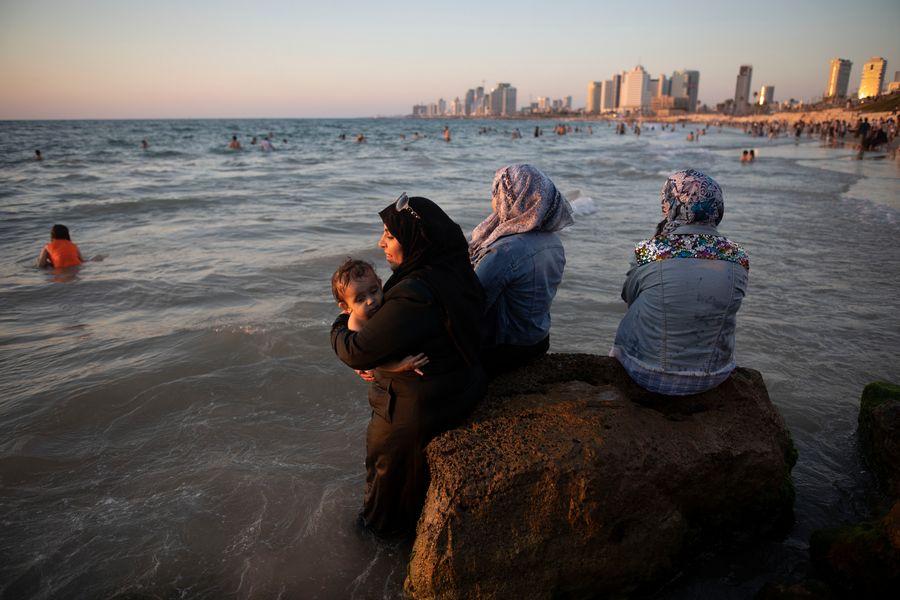
Israel Palestinians Eid al-Adha
Israel's Bustle and Embattlement Obscure Palestinian Question
COMMENTARY
Published June 25, 2023 • Read time: 8m
Join the Conversation
0TEL AVIV—Like this wonderful city – sometimes referred to by its residents as “the state of Tel Aviv” and sometimes as “the crazy bubble” – Israel is bustling and embattled.
This time of year, lovers of sand, sun, and surf of all ages delight in Tel Aviv’s Mediterranean beaches. Locals and tourists crowd the bars dotting the wide boardwalk that extends the city’s length, and pack the fashionable, reservations-required cocktail lounges. The open-air exhibitions of the recently concluded Hebrew Book Week featured an extraordinary range of titles and genres. In offices, cafes, and restaurants, businessmen and businesswomen dream up plans, jockey for advantage, and make and break deals in pursuit of eye-popping exits. On Friday evenings, many of Tel Aviv’s largely secular households slow down, catch their breaths, and welcome Shabbat with a family dinner.
Yet a sense of embattlement hovers over the city. Last Wednesday, opposition head Yair Lapid and National Unity Party leader Benny Gantz walked out of negotiations over the government’s far-reaching judicial reforms – the center and the left and non-trivial numbers on the right refer to them as “regime change”; this week the government plans to resume the judicial overhaul by introducing a bill to bar courts from reviewing and invalidating government decisions based on their reasonableness. Meanwhile, high-tech capital flows out of the country. Violent crime is surging in Israel’s Arab cities. West Bank terrorism is on the rise and so is violent retaliation by Israeli civilians. The government’s recently enacted two-year budget incentivizes the fast-growing ultra-Orthodox sector to persist in separating its members from the rest of the country and in shirking the responsibilities of ordinary citizens. The normalization of relations with Saudi Arabia, which many anticipated following the 2020 Abraham Accords, seems to be receding. And Iran appears to have achieved threshold nuclear status while continuing to arm proxies in Syria, Lebanon, and the Gaza Strip with increasingly sophisticated rockets and missiles targeted at Israel.
Nuclear Jihad: The Threats Are Inside Our Tent
Israel's "Sorrow of the Left"
Signs of Progress Against Extremists in Syria
The World Is Getting Worse, But This Time America Won't Save It
The bustling in Tel Aviv is not interrupted by and the embattlement does not extend to – indeed, they distract from – Israel’s longest-running challenge: the ultimate disposition of the West Bank territories, biblical Judea and Samaria, that Israel seized in the 1967 Six Day War. Israel’s withdrawal from Judea and Samaria would likely bring about the Palestinian Authority’s collapse, Hamas’s seizure of power, and installation of a virulently Islamist dictatorship. Those grim consequences, however, do not diminish the peril the Jewish state faces from staying put. If Israel retains indefinite military control of the West Bank, Jerusalem must eventually either make the approximately 3 million Palestinians who live in Judea and Samaria Israeli citizens and lose its Jewish character or deny them political and civil rights and betray its free and democratic principles.
In “Israel’s One-State Reality,” which appears in the May/June 2023 issue of Foreign Affairs, four American political science professors argue that Israel is for all practical purposes already a single apartheid state stretching from the Jordan River to the Mediterranean Sea. To push their inflammatory narrative, the professors redefine the term “state.” They include both the areas over which Israel formally exercises sovereignty and those – the West Bank and Gaza – over which it is compelled by military necessity to impose various forms of control. The authors, moreover, conflate different kinds of military control. West Bank Palestinians are largely subject to the Palestinian Authority, though Israel retains overall military authority in Judea and Samaria. But in 2005, Israel separated from the Gaza Strip, which Hamas conquered in 2007 and today is home to some 2 million Palestinians. Such control as Israel exercises over Gaza residents reflects defensive measures adopted by Jerusalem to protect itself against the war Hamas wages against the Jewish state.
The authors must also redefine “apartheid,” which refers to the heinous system by which white South Africans segregated the country’s majority black population. Since West Bank and Gaza Palestinians have never been Israeli citizens, live under Palestinian governments, and generally refuse to recognize and live in peace with the Jewish state, invocation of the ugly policy “apartheid” to describe the Israeli regime obscures complex and tragic circumstances.
Nevertheless, maintain George Washington University professors Michael Barnett, Nathan J. Brown, and Marc Lynch, and University of Maryland professor Shibley Telhami, the facts on the ground oblige the United States to “banish the terms ‘two-state solution’ and ‘peace process’ from its vocabulary.” The authors contend that the U.S., which “does not have ‘shared values’ and should not have ‘unbreakable bonds’” with Israel because it has ceased to be a liberal democracy, should adopt a “radical response” to compel Jerusalem to grant full political and civil rights within Israel to West Bank and Gaza Palestinians. Without addressing the grave security threats and while obscuring the fundamentally different political situations, the professors state that Washington should condition aid to Israel on its ending military rule over the West Bank and Gaza. Furthermore, the authors maintain, the U.S. should prepare targeted sanctions; cease protecting Israel from the judgments of international organizations and the U.N Security Council; and back non-governmental organizations that accuse Israel of “structural injustice,” the most prominent of which – the Boycott, Divestment, and Sanctions Movement (BDS) – questions Israel’s right to exist.
In “Can the Two-State Solution be Saved?” respondents illuminate the many defects of the Barnett, Brown, Lynch, and Telhami polemic. Distinguished author and former Israeli ambassador to the United States Michael Oren emphasizes the professors’ paradoxical erasure of Palestinian ideas and actions. Palestinian leaders have repeatedly rejected proposals for two states – in 1937 and 1947 before Israel’s establishment and again in 2000, 2001, and 2007 after the creation of the Palestinian Authority – because they deny the very idea of Jewish peoplehood and therefore the legitimacy of the Jewish state. Moreover, Palestinians have failed to build free and democratic institutions in the West Bank and Gaza and continue to champion terror.
Council on Foreign Relations fellow Martin Indyk, who was centrally involved in U.S.-Israel diplomacy in the Clinton and Obama administrations, argues that despite the genuine obstacles to a two-state solution, the authors’ proposals “would have the United States transform Israel from a strategic ally into a pariah state” and “into a binational state in which Palestinians would constitute a majority.”
Haaretz columnist and Century International policy fellow Dahlia Scheindlin and University of Haifa political scientist Asad Ghanem mostly agree with the analysis set forth in “Israel’s One-State Reality.” Yet Scheindlin warns that the authors’ “tougher U.S. policy” overlooks that Iran and not the Israeli-Palestinian conflict is the principal source of regional instability and that implementation of the professors’ self-styled radical proposals could exact a harsh political cost since Israel still enjoys considerable overall support – if declining among Democrats – in the United States. Ghanem faults the authors for ignoring the collapse of the Palestinian national movement – a movement he thinks is a precondition for “a true bi-national state.”
Washington Institute for Near East Policy executive director Robert Satloff brings into focus several crucial elements of the Israeli-Palestinian conflict that the authors must suppress to depict a single state comprising Israel, the West Bank, and Gaza. Their article counts as vulgar propaganda, “Because in its eagerness to market the catchphrase ‘one-state reality,’ it neglects to mention the hard borders between Israel, Hamas-controlled Gaza, and the Palestinian Authority-controlled urban areas of the West Bank, which make it impossible for anyone – Israeli, Palestinian, or third-country national – to traverse the length and breadth of this supposedly single state and quite dangerous for anyone even to try,” writes Satloff. “Because to make its case, it avoids inconvenient facts, such as the impressive advance of Arab Israelis within Israeli society in recent decades and the rejection of the ‘apartheid’ label by many leading Arab figures on both sides of the Green Line, including the Knesset Member Mansour Abbas, the rights activist Bassem Eid, and the peace activist Mohammed Dajani. Because it disparages the state of Israel’s democracy, which is older than those of about half the countries in the European Union, and makes only passing reference to the remarkable vitality of the country’s civil society, underscored by the huge nationwide protests against proposed judicial reforms that began in early 2023. And because, without a single reference to Hezbollah missiles, Hamas rockets, or a potential Iranian nuclear bomb, it leaves the unsuspecting reader to wonder whether Israel’s neighbors are Andorra, Lichtenstein, and Switzerland.”
To deny that Israel, the West Bank, and Gaza form a single state is not to dismiss the long-term danger. The Israeli government’s ignoring or encouraging of the construction of illegal West Bank outposts increases the difficulty of separation from West Bank Palestinians while obscuring the grim implications. As Hebrew University classics professor Alexander Yakobson recently wrote in the Israeli newspaper Haaretz, “The right is building in practice a single state between the Jordan River and the Mediterranean Sea and deceives itself that the state will remain Israel.” Those on the left who welcome a single state, he indicates, delude themselves that it will be bi-national. The reality, argues Yakobson, would be “one additional Arab state in the region.”
To safeguard its exhilarating bustle and notwithstanding its intensifying embattlement, Israel must redouble efforts – consistent with its national security and its free, democratic, and Jewish character – to steadily enlarge Palestinian self-rule and prosperity.

Democrats Won the Midterms. Common Sense Won, Too
Jordanne Kemper • RealClearPolitics
The 120th Congress Shapes Up
Carolina Lumetta • RealClearPolitics
Flooding GOP Primaries With Democrats
Robert Natelson • RealClearPolitics
Washington Keeps Rewarding Oracle—Veterans Keep Paying the Price
Darin Gaub • RealClearPolitics
The Seeds of Unrestricted Warfare
John Teichert • RealClearPolitics
The Primary System Is Losing the Next Generation
Sean Trende • RealClearPolitics
RCP Today
Top stories on RealClearPolitics
The Takeaway
Polling intelligence and analysis delivered to your inbox
World News
Featuring the latest world news
Policy
Featuring the latest policy news
Support Our Mission
As part of RealClearPolitics, authors aim to provide balanced, non-partisan analysis by presenting top reporting and commentary from all sides of the political spectrum.
Trusted by policymakers and citizens alike since 2000