
Federal Reserve
Fed Hopes It's Finally Seeing Relief From High Inflation
Published June 15, 2023 • Read time: 6m
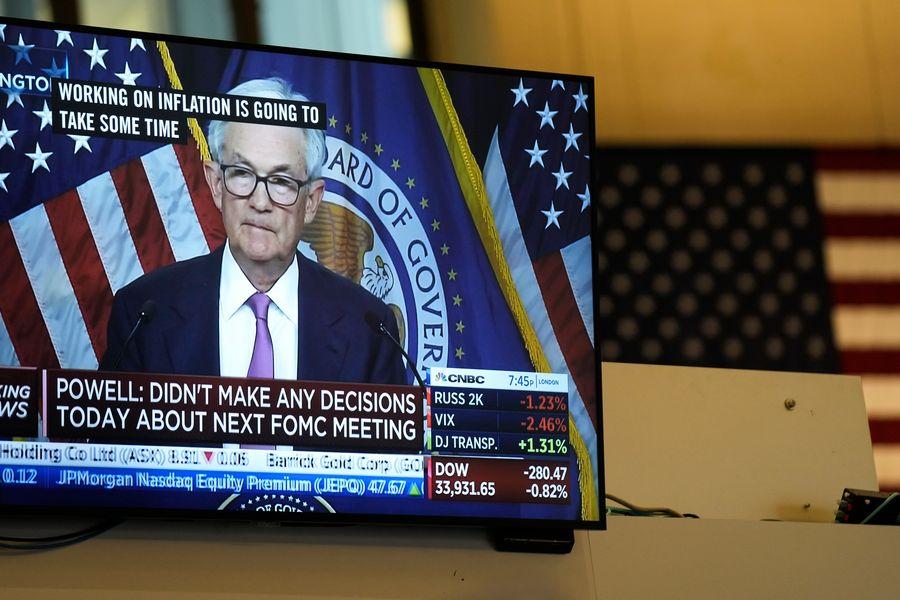
For the first time in 15 months, the Federal Reserve decided Wednesday not to increase interest rates as inflation continues to drop.
The central bank issued a statement saying it will keep the target range for the Federal Funds Rate, the interest rate that the Fed manipulates, between 5-5.25% in order to “achieve maximum employment and inflation at the rate of 2% over the longer run.”
On Tuesday, the Bureau of Labor Statistics announced that the Consumer Price Index, the most used inflation metric, fell for the 10th consecutive month, down to 4% from the peak of 9.1% in June 2022.
For months, Sen. Elizabeth Warren and other progressives have been calling on Fed Chairman Jerome Powell to stop increasing rates. “Yes, he is responsible for dealing with inflation, but he is also responsible for employment,” Warren said shortly after the March collapse of Silicon Valley Bank. Warren said if the rate increases continued, “by the Fed’s own estimate 2 million people will lose their jobs.”
Others argue that the Fed should have never created a situation where it had to choose between fighting inflation and trying to keep banks open. American Prospect analyst Matt Stoller argues that the Fed needs better oversight from Congress. He questions whether the decisions by the Fed in the last two years should lead to more oversight of the printing of the U.S. dollar.
Hazy Predictions
The Fed readily admits that in hindsight it missed the mark the last two years as inflation started rising. “I think what we missed about inflation was that we didn't predict the supply side problems,” Powell told the the Senate Banking Committee way back in November 2021. “And those are highly unusual and very difficult, very non-linear, and it's really hard to predict those things.”
Volcker, Reagan & History
Preserving Their Monopoly on Monopoly Money
Prophets and Losses
Bernanke's Speech on Monetary Policy And It's International Implications
Treasury Secretary Janet Yellen also acknowledged misjudging the path of inflation. “I think I was wrong then about the path that inflation would take,” she told CNN a year ago. “As I mentioned, there have been unanticipated and large shocks to the economy that have boosted energy and food prices and supply bottlenecks that have affected our economy badly that I didn't at the time … fully understand.”
Even while admitting that their response wasn’t perfect, they still opted not to increase the interest rate until March 2022. This was because they thought inflation was “transitory.” As inflation began to rise above 2%, in every statement put out by the Fed from April to September of 2021 it said, “Inflation is elevated, largely reflecting transitory factors.”
This caused the bank to keep interest rates low, despite high inflation. In the first graph below, showing the time period from early 2012 to late 2019, you can see that as the Consumer Price Index, the primary inflation metric (blue line) went up, the red line, the interest rate that the Federal Reserve controls, also usually went up. The green line is straight at 2%, the number that the Fed wants to keep inflation below.
Federal Reserve Bank
The graph after 2020 looks very different. Inflation goes well above the long-run target rate of the Fed starting in March of 2021, but the interest rate doesn’t even begin to creep up in February and March of 2022. They justified holding off on increasing rates for over a year because the Fed wanted to achieve “maximum” employment.
Federal Reserve Bank
Because inflation was not subsiding and was instead getting higher, at the press briefing after the November 2021 statement, Powell said, “Transitory is a word that people have had different understandings of. For some, it carries a sense of being short-lived and there’s a real-time component measured in months let’s say. Really for us what transitory has meant is that if something is transitory it will not leave permanently or very consistently higher inflation.”
By late November 2021, he said, “It is probably a good time to retire that [transitory] word.”
Despite determining that inflation was not transitory, Powell and the other Fed board members still decided to hold off on increasing interest rates until five months later in March of 2022. At that point, inflation was 8.5% and it was a full year after inflation was above the Fed’s long-term target of 2%.
Only in the official Federal Open Market Committee announcement in June of 2022, when inflation was the highest it had been in 40 years at around 9.1%, did they indicate that, “The Committee is strongly committed to returning inflation to its 2% objective.” Until then, the Fed was focused on bringing unemployment down, or reaching what the Fed calls “full employment,” despite unemployment percentages being below 5% since August 2021, almost a full year before they changed their focus to inflation.
Since then, inflation has begun to come down, and as of May 2023, the CPI was 4%.
Could High Inflation Have Been Avoided?
Although Jerome Powell and Janet Yellen got their inflation predictions wrong in 2021, others predicted higher levels of inflation much earlier.
Lawrence Summers, U.S. Secretary of the Treasury under Bill Clinton, was very open about how he thought the Fed was led astray in calling inflation transitory and keeping interest rates low despite rising inflation in 2021 and early 2022.
Before the Fed backed off the transitory term, Summers wrote an op-ed for the Washington Post criticizing all five justifications Powell had for calling inflation transitory. He said the Fed should immediately address inflation. “If price stability is lost and inflation accelerates, sooner or later the consequence will be a severe recession that will hit the poor and middle class hardest and undo recent employment gains,” he wrote.
In another interview with the Post on May 31, 2022, Summers added, “Frankly, it's been my view that the Fed was way slow to recognize the gravity of the gathering inflation score, even though there was substantial evidence of it.”
When the Post asked how he hoped Powell would respond to the inflation, then around 8.6%, Summers said, “It's hard to find a measure where inflation has gone up less than three or four percentage points. And I think that's the kind of increase in interest rates that, at a minimum, we're going to need if we're going to have a prospect of containing inflation.”
The Fed slowly increased the Federal Funds Rate by 4% from around 1%, which it was at the time of the interview, to the current 5%.

Democrats Won the Midterms. Common Sense Won, Too
Jordanne Kemper • RealClearPolitics
The 120th Congress Shapes Up
Carolina Lumetta • RealClearPolitics
Flooding GOP Primaries With Democrats
Robert Natelson • RealClearPolitics
Washington Keeps Rewarding Oracle—Veterans Keep Paying the Price
Darin Gaub • RealClearPolitics
The Seeds of Unrestricted Warfare
John Teichert • RealClearPolitics
The Primary System Is Losing the Next Generation
Sean Trende • RealClearPolitics
RCP Today
Top stories on RealClearPolitics
The Takeaway
Polling intelligence and analysis delivered to your inbox
World News
Featuring the latest world news
Policy
Featuring the latest policy news
Support Our Mission
As part of RealClearPolitics, authors aim to provide balanced, non-partisan analysis by presenting top reporting and commentary from all sides of the political spectrum.
Trusted by policymakers and citizens alike since 2000