
Israel Politics
Restoring Israel's Founding Balance
COMMENTARY
Published April 23, 2023 • Read time: 8m
Join the Conversation
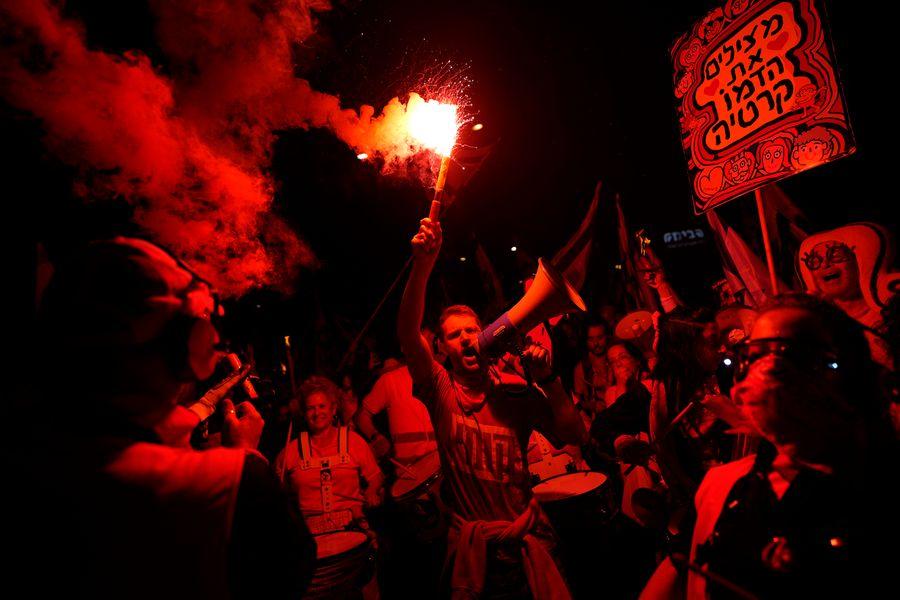
0In early January, just days after the swearing-in of Prime Minister Benjamin Netanyahu’s government but without preparing the nation, Justice Minister Yariv Levin announced an ambitious judicial-reform package aimed at severely restricting the Supreme Court’s power to check the legislative and executive branches. The proposed judicial overhaul sparked massive protests throughout the country. Energized by the center and left – including large swaths of the national security community and the high-tech sector – while drawing noteworthy support from the right, the protests are entering their 17th week. In late March, amid declining poll numbers, Netanyahu suspended the parliamentary rush to curb the judiciary – the opposition calls it “regime change” – until the Knesset’s summer session, which begins May 1. The pause bought Israel time but did not end the unprecedented national crisis.
Netanyahu’s April 10 televised speech exhibited conflicting tendencies. On the one hand, he called for national unity. He reported that his government responded forcefully to terrorist attacks in Israel and the territories and to rocket fusillades from Lebanon and Syria and, with the military’s full support, would persist. He also promised that judicial reform would maintain protection of individual rights while establishing a sound separation of powers. On the other hand, Netanyahu fanned the flames of disunity. He denounced the previous government for weakening the country and for inviting the new round of hostilities. He also portrayed judicial-reform opponents – encompassing more than half the country, according to recent polls – as undermining Israel’s national security and political stability.
Nuclear Jihad: The Threats Are Inside Our Tent
Israel's "Sorrow of the Left"
Signs of Progress Against Extremists in Syria
The World Is Getting Worse, But This Time America Won't Save It
Eminent opposition members have also sown discord. To take an egregious example, former Prime Minister Ehud Barak likenedIsrael’s President Isaac Herzog’s efforts at mediation to the West’s initial appeasement of Nazi Germany. In addition, more than a few flag-waving protesters have raised the stakes: They seek not merely to block the government’s judicial reforms but to oust Netanyahu. For several years the center and left have rallied around the slogan, “just not Bibi.” Instead of championing alternative policy, they have concentrated on demonizing Netanyahu and by extension, his supporters.
Citizens’ internalization of their political leaders’ exhortations to despise the other side may pose the greatest long-term threat to the Jewish state. So argues distinguished Israeli journalist Ari Shavit in a slender volume prompted by the political crisis of which the judicial overhaul, he contends, is only the proximate cause. Composed, he explains, with love, apprehension, and haste, “Saving Israel” (an English translation is in the works) provides a searing analysis of the clash of enmities and empowerment of zealotry in the Jewish state. It also offers an inspiring account of the submerged convictions that still unite a Zionist majority of right and left. And it specifies concrete steps to avert disaster.
A political pamphlet in the old-fashioned sense – capturing unfolding events, distilling essential ideas, touching the heart, elevating debate, and summoning to action – “Saving Israel” stresses that the stakes could scarcely be higher: “The deep crisis of 2023 endangers the Israeli miracle. It threatens to erase our sensational achievements and leave us homeless.”
In the shadow of the Holocaust and situated in a cruel neighborhood, recounts Shavit, Israel’s courageous and farsighted founders established a state that wove together the Jewish people’s magnificent heritage with the principles of freedom and democracy. Authoritatively expressed in Israel’s 1948 Declaration of Independence, that founding balance remains crucial to the Jewish state’s survival. “Israel must be powerful and moral, nationalist and liberal, Jewish and democratic,” Shavit writes. “Only the combination of toughness and openness will ensure that neither weakness nor zealotry will bring us to the edge of the abyss.”
Facing “impossible conditions,” writes Shavit, Israel made itself “a powerful nation against all odds.” Under British imperial rule in the decades before Israel’s birth, Jews built the physical and institutional infrastructure of a state. They defeated five Arab armies that launched a war of annihilation against their fledgling country. In the following years, Israel accomplished what no nation before or since has even attempted: The country absorbed a refugee population – some 650,000 Sephardi Jews expelled, or in flight, from their homes in North Africa and the Middle East – almost equal to the nation’s population. While assimilating this enormous influx of immigrants, Israel constructed world-class hospitals and universities, built the region’s most formidable military and high-tech economy, and remained the Middle East’s only rights-protecting democracy.
Shavit acknowledges Israel’s mistakes. The Jewish state must work harder to integrate the ultra-Orthodox and Arab citizens into the nation’s life. It must more fully address many Sephardi Jews’ lingering resentments for their community’s treatment as second-class citizens at the hands of the mostly Ashkenazi Jews – of European origin – who founded Israel and dominate the country’s political institutions, economy, media, and education. And it must improve arrangements to provide for both West Bank Palestinians’ self-rule and Israeli security.
The right-wing governments that led Israel for most of the last 45 years, Shavit argues, both preserved and obscured the nation’s founding balance. Elected prime minister in 1977, conservative Zionist Menachem Begin kept faith with the imperative to harmonize Israel’s Jewish, free, and democratic character. So, too, until recently, did his right-wing Zionist successors – Yitzhak Shamir, Ariel Sharon, and Benjamin Netanyahu. At the same time, exploitation of resentments for political gain by both right and left have divided Israel into bitter and belligerent tribes: Ashkenazi and Mizrachi, religious and secular, Jew and Arab.
Conciliation has become a dirty word. Many on the right have not forgiven the left for the mid-1990s Oslo peace process, culminating in the early 2000s in the devastating Second Intifada, and for the 2005 Gaza evacuation. Meanwhile, many in the center and on the left revile the right for aggressive settlement policies in Judea and Samaria that push Israel toward a single state – which cannot remain Jewish as well as free and democratic – between the Jordan River and the Mediterranean Sea.
In November 2022, according to Shavit, Netanyahu – a defendant in a long-running criminal trial for bribery, fraud, and breach of trust – formed a coalition that shattered the nation’s founding balance. For the first time in Israel’s history, half the coalition comprised ultra-Orthodox and religious ultra-nationalist parties. Consequently, Israel’s most extreme elements could for the first time hold the prime minister hostage on essential matters.
Notwithstanding the coalition’s solemn talk of restoring democracy, its judicial overhaul would shift power from one minority to another, Shavit observes. Yes, the Supreme Court overreached by adopting a highly expansive understanding of judicial review. Yes, the judicial selection committee’s composition long allowed high court justices to replenish their ranks with like-minded left-leaning justices, though reforms instituted in 2008 gave the governing coalition as well as the legal establishment a veto over appointments. And yes, the high court has used its sweeping jurisdiction to impose progressive outcomes contrary to majority will.
But – as Yediot Aharonot columnist Ben-Dror Yemini and Yeshiva University Professor Neil Rogachevsky have also pointed out – the nation’s coalition-government system, coupled with Israeli society’s distinctive fractures, empowers other minorities to dictate law and public policy. Judicial-overhaul opponents rightly fear that a diminished court will enable the ultra-Orthodox, who constitute 13.5% of Israel’s population, to entrench their schools’ substantial subsidies, persist in omitting core subjects from their curricula, and make permanent their exemption from military service. Judicial-overhaul opponents also understandably suspect that the religious ultra-nationalist minority will take advantage of an enfeebled court to accelerate construction beyond the major blocs in Judea and Samaria.
Shavit sees a way out. Israel’s Zionist majority – encompassing significant swaths of the right and left, Ashkenazim and Sephardim, traditionalists and nationalists, moderate ultra-Orthodox and religious nationalists – must band together. Committed to rights and democracy, the Zionist majority’s several components must cease internal feuding, put national interest ahead of personal ambition and party politics, and form a broad-based coalition. This new “Zionist covenant” calls for a reconfiguration of “the Israeli political map” in which the decisive opposition would “no longer be right against left but moderates against extremists.”
Painful concessions will be necessary, Shavit stresses. Netanyahu, who has licensed zealotry and has leveraged grudges and grievance, must prepare his fellow conservative Zionists for a coalition that does not depend on the ultra-Orthodox and the religious ultra-nationalist minorities. Meanwhile, the center and center left must set aside their loathing of the prime minister and retract their refusal to enter into a power-sharing agreement with him. Current polls suggest that a center-right led coalition embracing the sober left, joined by the rights-respecting ultra-Orthodox and rights-respecting religious nationalists, could form a broad and stable government.
The national-unity government envisaged by Shavit would enjoy the democratic legitimacy to pursue the new majority position in Israel: judicial reform is necessary but must establish a stable and effective separation of powers that preserves an independent, rights-protecting high court. This institutional reform would do more than avert the present crisis. It would invigorate the nation’s founding balance, which would empower conservative and progressive Zionists to cooperate in fortifying a Jewish, free, and democratic Israel.
Democrats Won the Midterms. Common Sense Won, Too
Jordanne Kemper • RealClearPolitics
The 120th Congress Shapes Up
Carolina Lumetta • RealClearPolitics
Flooding GOP Primaries With Democrats
Robert Natelson • RealClearPolitics
Washington Keeps Rewarding Oracle—Veterans Keep Paying the Price
Darin Gaub • RealClearPolitics
The Seeds of Unrestricted Warfare
John Teichert • RealClearPolitics
The Primary System Is Losing the Next Generation
Sean Trende • RealClearPolitics
RCP Today
Top stories on RealClearPolitics
The Takeaway
Polling intelligence and analysis delivered to your inbox
World News
Featuring the latest world news
Policy
Featuring the latest policy news
Support Our Mission
As part of RealClearPolitics, authors aim to provide balanced, non-partisan analysis by presenting top reporting and commentary from all sides of the political spectrum.
Trusted by policymakers and citizens alike since 2000