Rwanda Hotel Rwanda Arrest
Despite Summit Invitation, Biden Keeps Up Pressure on Rwanda
Published Dec. 15, 2022 • Read time: 6m
A history of human rights abuses was not disqualifying this week when President Biden welcomed nearly 50 African leaders to Washington for the first U.S.-Africa summit in nearly a decade. Instead, invitations were easy to come by as the administration seeks to reinvigorate relations on that continent.
The White House made up the invite list deliberately and in cooperation with the African Union. Any nation in good diplomatic standing with both was welcome.
This includes Rwanda, whose decades-long president Paul Kagame touched down in Washington on Monday before attending meetings with the International Monetary Fund and a celebration of the first-ever U.S.-Africa Space Forum on Tuesday. Paul Rusesabagina, a naturalized Belgian citizen with legal status as an American permanent resident, meanwhile, remains behind bars in Rwanda.
That delicate situation underscores part of the difficulty of the current diplomatic effort. But the Biden administration officials insist that they are not making concessions when it comes to human rights.
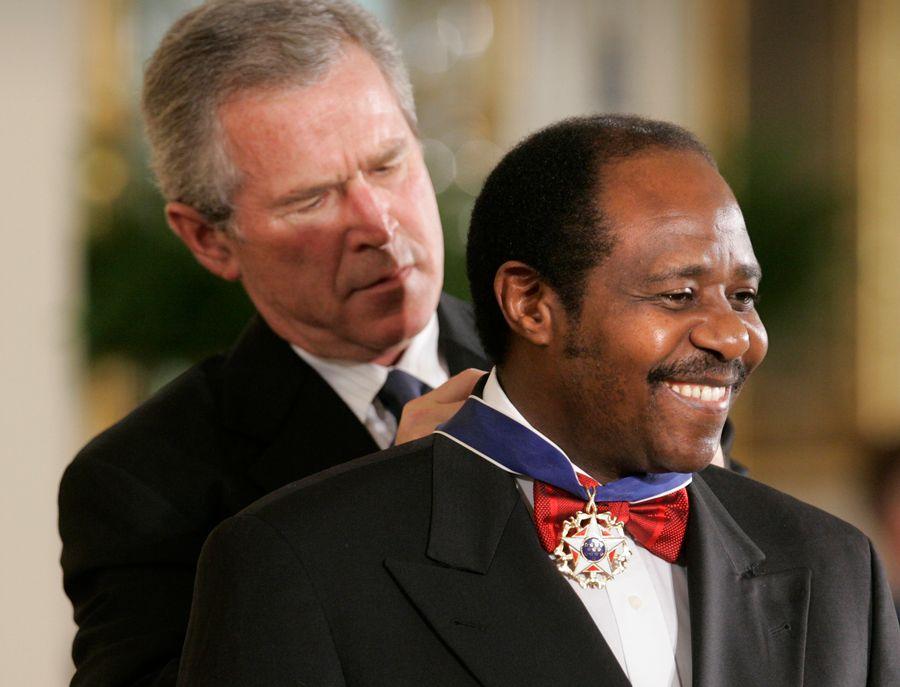
“We don't pull punches no matter where we are or with whom we're speaking,” a senior State Department official told RealClearPolitics when asked specifically about the decision to invite Rwanda. And despite the warm welcome that Kagame received, the United States previously rebuked his government for its treatment of political dissidents. In May, the State Department determined that Rusesabagina, a recipient of the Presidential Medal of Freedom, had been “wrongfully detained.”
Vacuums of Sovereignty
Afghan War Enters 12th Year
Mother Mourns 2,000th Death in Afghanistan
Tracking Uganda's Lords Resistance Army: The Regional Context
That designation was previously applied to Brittany Griner, the WNBA star recently freed from Russia. In both cases, the administration cited “the lack of a fair trial.”
During the 1994 Rwandan genocide, Rusesabagina hid more than a thousand Tutsi refugees from brutal Hutu militants, heroism that was later portrayed in the movie “Hotel Rwanda.” The 2004 film was nominated for an Oscar, and an audience with President George W. Bush followed for the celebrated hotelier, as well as a sit-down with Oprah Winfrey.
Rusesabagina was initially hailed as a hero in Rwanda, too, but that changed as he evolved over the years into a vocal critic of the Kagame regime. In August 2020, he boarded a chartered flight in Chicago that he’d been told was headed to Bujumbura, Burundi. It landed in Rwanda instead where Rusesabagina was turned over to authorities. “He delivered himself here,” Rwanda’s spy chief, Brig. Gen. Joseph Nzabamwita, told the New York Times reportedly with a smile. “Quite a wonderful operation.”
That wasn’t a universal reaction. Americans who followed the case consider the ruse essentially a state-sponsored kidnapping. Human Rights Watch called it a “forced disappearance.”
Whatever it’s called, Rusesabagina’s detainment was not enough to keep Rwanda from participation in the Africa Summit in Washington this week, a fact that did not escape the attention of Jeffery Smith, the founding director of Vanguard Africa, a nonprofit focused on free and fair elections and democracy in sub-Saharan Africa.
“If the Biden Administration is sincere about building on ‘shared values’ and advancing equitable relationships with African citizens,” Smith wrote in a recent Time Magazine op-ed, “then investments beyond retrograde strongmen like Paul Kagame would be an ideal place to start.”
Kagame doesn’t have the most austere resume when it comes to democracy. He has been accused of rigging elections in Rwanda, regularly receiving over 95% of the vote for the presidency. And in 2014, the Obama administration issued a harsh rebuke after one of the Rwandan president’s rivals was found dead in a South African hotel room.
Kagame denied ordering an assassination, though he told the Wall Street Journal he “wished” he had. The strongman added of his political rivals, “many of them tend to die.”
Human rights advocates fear that a similar fate may be in store for Rusesabagina. He was convicted last September on “terrorism” charges alleging that he wanted to overthrow the Rwandan government. At his trial, Rusesabagina admitted that he was involved in the Rwanda Movement for Democratic Change, but as Reuters reported at the time, he denied responsibility for attacks carried out by that movement’s armed wing, the National Liberation Front.
The judges ruled at the trial that the two groups were indistinguishable and sentenced the American resident to 25 years in prison. The move was met with international condemnation, including on Capitol Hill, where the House of Representatives passed a resolution calling for Rusesabagina’s immediate release.
The leader of that effort, Texas Rep. Joaquin Castro, wrote at the time that if Kagame and the Rwandan government wanted “to rebuild their credibility on the international stage, they must start by sending Mr. Rusesabagina back home to his family in San Antonio.”
A spokeswoman for Castro, however, declined to comment when RCP asked whether it was prudent to invite Kagame to the Africa Summit.
The controversy comes at a delicate diplomatic moment. The Biden administration is trying to rebuild African relationships after President Trump largely ignored the continent, dismissing sub-Saharan African nations as “sh*thole countries.” China, meanwhile, sees in Africa an opportunity to gain access to critical natural resources and expand its influence.
Jake Sullivan, Biden’s national security advisor, told RCP that the summit was not about “attempting to compare or contrast” Washington or Beijing’s actions in Africa. Instead, the gathering was meant to offer “a positive proposition about the United States’ partnership with Africa.”
But the Chinese haven’t been been coy about their ambitions, and have courted Rwanda aggressively as part of their “Belt and Road” initiative to project economic power across the globe. In November, Beijing forgave a $7.1 million debt for a Chinese-built road that runs through the northeast part of the country. The road runs parallel to the Rwandan capital where Rusesabagina is imprisoned.
But even as the United States looks to renew relations with Rwanda, Secretary of State Antony Blinken has not shied away from discussing the president’s checkered record on human rights. “Not only did the secretary raise this in private,“ a senior State official told RCP of Rusesabagina’s detainment, “but in some ways it may have seemed even more uncomfortable for him, when he when he raised it standing right next to the Rwandan foreign minister in a press conference.”
Unprompted during an August press conference, Blinken brought up the case of the detained American resident, reiterating that the United States believed he did not receive “a fair trial.” His Rwandan counterpart, foreign minister Vincent Biruta, stood awkwardly just feet away.
“We have been clear about our concerns related to Paul Rusesabagina’s trial and conviction, particularly the lack of fair trial guarantees. We continue to urge the government to address our concerns about the legal protections afforded to him in his case,” Blinken told reporters.
Biruta protested in that same press conference that “as far as the government of Rwanda is concerned, Paul Rusesabagina is a Rwandan citizen. And he was arrested. He was tried and convicted.”
That defiance was again on display in Washington this week at a news event hosted by Semafor on the sidelines of the U.S.-Africa summit. Asked about Blinken’s appeals on behalf of Rusesabagina, Kagame replied, “We’ve made it clear there isn’t anyone going to come from anywhere to bully us into something to do with our lives.”
“Maybe make an invasion and overrun the country,” the Rwandan president added. “You can do that.”

A RealClear Thanksgiving: Investing in a Better Future
David DesRosiers • RealClearPolitics
Trump’s Newsom Problem: Antagonist-in-Chief
Carolina Lumetta • RealClearPolitics
America’s Free Spirit
John Maxwell Hamilton • RealClearPolitics
The GOP Majority Should Go Out in Glory
Daniel McCarthy • RealClearPolitics
Republican Majorities Could Return Sooner Than Expected
J.T. Young • RealClearPolitics
The Danger Before the Attack
Leslie J. Sullivan • RealClearPolitics
RCP Today
Top stories on RealClearPolitics
The Takeaway
Polling intelligence and analysis delivered to your inbox
World News
Featuring the latest world news
Policy
Featuring the latest policy news
Support Our Mission
As part of RealClearPolitics, authors aim to provide balanced, non-partisan analysis by presenting top reporting and commentary from all sides of the political spectrum.
Trusted by policymakers and citizens alike since 2000