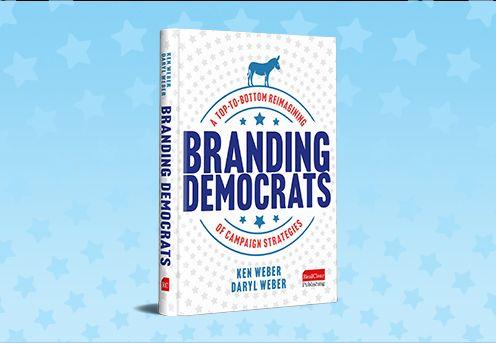
RealClear Publishing Preview: Branding Democrats
Published Aug. 19, 2022 • Read time: 6m
Branding Democrats: A Top-to-Bottom Reimagining of Campaign Strategies
(Following is an excerpt of RealClear Publishing’s upcoming book by Ken Weber and Daryl Weber, to be released September 13, 2022.)
The headline of the Los Angeles Times on July 7, 2021, was blunt: “Democrats brace for 2022 elections with ‘little margin for error.’”
The article begins ominously: “Democrats are at high risk of losing control of Congress next year, and the perilous outlook is shaping party strategy on every level, a modern illustration of the old saw: Nothing focuses the mind like the sight of the gallows.”
“Little margin for error” is starkly realistic for two reasons: First, during most midterm elections, the party in power loses congressional seats.
Second, the 2020 elections gave Democrats a razor-thin majority in the House of Representatives and a tie in the Senate, meaning, in reality, there is no room for error.
Then there’s this dark headline from Judd Legum’s Popular Information newsletter on July 15, 2021: “How corporations give Republicans a massive financial advantage in state politics.” That story begins:
Over the last decade, public corporations have given Republicans at the state level a financial advantage that exceeds $200 million, according to new research provided exclusively to Popular Information by the Center for Political Accountability.
Despite winning the House, Senate, and the White House in 2020, we on the left must face up to a sad fact: there’s very little good news for Democrats on the horizon. There is no question that the need for Democrats to do better is urgent—extremely urgent. Republicans have tacked sharply to the right. Many in top positions are aggressively pandering to the radical Right while compromising their ethics and values. And some of them are borderline crazy.
Sanders Seeks Caucus Trifecta Win to Close Delegate Gap
Sanders Fighting Perception He Can't Overcome Clinton Edge
Clinton Targets Trump as Sanders Circles
Sanders, Clinton Differ Sharply at Flint Debate
We can’t dawdle. America’s future depends on Democrats doing better in elections. After every election, pundits tell us why Democrats should have done better. They lay out their reasons, and most present smart, insightful examinations of what happened in this particular election. This is fine, but it misses the larger point.
Democrats fail to achieve widespread and sustained election success because they fail to exploit the tenets of long-term branding and smart marketing.
This book is a handbook—a field guide for every Democratic candidate and those who support them at every level, from the smallest local elections to national offices. The techniques are roughly the same for every candidate.
We all know that a huge percentage of Americans rarely, if ever, read a respected newspaper or watch network news shows. They don’t subscribe to quality news magazines or listen to news-related podcasts or radio. Worse, few, if they care about the news at all, get their information from accredited, reliable media sources. They have trouble naming even one of their senators, let alone their congressional representative. And they certainly cannot name the person who represents them on their city council or county board. So when they walk into a voting booth, they may have some idea of who’s at the top of the ticket. But as they go down the ballot, they are looking at names that might as well be in Serbo-Croatian.
That’s why long-term branding is vital. If you yourself are a Democratic politician, it’s reasonable to assume that you are fairly smart, articulate, and passionate about the important issues of the day.
But none of that means you have any experience with or insight into branding and marketing. You might say, “Hey, we have consultants who do all that.” To which we say yes, but if they had been better at their jobs there would be no need for us to write this book. Democrats would be winning more of the close elections.
This sad phenomenon is real. Here’s a story from the New York Times, published on February 21, 2021: “Democrats Beat Trump in 2020. Now They’re Asking: What Went Wrong?”
In the past, Democratic attempts at self-scrutiny have tended to yield somewhat mushy conclusions aimed at avoiding controversy across the party’s multifarious coalition.
Indeed. But smart branding sidesteps “mushy conclusions.” It can apply to every candidate and every campaign. Our goal here is nothing less than a major reset, a rejection of most traditional Democratic marketing strategies. We’re going to present you with new techniques for reframing old strategies.
Our target in the following pages is the 1% or 2%—the small slice of the electorate that frequently shifts elections from red to blue, or vice versa. And we want to motivate the “surge” voters, those who lean to the left but tend to wait for the “critical” presidential elections. We want them to vote in every election.
Plus, there is an even bigger opportunity for Democrats to reach the huge portion of the electorate that doesn’t vote at all. Gen Z especially is just starting to form political opinions, and they can become lifelong Democrats if we reach them with effective messaging.
And then there’s this often-overlooked fact: today’s 14-year-olds and 15-year-olds are only two election cycles away from getting a ballot! They are far more comfortable with LGBTQ, racial, and environmental issues than earlier generations. Importantly, they would seem to have a natural affinity for the Democratic brand. According to the Pew Research Center (“On the Cusp of Adulthood and Facing an Uncertain Future: What We Know About Gen Z So Far”):
“[A]mong Americans ages 13 and older (the survey was done in the fall of 2018) found that, similar to Millennials, Gen Zers are progressive and pro-government, most see the country’s growing racial and ethnic diversity as a good thing, and they’re less likely than older generations to see the United States as superior to other nations.” These young voters need to be brought into the fold as quickly as possible.
We must start “cultivating” everyone, and we need to do it now. If you are a seasoned political player, you might think you already know how to campaign and message. But as we point out again and again, past branding and marketing mistakes by Democrats at every level of politics have yielded less-than-ideal results.
This book is a compendium of needed actions. They have never been collected in one place before, and we are certain you have not previously seen many of these suggestions.
Democrats cannot and do not need to win over vast swaths of hardline conservative voters. Most Americans are immutable when it comes to party affiliation. But if the suggestions here can move that 1% or 2% toward our team, that might be enough to push an election—and the future of our country—in the right direction.
On July 25, 2021, Rahm Emanuel correctly pointed out on ABC’s This Week with George Stephanopoulos: “The election will be won in swing states by swing voters in swing districts.”
Let’s get those swing voters. We can—with smart branding and marketing techniques.
*****
In a recent interview, RCP Washington Bureau Chief Carl Cannon speaks with Ken and Daryl Weber about their new book.

A RealClear Thanksgiving: Investing in a Better Future
David DesRosiers • RealClearPolitics
Trump’s Newsom Problem: Antagonist-in-Chief
Carolina Lumetta • RealClearPolitics
America’s Free Spirit
John Maxwell Hamilton • RealClearPolitics
The GOP Majority Should Go Out in Glory
Daniel McCarthy • RealClearPolitics
Republican Majorities Could Return Sooner Than Expected
J.T. Young • RealClearPolitics
The Danger Before the Attack
Leslie J. Sullivan • RealClearPolitics
RCP Today
Top stories on RealClearPolitics
The Takeaway
Polling intelligence and analysis delivered to your inbox
World News
Featuring the latest world news
Policy
Featuring the latest policy news
Support Our Mission
As part of RealClearPolitics, authors aim to provide balanced, non-partisan analysis by presenting top reporting and commentary from all sides of the political spectrum.
Trusted by policymakers and citizens alike since 2000