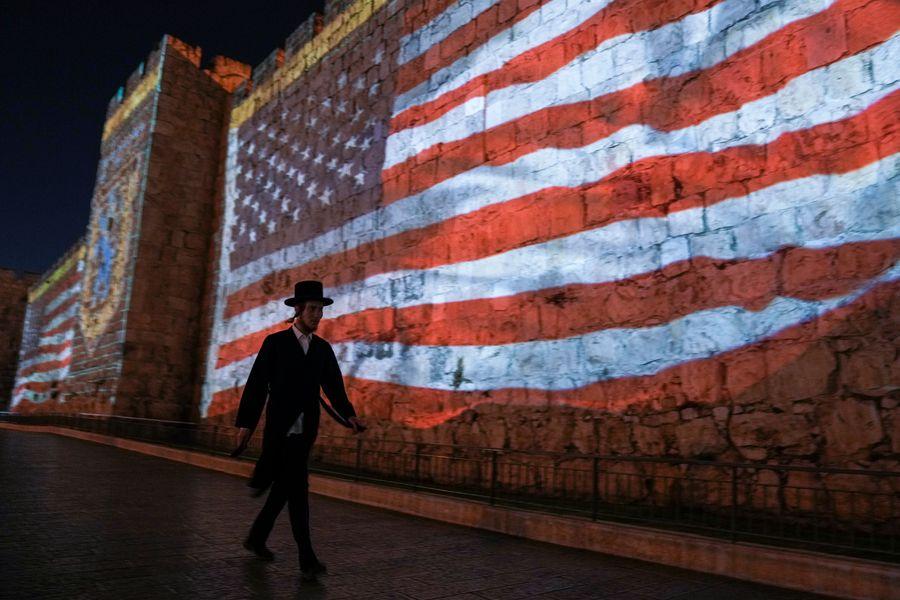
APTOPIX Biden US Mideast
The Conservative Puzzle in Israel
COMMENTARY
Published Aug. 7, 2022 • Read time: 8m
Join the Conversation
0Israelis on the right have discovered conservatism’s rich intellectual tradition. Of special interest to them, especially among the religious Zionists at the forefront of the expanding effort to develop a distinctively Israeli conservatism, is American conservatism’s relation to their fledgling movement. The transnational appeal of U.S.-style conservatism should be of special interest to Americans as well.
A few weeks ago, Ben Shapiro, the outspoken and acerbic American conservative commentator and Orthodox Jew, addressed an enthusiastic Tel Aviv crowd at a Conservative Political Action Conference. At the event, which CPAC convened as part of its ambition to develop ties with conservatives abroad, Shapiro told the thousands in attendance that Israel could count for reliable support in the U.S. on only the Orthodox among Jews and the Republicans among America’s two dominant political parties. Reporting on the event, Israel Hayom journalist Ariel Kahana cautioned against uncritical acceptance of Shapiro’s counsel. In the United States, he noted, many non-Orthodox Jews, independents, and Democrats also back Israel, and Republicans don’t always control the White House and Congress.
As they turn to American ideas and experience to refine their views, members of the Israeli conservative movement would do well to recognize not only the intricacies of U.S. politics but also the complexities of American conservatism.
These complexities spring from the blending of the several traditions that formed the United States. The numerous Protestant sects to which most Americans belonged in the Founding era tended to agree that toleration and separation of church and state reflect God’s will. The educated class in 18th-century America embraced the classical Roman ideal of a public-spirited citizenry that maintains freedom through the exercise of civic virtue. And most Americans at the time of the country’s founding took as axiomatic the view – elaborated by 17th-century British thinker John Locke and affirmed in 1776 by Thomas Jefferson in the Declaration of Independence – that human beings are by nature free and equal and that the principal purpose of government is to secure unalienable rights shared equally by all.
Is Trump Right About NATO?
Over Here: Competence Amid Repulsive Politics
We're Not a Poor Country, Donald
U.S. Officials Say 2 Americans Died in Brussels Attack
This founding inheritance reverberates throughout American history. It was instrumental in enabling the U.S. to overcome the evil of slavery; vindicate the fundamental rights of women and other classes of citizens who have been wrongly denied the equal protection of the laws; and build a prosperous, democratic superpower composed of citizens from every region of the world.
In a feature in last weekend’s supplement to the Hebrew-language daily newspaper Haaretz, “The Right Has an Opportunity to Formulate a Clear Agenda. It Should Take Advantage of It,” my friend Gadi Taub argued that Israeli conservatives must appreciate better not only the complexities of conservatism in America but also the complexities of the conservative challenge in Israel. He is suited to make the case.
A leading conservative voice in Israel, Taub holds a PhD in American history from Rutgers University and is a senior lecturer in the School of Public Policy and the Department of Communications at The Hebrew University of Jerusalem. He is also a Haaretz columnist and a podcast host. Polemical and scholarly; well versed in America and deeply rooted in Israel; a respecter of tradition and a lover of freedom; an accomplished and well-traveled intellectual and a defender of ordinary people, local communities, and national traditions; and a life-long Zionist who migrated from the left to the right – Taub is keenly attuned to the layers of paradox that mark the effort to transplant American conservatism in Israel.
In his lengthy essay, Taub emphasized that American conservatism itself is marked by “internal contradictions.” The most basic, he argues, is between America’s classical liberal heritage and the seminal critique of abstract rights and individual choice in the name of tradition, knowledge grounded in experience, and gradual reform championed by 18th-century British statesman Edmund Burke, the founding father of modern conservatism. But, Taub observed (citing the report of the U.S. State Department’s Commission on Unalienable Rights, for which I served as executive secretary), individual rights and limited government are woven into the very fabric of America’s traditions. Consequently, in the U.S., preserving freedom is essential to the conservative task.
Preserving freedom, however, can’t be the entirety of the conservative task, Taub hastened to add. That’s because freedom is neither self-sustaining nor the comprehensive good and the last word about justice. Freedom depends on citizens’ character. Moreover, while carving out room for individual choice, freedom does not determine which choices and attachments best promote flourishing lives.
Accordingly, conservatives also undertake to encourage the virtues on which freedom and flourishing depend and to counteract excesses to which the individualism that freedom fosters gives rise. Instead of turning to government to fortify freedom and mitigate its disadvantages, however, conservatives seek to safeguard other essential features of the American tradition that restrain wayward impulses, teach duties, and bolster community and political cohesiveness. Foremost among these for American conservatives are family, faith, and nation.
In clarifying their core principles, Taub advises, Israeli conservatives should neither get lost in the policy debates such as gun rights and abortion that currently preoccupy American conservatives, nor should they expect definitive answers to the controversies that roil Israeli politics. For the moment, they should focus on the larger question concerning the character of their movement: Is the American synthesis of Burke and Locke – the balancing of freedom and tradition – appropriate for an Israeli conservatism?
One obstacle, Taub observed, is the socialism bound up with Israel’s founding ethos and which exerted influence throughout the Israeli political spectrum. That cuts against the easy implantation into the Israeli body politic of an American conservatism for which free market principles are a central component.
Yet, Taub argues, a commitment to free-market ideas, spurred by four decades of government reform, has taken root in Israel. Today, free-market beliefs are found where one might expect – among wealthy, predominantly secular high-tech elites who are in large measure Ashkenazi Jews who immigrated to Israel from Europe. But capitalism has also been embraced by Mizrachi Jews of North African and Middle Eastern descent. Many are working class, vote for Likud Party leader and former Prime Minister Benjamin Netanyahu, and see themselves as scorned by Israel’s progressive elites.
Israel’s sizeable population of Mizrachi Jews, Taub argues, must form the backbone of any organic and viable conservative movement in Israel. Indeed, many among the Mizrachi community are known as “traditionalists” because of their propensity to cherish family, faith, and the nation. In contrast to progressive elites, who tend to believe that Zionism and religion are incompatible, Mizrachi traditionalists typically see a smooth fit between Jewish nationalism and Jewish faith.
Moreover, having suffered discrimination in the 1950s, 1960s, and 1970s at the hands of Israel’s then-semi-socialist establishment, Mizrachi Jews played a major role in the mid-70s in ending the control over government enjoyed by the Israeli left since the country’s 1948 founding. In 1977, large numbers of the Mizrachi community embraced Menachem Begin’s mix of classical liberalism and Zionism, which propelled the Likud Party leader to the prime ministership. That mix also served Netanyahu well.
Over the decades, the combination of nationalism and freedom, according to Taub, “not only promised, but operated to open paths to, mobility.” Since the mid-1990s, Israel’s GDP per capita has increased by more than 50% and the income gap between Ashkenazi and Mizrachi has steadily decreased. As a result, writes Taub, “Milton Friedman was integrated into the Likud, and the liberal-national synthesis was established as a fundamental principle among its traditionalist voters.”
To make good on their aspiration to develop a self-conscious Israeli conservatism, maintains Taub, religious Zionist intellectuals must grasp that the Mizrachi traditionalists represent the “wide and sturdy base of that which deserves to be called conservatism in Israel.” Beyond publications and conferences, according to Taub, it is vital for conservative intellectuals in Israel to form a coalition with the traditionalist voters who live their conservatism without need of lectures, seminars, and learned writings.
In this, Taub provides further confirmation of Burke’s pertinence to Israeli conservatism. Like his heirs in the post-World War II conservative movement in America, Burke defended the moral outlook and everyday ways of ordinary people from the pretensions of those keen to use government to dictate morals and manage citizens’ lives.
Taub also confirms the importance to Israeli conservatism of Locke and liberal democracy. Democracy, he stresses, enables the people to give political expression to their culture and national identity. Taub does not stress it, but individual freedom – basic civil and political liberties of the sort that flow from unalienable rights – is essential in a pluralistic democracy like Israel’s as well. By limiting state power, individual rights both safeguard minorities from oppressive expressions of majority will and protect the majority from managerial elites and judges and government bureaucrats determined on their own authority to override majority preferences and moral judgments to implement their class’s preferences and moral judgments. Individual rights and the respect for human dignity which they reflect, moreover, have strong roots in Zionism, as attested to by the abundant appeals to fundamental rights in Israel’s Declaration of Independence.
Well understood, carefully translated, and prudently applied, American conservatism’s synthesis of Burke and Locke is highly relevant to the cultivation of a distinctively Israeli conservatism.

A RealClear Thanksgiving: Investing in a Better Future
David DesRosiers • RealClearPolitics
Trump’s Newsom Problem: Antagonist-in-Chief
Carolina Lumetta • RealClearPolitics
America’s Free Spirit
John Maxwell Hamilton • RealClearPolitics
The GOP Majority Should Go Out in Glory
Daniel McCarthy • RealClearPolitics
Republican Majorities Could Return Sooner Than Expected
J.T. Young • RealClearPolitics
The Danger Before the Attack
Leslie J. Sullivan • RealClearPolitics
RCP Today
Top stories on RealClearPolitics
The Takeaway
Polling intelligence and analysis delivered to your inbox
World News
Featuring the latest world news
Policy
Featuring the latest policy news
Support Our Mission
As part of RealClearPolitics, authors aim to provide balanced, non-partisan analysis by presenting top reporting and commentary from all sides of the political spectrum.
Trusted by policymakers and citizens alike since 2000