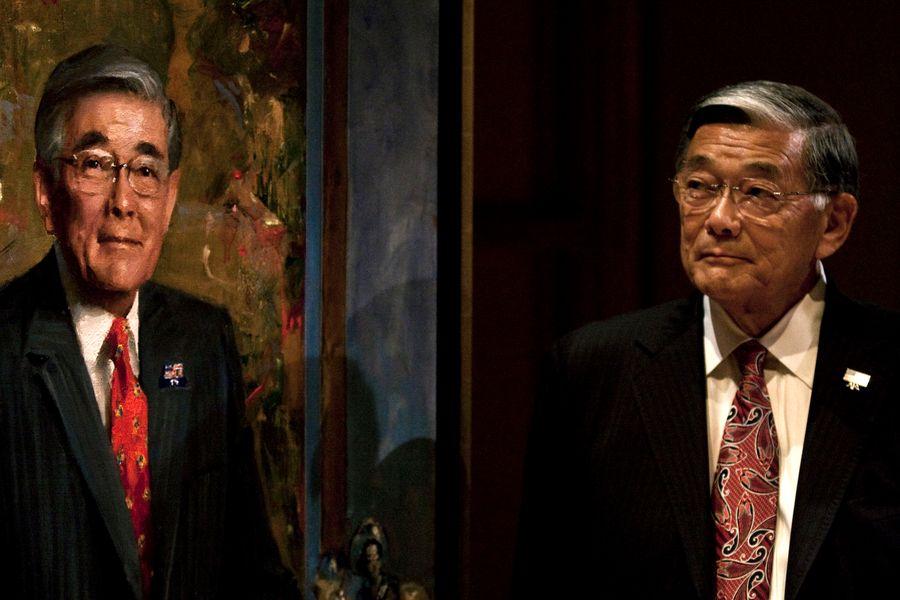
Obit Mineta
Norman Y. Mineta: An Appreciation
Published May 6, 2022 • Read time: 20m
Join the Conversation
0Eighty years ago this month, a 10-year-old American boy from San Jose, California, was loaded by armed U.S. Army soldiers onto a train heading to Los Angeles. With him were his four siblings, also American-born, and his immigrant parents, along with hundreds of other Americans of Japanese descent. They were headed to Santa Anita, the famous Southern California racetrack, where they would live in temporary barracks and shower near horse paddocks while the vast prison camps that could accommodate families were erected throughout the American West.
Holiday House/Ferguson
Six months after Japan’s sneak attack on Pearl Harbor, 120,000 men, women, and children were incarcerated without trial, most of them for the remainder of the war. It was done partly for their own safety, they were told, while the Roosevelt administration’s explanation to the newspapers and the U.S. Supreme Court was that these innocent people were a national security risk.
It was all a lie, as the government would later admit with an official apology and a $20,000 check. Redress came scandalously late – only half of those imprisoned during the war were still alive – and the sum paid was too little considering what they’d endured and the monetary losses they’d incurred. So, it wasn’t enough, which everyone knew. Yet it was also extraordinary. No other country had done anything like it after the horrors of World War II.
When President Reagan signed the redress bill, the Civil Liberties Act of 1988, he singled out that 10-year-old boy from San Jose who had worn his Cub Scout uniform on the train that took him away from everything he knew. His name was Norman Mineta. By then, he’d come a long way from Santa Anita and the Wyoming relocation camp. He had farther still to go.
After the war in the Pacific ended, Norm Mineta returned home and attended San Jose High School, went to college in Berkeley, joined the U.S. Army, and entered politics. In Congress, he was one of two members of California’s Democratic congressional delegation who’d been in the camps, and both worked hard at turning the concept of Japanese American reparations into law.
As a young regional reporter in Washington for the San Jose Mercury News, I covered the California congressional delegation and wrote extensively about that legislation. It’s how I first came to know Norman Yoshio Mineta, who died Tuesday at age 90 at his home in the Chesapeake Bay town of Edgewater, Maryland. And to know him was to appreciate his dedication to his job and his country. His life’s work served as a reminder that America’s extensive conversation about race and racial reckoning is neither new nor unsolvable. Norm Mineta was a guiding light.
Rethinking the Pledge; Trump and Women; One Last Egg Roll; Eulogizing Ike
2016: A Repeat of the 1960s
An Apology, Fashioned for Nancy Reagan
Nancy Reagan, Guardian of a Legacy
To a 10-year-old Cub Scout clutching his most prized possessions – a baseball glove, a ball, and a bat – boarding a freight train for an unknown destination initially seemed like an adventure. That feeling of anticipation was short-lived. Right there on the railway platform, the military police confiscated the bat. It might be used as a weapon, the MP explained.
“It’s okay,” Kunisaku “Kay” Mineta told his distraught son. “We’ll get another one.”
An American soldier guards a Japanese internment camp at Manzanar, Calif. in 1943.
AP Photo/File
That was on May 29, 1942. Six months earlier, on December 7, 1941, Norm Mineta had seen his father cry for the first time. “I can’t understand,” Kay Mineta told his family, “why the land of my birth attacked the land of my heart.’”
Now on the train heading south, he saw his father’s tears again. Kay Mineta’s heart would be stretched to the breaking point at Santa Anita and later at their Wyoming internment camp, a place with an ironic name: Heart Mountain.
After the war, the Minetas returned to their San Jose neighborhood, “J-Town,” as it was called. Not all the Issei (immigrants) or Nisei (the first generation born in the U.S.) were so fortunate, but the Minetas kept their home. At the time, California law prohibited Asian immigrants from owning property in the state, but a sympathetic white San Jose attorney named J.B. Peckham held the title to the property until Norm’s oldest sister, a U.S. citizen by birth, turned 21, when it was put in her name.
Kay Mineta slowly rebuilt his insurance business and resumed his place as a J-Town community leader. Norm went to high school, where he was student body president, and on to college, where he majored in political science. After graduation, he spent three years during the Korean War as a U.S. Army intelligence officer. Norm’s oldest sister would later tease her brother by pointing out that he was an ardent Republican in those days, but Norm made no apologies. (“It was the damn Democrats who stuck us in those damned camps,” he’d reply.)
But their wartime ordeal had convinced J-Town’s community leaders that they needed representation in government just as San Jose was beginning a slow transition from a nominally Republican city to a Democratic bastion. For Mineta, the commitment of California Democrats to civil rights was part of the equation, and some of it was happenstance. One of J-Town’s elders, Wayne Kamemoto, was appointed to a municipal judgeship by California Gov. Pat Brown, a Democrat. Three others formed a local Nisei Democratic Club, and one of them, I.K. Ishimatsu, recalled setting his sights on Norm. “I listened to him speak – good speaker – and I said, ‘This is the guy.’”
So Mineta became a Democrat. It was the GOP’s loss. After mustering out of the military, he worked briefly in the family insurance business, but when Kamemoto was appointed to the bench, he made sure that Mineta took his place on the San Jose Human Rights Commission. From that perch, Norm was appointed to a vacancy on the San Jose City Council, becoming its first non-white member. He kept ascending, never losing a campaign in his life. He was elected the first Asian-American mayor of a large U.S. city on the mainland. In 1974, he ran for an open congressional seat against a well-regarded Sacramento Republican legislator named George Milias and the race was close, with Norm winning 53% to 47%.
It was a good year to take the chance: Mineta rode a midterm election wave that sent more than 70 freshmen Democrats to Congress, many of them much younger than the Republicans they replaced. Mineta was one of these much-touted “Watergate babies,” so named because of their youth and the scandal that consumed Richard Nixon’s presidency.
U.S. Transportation Secretary Norm Mineta speaks during a news conference in Sacramento, Calif., on March 31, 2005.
AP Photo/Rich Pedroncelli, File
By the early 1980s, the California delegation was a stimulating collection of kooks, characters, patriots, political savants, sincere good-government types – and statesmen (and only a couple of stateswomen). Nominally, the “dean” of the delegation was Don Edwards, a gentlemanly liberal also from San Jose who was Mineta’s closest friend in Congress. But the nation’s largest congressional delegation was dominated by the towering presence and unrefined energy of another liberal, Rep. Phil Burton, who controlled San Francisco’s political machine as well as the Democrats’ gerrymandering apparatus. (I’m not objective about Phil Burton because he was a family friend, but it’s a matter of historical record that he was such a force of nature that after his death, his wife Sala inherited the San Francisco House seat – and that when Sala Burton became terminally ill four years later, she was able to steer the seat to a young San Francisco Democrat with no elective experience: a transplant from Baltimore named Nancy Pelosi.)
Other Democratic luminaries from Northern California included Phil Burton’s brother John and Barbara Boxer, a Brooklyn native who succeeded John ; George Miller Jr., a Burton ally; Leon Panetta from Monterey; Ron Dellums, Berkeley’s ultra-liberal black representative; Tom Lantos, a Holocaust survivor; and Sacramento Democrats – the much-loved Vic Fazio, and Bob Matsui, who also had been in the relocation camps as a baby. The Southern California contingent included progressive Edward Roybal, a co-founder of the Congressional Hispanic Caucus; early abortion rights advocate Anthony Beilenson; and a rival Los Angeles political machine led by Henry Waxman and Howard Berman. From the Central Valley came a fundraising dynamo named Tony Coelho.
In addition to the skillful and effective Sen. Pete Wilson, the GOP Republican side featured good-government House workhorses like David Dreier and Jerry Lewis and a share of entertaining personages. They ranged from the eccentric but principled conservative Robert Dornan (dubbed “B-1 Bob” by friends and foe); Dan Lungren; Barry Goldwater Jr.; and John Rousselot, a congenial right-winger from Pasadena who’d contracted polio as a youth and walked with a pronounced limp. Rep. Pete McCloskey, Rousselot’s friend since boyhood, and the most liberal Republican in Congress, represented the district that would become the heart of Silicon Valley. A U.S. Marine decorated for heroism in the Korean War, McCloskey had challenged Nixon in the 1972 GOP primaries, running as a peace candidate. McCloskey was succeeded in the House by a polymath named Ed Zschau, a former champion ice skater and Stanford PhD – and one of the brightest people I ever knew in or out of politics. How brainy was he? His senior thesis at Princeton was titled “Space Time and Geometry from Kant to Einstein.” You could look it up.
All of these members were doing interesting things on Capitol Hill, and most of them would return your phone calls. They weren’t shy about mixing it up with reporters, either. At a press conference, I once got in a shouting match with Lungren over offshore oil drilling (he did the yelling). All in all, it was a great time to cover Washington politics, especially if you were from California, as were President Reagan and many of his top aides.
Norm Mineta, second from left, joins President Bill Clinton at the signing of the Asian/Pacific American Heritage Awareness Proclamation, May 3, 1993.
AP Photo/Marcy Nighswander, File
As for Mineta, although stardom was predicted for him early on, there were bumps in the road. Norm got into a beef with Phil Burton that hadn’t resolved itself when Phil died suddenly in 1983. Mineta was passed by in the scramble up the leadership ladder by Tony Coelho, whose fundraising prowess gave him chits with his colleagues that trumped Mineta’s steady, old-school approach to legislating. In the end, Coelho turned out to be a hare to Mineta’s tortoise: Arriving in D.C. in 1979, Coelho resigned his seat a decade later to avoid an inquiry into his purchase of $100,000 in junk bonds.
Norm, by contrast, was such a square that during a visit to a casino in South Korea during a congressional trip, he was given some poker chips to use at the gambling tables. When it came time to leave, he turned them in – and didn’t keep his winnings. Good move. It turned out that the casino trip was underwritten by sketchy lobbyist Tongsun Park, whose largesse with lawmakers launched the “Korea-gate” scandal.
This casino story, which I didn’t know at the time, must have been on Norm’s mind one day when I gave him a present. As far as I know, it’s the only gift I ever bought for someone I covered, but it seemed the right thing to do. While browsing in an out-of-print bookstore in the Shenandoah Valley, I found a book of Ansel Adams photographs from the Japanese internment camp at Manzanar. I assumed that, as a first edition, it was worth much more than the $25 the shop was charging for it and tried to tell the clerk I thought it was mispriced. She shrugged and said, “Do you want to buy it or not?”
So I bought it and gave it to Norm, figuring he had more of a right to it than I did. His reaction was a surprise. Thinking, as I did, that it might be valuable (we were both mistaken) he hesitated at accepting it and barely thanked me. Only later was I told that he was wondering if under House ethics rules he was allowed to keep it. Something like that had already happened to him before.
In the early 1990s, a man with an impressive baseball memorabilia collection read about Mineta’s life and sent him a bat to replace the one the government had confiscated on the train platform in 1942. This one, though, was signed by Hank Aaron and Japanese home run king Sadaharu Oh. Mineta was delighted, but when my old newspaper wrote an item about it, the reporter noted that the bat was probably worth $1,500. Reading this, straight-arrow Norm figured he should return the bat because it exceeded the $250 value limit on gifts to members of Congress. To the Mercury News reporter who’d penned the item, Mineta sent a wry note. “The government’s taken my damn bat again.”
I don’t know what happened to the Ansel Adams book, but the baseball bat story eventually had a happy ending. When Norm finally retired from government service in 2006, the man with the memorabilia collection sent the bat back to him. He hung it on a wall in his home, a testament as I wrote at the time to perseverance and the idea that we can all hit home runs in life if we keep our eye on the ball and swing for the fences.
In a way, I had as convoluted a journey with Mineta as that baseball bat. Before leaving the San Jose Mercury News, I co-authored an article for the paper’s Sunday magazine that Mineta and his allies, including my friend Les Francis, who occasionally writes for RCP, considered overly harsh. I came to think they were right. The piece delved too deeply into Mineta’s then-strained relations with his two sons, much of it having to do with his recent divorce. Our story also suggested that Mineta’s caution had precluded him from reaching his potential – that he would never be House speaker, for example, or a U.S. Senator.
President Bush bestows the Presidential Medal of Freedom to Norman Y. Mineta on Dec. 15, 2006.
AP Photo/Pablo Martinez Monsivais, File
Well, he was never speaker and didn’t even run for Senate, but in no conceivable way was Norm Mineta a failure. By the time he retired, it was obvious that he’d had a remarkable career, one characterized by diligent work in the trenches, chairmanship of a powerful congressional committee, and several crowning legislative successes. He was awarded the Presidential Medal of Freedom from George W. Bush and served in the cabinet of both a Democratic and a Republican president. How many politicians can say that?
Today, flying into the Silicon Valley, you land at Norman Y. Mineta San Jose International Airport. If you study transportation, you might attend events at the Mineta Transportation Institute at San Jose State University. Those are tributes to a public servant who carved out a niche in Congress on transportation issues and who served as Transportation secretary. But his most valuable legacy today may be the example he set while fashioning significant – and bipartisan – legislation on everything from civil rights to U.S. transportation policy, which became a special area of expertise. “There is no such thing as a Democratic highway or a Republican bridge,” he liked to say.
It is a measure of Norm’s effectiveness that the most important laws he was instrumental in enacting were signed into law by Republican presidents. One of them was the Intermodal Surface Transportation Efficiency Act of 1991, the most sweeping update to transportation policy since the Eisenhower administration. Another was the post 9/11 Aviation and Transportation Security Act, which he helped draft from a perch in the executive branch – the law that brought TSA into existence in a matter of weeks.
Mineta also partnered with Coelho on the Americans with Disability Act, signed by President George H.W. Bush. Norm, who wrote the transportation part of the legislation, dated his interest in that issue back to his first San Jose mayoral campaign.
“I had a friend working on my campaign named Bill Poole, who’d been in a wheelchair all his life,” Mineta told me several years ago. “One day he asked me whether I would consider spending my first week as mayor in a wheelchair. After I won the election, I did that. I put a wheelchair in my trunk each morning, and quickly realized how difficult things were for Bill and people with disabilities. I couldn't get up the stairs to City Hall. I couldn’t go to the bathroom. I couldn’t get a drink from the public fountain. As a result, we were one of the first cities to have curb cuts – in 1971.”
His proudest achievement, of course, was HR 44, the Civil Liberties Act of 1988, which finally corrected the record on internment and recompensed the Japanese Americans who were ripped from their homes amid the xenophobic wartime hysteria of 1942. What is ripping this country apart 80 years later is a political hyper-partisanship that had led to government gridlock, widespread intolerance, and the casual demonization of those with whom we disagree politically. Here, too, Norm Mineta lit a better path.
Mineta briefs the press at the site of a deadly 2005 train versus vehicle collision.
AP Photo/Reed Saxon, File
After leaving Congress, Norm was briefly secretary of the Department of Commerce in the waning days of Bill Clinton’s presidency. He served in George W. Bush’s cabinet, too – the only Democrat to do so – and not as a figurehead. In the crucible of 9/11, Mineta was the decisive secretary of transportation who grounded every U.S.-based passenger plane in the world.
By the time he worked in the Bush administration, I’d apologized privately to Norm for the 1989 story, and I wrote a public mea culpa in April 2006 that mutual friends told me meant a lot to him. This must have been true because three months later, when he finally retired from government service at nearly 75 years of age, Norm sent word that he wanted to do an exit interview with me. Since my days as a regional reporter, I had gone on and done other things, too: covering the White House for 15 years, writing books, leaving newspapers for magazines. Yet, in our 2006 interview, I was struck by how similarly he and I had come to view what was ailing Washington. Asked what single thing he’d like to change about how politics was practiced in this country, he replied, “To try and restore some civility back into the political quotient.”
“I’m not sure what it would take,” he added. “But what's happening is a shame because there's a growing cynicism in the political process that's been leading to lower participation in terms of voting and volunteer activities. This sentiment is echoed by many people of both parties, including my great philosopher friend Alan Simpson, who has been espousing this since he left Congress in 1997.”
For those who knew Mineta’s story, invoking Simpson, an avuncular Republican and former senator from Wyoming, was hardly a surprise. These very different men were buddies who had formed an unlikely bond at Heart Mountain. By 2006, I’d heard the story many times, and written it myself, but on that day, Mineta laughed aloud as he recalled their first meeting:
“I met him in 1943 at the Heart Mountain relocation center in Wyoming – we were Boy Scouts, but on different sides of the barbed wire,” Norm said. “Our camp elders had written to the Boy Scouts of America headquarters in New York to come into the camps to organize Boy Scout troops at Heart Mountain… [The locals] thought, ‘Wait a minute, they are POWs; we are not going in there.’ But cooler heads prevailed. They pointed out that these are Boy Scouts of America. They read the same manuals, wear the same uniforms, pursue the same merit badges. Finally, a Boy Scout troop from Cody came in.
“So there we were, carving, knot-tying, starting fires without matches, doing what scouts do, and we were paired off into tents. I'm paired off with this boy named Alan from Wyoming, and while we were building a moat around our tent the way you're supposed to do in case it rains, he says to me, ‘There’s a kid in that tent downhill from me, and I don't care for him. Do you mind if we dig our moat for the water to go that way – so it drains into his tent?’ So we did it. As luck would have it, it started raining. Our moat worked perfectly, both protecting our tent and draining all the water into theirs, practically washing it away. So that night Alan is sitting in our tent laughing. He couldn't stop laughing. Finally, I said, ‘Alan, would you please shut up so we can get some sleep?’ That boy was Alan Simpson. He was as funny and ornery – and as loyal a friend – as he is today.”
Norm Mineta listens to questions during a news conference at O'Hare International Airport on Nov. 21, 2005.
AP Photo/Nam Y. Huh, File
Still, working with friends across the aisle on Capitol Hill is different than serving in an administration of the rival political party, so I asked Norm if he ever felt “home alone” in the Bush administration. “No, not really,” he replied. “Having a ‘D’ or an ‘R’ after your name didn't really matter, but I was chided more for being a Californian in a sea of Texans.”
He was half-kidding. The truth is that by then George W. Bush had come to see Mineta as a living exemplar of the better angels of our nature and was grateful for his presence in the adminstration. After the 9/11 attacks, Bush invited the joint leadership of both houses of Congress to a White House cabinet meeting. Rep. David Bonior, a progressive Michigan Democrat, spoke up. “Mr. President, we have a large Arab American population in Michigan and they are very concerned about what will happen to them.”
“There was already a lot of invective about Arabs,” Mineta recalled, “and the president listened to Bonior and said, ‘David, you are absolutely right – we are concerned about what’s being said and we've got to remember what happened to Norm in World War II. We’re not going to let anything like that happen again!”
Bush was good to his word, making a visit to Washington’s Islamic Center six days after the 9/11 attacks and repeatedly making similar assurances to leading Muslims throughout the coming months and years.
Did the man famous for bestowing nicknames have one for Mineta? Yes, he told me. “Footsteps.” Although this was uncharacteristically cryptic for Bush, what the 43rd U.S. president was apparently getting at with that moniker was the idea that more people should follow Mineta’s example. But those are not easy footprints to duplicate.
Norman Mineta waits to enter a Mass of Christian Burial for former Rep. Jim Oberstar in Potomac, Md., on May 8, 2014.
AP Photo/Cliff Owen
In the end, retirement seemed to agree with Norm. He settled outside Annapolis with Deni, a second marriage for both and by all accounts a happy one. The two boys wounded by his 1980s divorce reconciled long ago with their father, who was also close to his two stepsons. In an interview with Los Angeles Japanese Daily News reporter Gwen Muranaka, Mineta revealed theories of grandparenting that mirror my own.
“Deni had two sons and I had two sons,” he told her. “We have four sons and 11 grandchildren. So we bring all the kids together without their parents for a week. So I ask, ‘Do you want pizza or ice cream at midnight?’ Then the parents come in for four or five days and they all go home. Afterwards my son said, ‘We’re still trying to undo all the damage you guys did.’ I said, ‘That’s our job, spoil the grandchildren.’”
Norman Mineta will be missed by those kids. He’ll be missed by many of us. Rest in peace, Norm. You earned it.

A RealClear Thanksgiving: Investing in a Better Future
David DesRosiers • RealClearPolitics
Trump’s Newsom Problem: Antagonist-in-Chief
Carolina Lumetta • RealClearPolitics
America’s Free Spirit
John Maxwell Hamilton • RealClearPolitics
The GOP Majority Should Go Out in Glory
Daniel McCarthy • RealClearPolitics
Republican Majorities Could Return Sooner Than Expected
J.T. Young • RealClearPolitics
The Danger Before the Attack
Leslie J. Sullivan • RealClearPolitics
RCP Today
Top stories on RealClearPolitics
The Takeaway
Polling intelligence and analysis delivered to your inbox
World News
Featuring the latest world news
Policy
Featuring the latest policy news
Support Our Mission
As part of RealClearPolitics, authors aim to provide balanced, non-partisan analysis by presenting top reporting and commentary from all sides of the political spectrum.
Trusted by policymakers and citizens alike since 2000