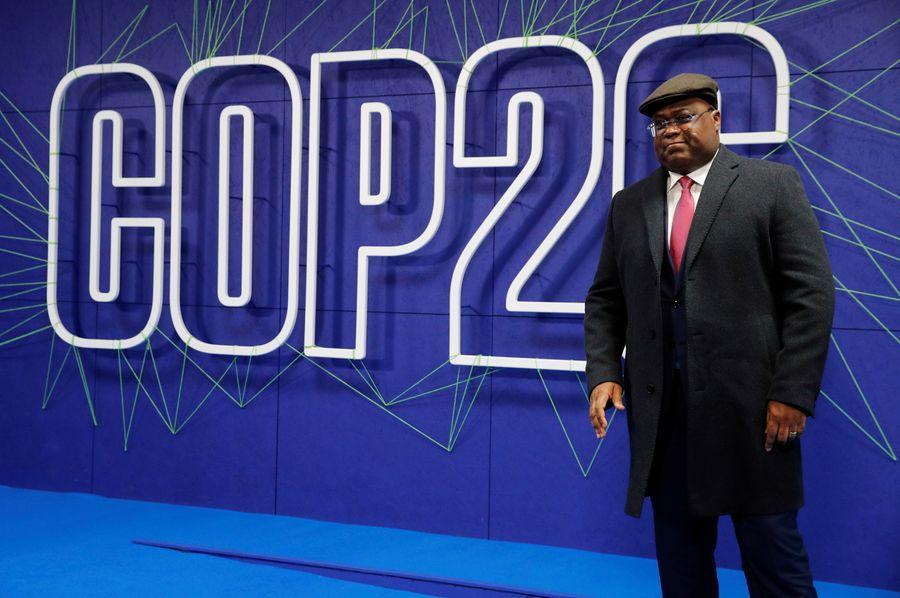
Climate COP26 Summit
The DRC: Driving Africa's Potential
COMMENTARY
Published April 23, 2022 • Read time: 4m
At the heart of the African continent is a country as big as all of Western Europe – the Democratic Republic of Congo. Stretching from the South Atlantic across the belt of Africa, the DRC is rich in natural resources, including diamonds, copper, iron ore and coal.
The DRC is also home to the world’s second-largest tropical rainforest, which makes it a haven for biodiversity. But more than that: it is also a massive carbon sink, meaning that it absorbs more carbon than it emits. So critical is the DRC’s rainforest to offsetting climate change, researchers have called it “the first lung of the planet.”
The DRC’s position as a frontline warrior in the fight against global warming is just one illustration of the country’s exciting development and economic potential. That is the potential I saw when I arrived in the country from Lebanon, with little more than pocket change and the dream to start a business.
Today, nearly four decades later, I consider the DRC my second homeland. The small company I started – Socimex SARL, a food staples business -- has grown to become Socimex Group, with interests in engineering and construction, electrification, green energy, food importation, logistics, car dealership and vegetable palm oil refining.
I believe the DRC has the same growth potential trajectory. This is increasingly being recognized by others. The DRC joined the seven-nation East Africa Community (EAC) in March of this year. DRC President Felix Tshishekedi envisions the creation a new organ within the EAC that will focus solely on mining, natural resources and energy and that will be located in Kinshasa, the DRC’s capital. President Tshishekedi attended President Joseph Biden’s 2021 Summit for Democracy, a recognition of the DRC’s commitment to good governance.
Vacuums of Sovereignty
Afghan War Enters 12th Year
Mother Mourns 2,000th Death in Afghanistan
Tracking Uganda's Lords Resistance Army: The Regional Context
Ideally located in central sub-Saharan Africa, the DRC is the crossroads of the continent, and a hub of pan-African trade. It is a young and rejuvenating population – 66 percent of the population is under 30 years old.
Aside from its favorable location and demographics, the DRC has a superpower that could benefit much of Africa: hydroelectric power generation. The DRC generates nearly 100 percent of the power it consumes domestically, thanks to the massive Inga I and Inga II dams on the Congo River.
The government is planning an Inga III dam as the next step toward what it is calling “Grand Inga,” an eight-dam project that could eventually supply most of the power needs for the entire African continent.
With the widespread electrification of the DRC, other industries are primed to grow, including agro-business, information technology and health. And of course, thanks to its lush forests and eye-popping scenery, the DRC’s tourism industry should rival that of any on the continent.
All of this and more can be achieved with positive action from the public and private sectors.
Foreign investment is key. I believe that the DRC should undertake tax reforms to make the country more attractive to foreign businesses and competitive in intra-African and global trade.
We must ramp up our education system by going beyond the classic academic realm, through vocational training to equip the thousands of skilled workers and technicians that will be required to carry out the next step in the DRC’s evolution.
The DRC also must begin the process of becoming a self-sustaining food environment, replacing imported food with locally grown food. This could be accomplished by requiring food importers to build local food production capacity as a condition of increasing food imports.
We must improve the DRC’s infrastructure to better connect the country’s production with its consumption; in other words, better connect producers with consumers. This is no easy task in a country the size of the DRC, but infrastructure improvement is a prerequisite for development.
Though we have challenges in the DRC, I have seen great progress and promise in my four decades in this remarkable country. I believe the next four decades could bring even more.
Ibrahim Issaoui is the founder and CEO of Socimex Group, which operates food importation, vegetable palm oil refining, logistics, Construction and engineering services, and other businesses in the Democratic Republic of Congo.

A RealClear Thanksgiving: Investing in a Better Future
David DesRosiers • RealClearPolitics
Trump’s Newsom Problem: Antagonist-in-Chief
Carolina Lumetta • RealClearPolitics
America’s Free Spirit
John Maxwell Hamilton • RealClearPolitics
The GOP Majority Should Go Out in Glory
Daniel McCarthy • RealClearPolitics
Republican Majorities Could Return Sooner Than Expected
J.T. Young • RealClearPolitics
The Danger Before the Attack
Leslie J. Sullivan • RealClearPolitics
RCP Today
Top stories on RealClearPolitics
The Takeaway
Polling intelligence and analysis delivered to your inbox
World News
Featuring the latest world news
Policy
Featuring the latest policy news
Support Our Mission
As part of RealClearPolitics, authors aim to provide balanced, non-partisan analysis by presenting top reporting and commentary from all sides of the political spectrum.
Trusted by policymakers and citizens alike since 2000