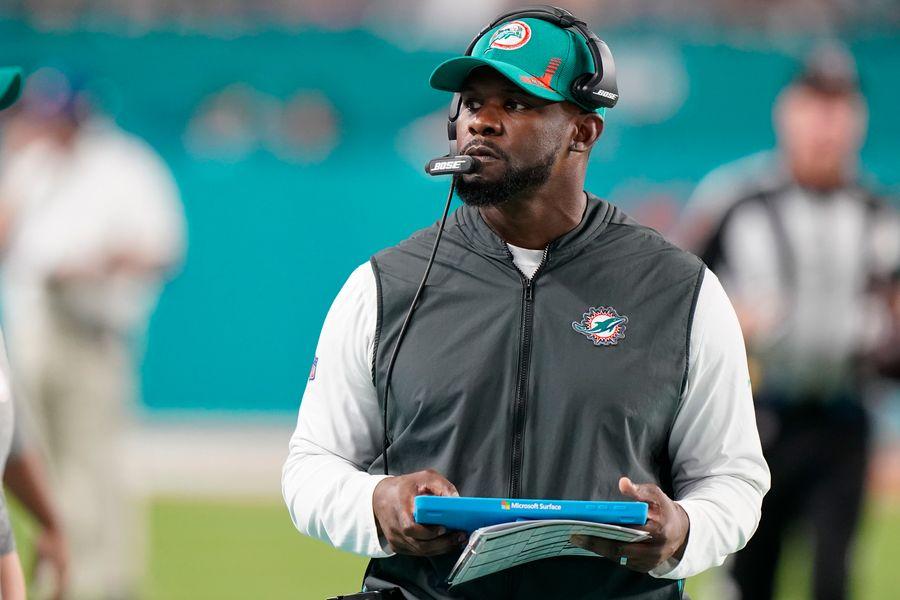
Patriots Dolphins Football
Flores Lawsuit Next Step Toward NFL Diversity
COMMENTARY
Published Feb. 24, 2022 • Read time: 7m
The lawsuit filed by former Miami Dolphins head coach Brian Flores against the National Football League and three of its teams, the Miami Dolphins, the New York Giants, and the Denver Broncos, did not go away when Flores was hired as the defensive coordinator by the Pittsburgh Steelers. Although all the executives named in the lawsuit have denied the accusations made in the 58-page document, the issues in this litigation will not be solved with press releases.
Several of the events that Coach Flores describes in his suit will come down to one man’s word against another’s. The defendants are already denying that many of these events transpired the way Brian described them, and even if they did, they will claim they don’t provide proof of racial discrimination. No one called Brian a racial slur and no one told him he wasn’t getting the job because he is Black.
Even as I talked to friends in the coaching business over the last week, several white coaches shared their own stories of attending “sham” interviews when a job was already going to someone else. So how is what Brian Flores experienced different than what they went through?
There is an answer, one that might surprise many whites, which extends far beyond the NFL. “Systemic” racism has become a buzzword in U.S. politics, with fault lines that are increasingly partisan. But the phenomenon is real in the NFL, and if it can exist in an industry as intensely in the spotlight as pro sports, it can exist anywhere.
Systemic racism describes systems and structures that have procedures and processes that disadvantage specific racial groups. Racism does not require the donning of hoods or the burning of crosses to have a dehumanizing effect. This is what Brian Flores is trying to show America.
The Empty Promises of Trump and Sanders
Good News for Discouraged Workers
A Vote for Trump Is a Vote Against American Consumers
First Lady Honors Pioneering Female Air Force Officer
When Brian learned that the New York Giants had already decided to hire a white head coach by the time they interviewed him, Flores described his interview process with the Giants as humiliating. Can there be any other word for it? And in this case it was also cynical. Under the so-called “Rooney Rule,” named after enlightened former Steelers’ owner Dan Rooney, NFL franchises are required to interview at least one minority candidate for every head coaching vacancy. The process isn’t supposed to be a sham, it’s supposed to be real. Brian’s lawsuit says the Giants were interviewing only to comply with the letter of the Rooney Rule, not the spirit. So, here’s systemic racism, 21st century-style: pretending to embrace diversity while adhering to cronyism, which almost by definition has a racial component.
Systemic racism does not require that someone do overtly racist things for a process to have a disproportionately negative effect on one part of the population. The fact that there was only one Black head coach in a league where 70% of the players are Black is prima facie evidence of racism. Since Brian was fired by Miami owner Stephen Ross after two winning seasons – and since Brian filed his lawsuit – a second Black head coach, Lovie Smith, has been hired. A third, Dolphins new coach Mike McDaniel, is mixed race. That is hardly progress: In 2003, when the owners candidly admitted the problem with their hiring practices by instituting the “Rooney Rule” there were three Black head coaches in the league – more than today.
The Rooney Rule is clearly not enough. The NFL admitted as much after the 2012 regular season when no minority candidates were chosen to fill any of the eight head coaching vacancies. At the time, league human resources director Robert Gulliver said, “While there has been full compliance with the interview requirements of the Rooney Rule and we wish the new head coaches and general managers much success, the hiring results this year have been unexpected and reflect a disappointing lack of diversity.”
In the nearly two decades since the rule was put in place, only 15 head coaching positions have gone to Black coaches, out of roughly 129 openings. As recently as 2020, the NFL amended the interview requirements to include two minority candidates for head coaching positions and one minority candidate for offensive and defensive coordinator positions.
But this well-intentioned tweak shows how subtle – and pernicious – systemic racism can be. The rule does not adequately address two of the biggest obstacles to the hiring of Black football coaches in the NFL. Let’s set aside outright racial prejudice for the moment, although it does still exist. I was sitting on a team van one day when one of my fellow Black assistant coaches was sitting in the front seat. A white senior executive approached him and said, “Back when I was coming up you wouldn’t have been sitting in the front seat.”
Perhaps he was just kidding around. Maybe he was trying to make a point about racial progress in this country. What I feel for sure is that it was insensitive and made me wonder whether this guy ever saw me and my colleagues as anything other than Black coaches.
But back to how systemic racism sets up perhaps unforeseen obstacles for Black coaches. The hot trend in the NFL is for owners to hire offensive coordinators as head coaches. This makes sense in a passing league. But those offensive coordinators usually have on their resumes a stint as a quarterback position coach. In that job, they tutor the teams’ most precious asset, the starting QB. In this year’s hiring cycle, six of the seven new coaches hired so far were offensive coordinators. NFL owners have a bias towards hiring head coaches who were offensive coordinators and there aren’t enough Black coaches in those roles. During the 2021 NFL season there were only four Black offensive coordinators in the league. Two of them, Eric Bieniemy in Kansas City and Eric Studesville in Miami, rose through the ranks as running back coaches. Both men are highly qualified veteran NFL assistant coaches, but they both lack the coveted title of quarterback coaches on their resume.
The second obstacle is the way coaches get into the pipeline. Tony Dungy, a Black coach with a Super Bowl win to his credit, built a staff in Tampa Bay and later in Indianapolis by hiring the best coaches he could find. Coach Dungy did not know Mike Tomlin before he hired him; he went looking for a talented young secondary coach and found Tomlin coaching defensive backs at the University of Cincinnati. That’s not the way most hiring is done in the NFL. I was personally fired from one team by a head coach who wanted to hire his best friend. I had another friend tell me this weekend he had just been fired for the same reason. Cronyism is a normal human impulse. But if we don’t guard against it, it’s also a convenient excuse for delaying diversity.
I applaud Brian Flores for standing up and calling out what he sees as the injustice suffered by Black coaches in the NFL. Solving the problem he has bravely identified will not be easy – and Brian Flores can’t do it alone. Black coaches can’t do it alone either. They need their white colleagues and the NFL owners, all of whom are white, to rethink a hiring system that is crippled with inherent biases. In the 1980s, Black quarterbacks were novelties. Now they aren’t. Think how much better the NFL game is now that the most important position on the field is available to anyone who can play it. Likewise, we will not see football at its best until Black coaches and executives are provided equal opportunities to advance.

A RealClear Thanksgiving: Investing in a Better Future
David DesRosiers • RealClearPolitics
Trump’s Newsom Problem: Antagonist-in-Chief
Carolina Lumetta • RealClearPolitics
America’s Free Spirit
John Maxwell Hamilton • RealClearPolitics
The GOP Majority Should Go Out in Glory
Daniel McCarthy • RealClearPolitics
Republican Majorities Could Return Sooner Than Expected
J.T. Young • RealClearPolitics
The Danger Before the Attack
Leslie J. Sullivan • RealClearPolitics
RCP Today
Top stories on RealClearPolitics
The Takeaway
Polling intelligence and analysis delivered to your inbox
World News
Featuring the latest world news
Policy
Featuring the latest policy news
Support Our Mission
As part of RealClearPolitics, authors aim to provide balanced, non-partisan analysis by presenting top reporting and commentary from all sides of the political spectrum.
Trusted by policymakers and citizens alike since 2000