Congress Voting Bills
Why is Censure Trending?
COMMENTARY
Published Feb. 7, 2022 • Read time: 6m
Remember back in 2016, when it was considered unseemly for party apparatchiks to interfere in party primaries? Fans of politicians as disparate as Donald Trump and Bernie Sanders certainly thought so. Trump threatened to withhold support for the Republican presidential nominee, if it wasn’t him, because, he explained, “I've been treated very unfairly … by, basically, the RNC [Republican National Committee], the Republican party, the establishment.” Sanders and his progressive supporters repeatedly accused the Democratic National Committee of putting its thumb on the scale in favor of his opponent Hillary Clinton.
Times have changed. On Friday, the now Trump-aligned RNC voted to censure and “cease any and all support” to two Republican members of Congress, Reps. Liz Cheney and Adam Kinzinger. Both have been outspoken Trump critics and are serving on the House committee investigating the January 6 insurrection. (Kinzinger is retiring from Congress, but Cheney is facing a stiff primary challenge from Harriet Hageman, a seasoned Wyoming pol.)
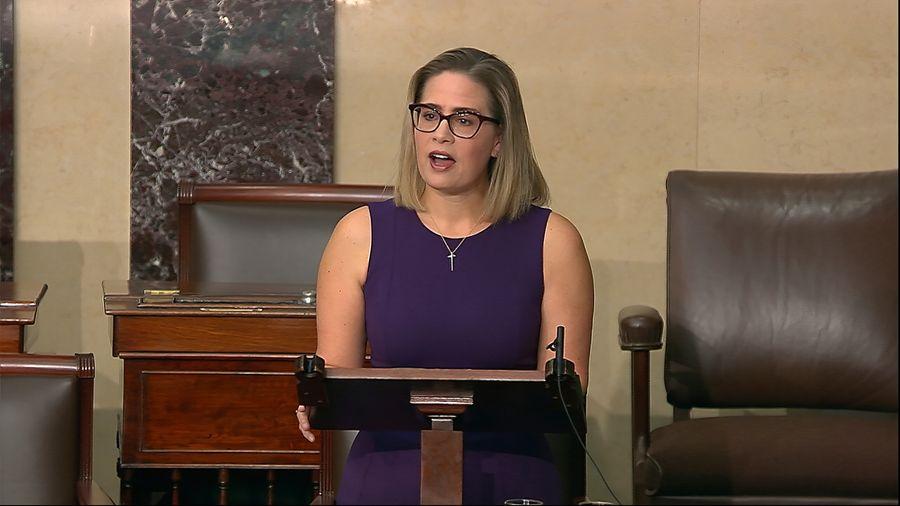
Two weeks prior, the Arizona Democratic Party (ADP) voted to censure Sen. Kyrsten Sinema because she refused to suspend the filibuster rule and ease passage of the Democrats’ voting rights bills. While censure is a symbolic gesture, a previous Arizona Democratic Party resolution said any such censure of Sinema would come "with the clear understanding she could potentially lose the support of the ADP in 2024." While 2024 is a ways off, Rep. Ruben Gallego has been teasing a primary challenge.
Cruz's Path to Nomination
Trump Stands by His Manager
With Tweets on Heidi Cruz, Trump Sinks to New Depths
A Vote for Kasich Is a Vote for Trump
These moves have not been condemned by the 2016 critics of the RNC and DNC – far from it. Trump praised the RNC censure, and is backing Harriet Hageman. Sanders, a democratic socialist who caucuses with the Senate Democrats, praised the ADP censure, and when asked if he would support a primary challenger running against Sinema, he responded, “Well yeah.”
To state the obvious, there is no moral equivalence between the actions of the RNC and the ADP. The Republican censure statement chastised Cheney and Kinzinger for investigating a grievous attack on our democracy. The ADP censure statement chastised Sinema for not doing enough to protect voting rights and strengthen our democracy.
However, there is political equivalence. Both censure statements are attempts by party organs to purge elected incumbents – already chosen by voters to serve – for the sin of voting their principles.
Purging ranks in the name of ideological purity is rarely a wise move. To win the presidency, the House and the Senate require a broad voting coalition. Trump spent his entire presidency proving the point. After four years of lashing out against anyone and everyone who didn’t offer blind loyalty, he lost Republican control of all three entities. The RNC remains so tethered to the chronically unpopular Trump that it risks blowing the 2022 midterms. As one brave RNC member told Politico, “We’ve got Biden in free fall, [Democrats] can’t get anything done in Washington, and for us to convene a circular firing squad, that make no sense to me.”
It’s an exaggeration to say Democrats can’t get anything done in Washington. They did just work with Republicans to pass a major infrastructure bill. And the person who led the effort was Kyrsten Sinema.
Yet instead of being celebrated by her state party committee members, they are trying to turn her into a pariah. “[W]e appreciate Senator Sinema’s leadership in passing the American Rescue Plan and the Bipartisan Infrastructure Law,” the state party chair said, but “the ramifications of failing to pass federal legislation that protects their right to vote are too large and far-reaching.”
Is that even true? Democrats have argued that Republican measures to curtail early voting and mail voting will suppress the vote in Democratic-leaning areas. But political science professor Alan Abramowitz recently analyzed 2020 vote patterns and found that “whether a state had restrictive or generous absentee voting procedures, conducted early in-person voting, allowed voters to use drop boxes, or required photo identification to vote had no effect on Biden’s margin.”
Democrats have also warned that Republican gerrymandering taking place this year will make it impossible for Democrats to have a fair shot at keeping the House, and in turn, included a ban on partisan gerrymandering in their voting rights package. But the Cook Political Report currently estimates that Democrats will gain a couple of districts from this year’s round of redistricting. (I’ve previously written that both parties’ narratives about various voting rights proposals are at odds with the facts.)
There are still legitimate, non-partisan reasons to support many of the Democrats’ proposals. But Sinema has legitimate reasons to believe democracy won’t be well-served if they become law on a narrow party-line vote by exploiting a loophole in the Senate rules to suspend the filibuster.
Political polarization is a major factor underpinning Trump’s attempts to bulldoze our democratic institutions. Sinema’s belief is that by keeping the filibuster, we can pass more bipartisan legislation like her infrastructure bill and depolarize our politics.
Arizona Democrats make clear in their precursor resolution, passed in October, that they more than just disagree with Sinema’s view. They blasted her for “doubling down on her factually contrary ‘we need bipartisanship’ argument for keeping the filibuster.” Yet soon after their resolution, Sinema’s infrastructure bill made it to Biden’s desk on a bipartisan vote, and for a brief moment, it seemed like Washington was working again. Only when the Democrats failed to pass their Build Back Better and voting rights bills on party-line votes did Washington appear to devolve into a dysfunctional state.
It may well end up the case that Sinema has angered too many Democrats to survive a 2024 primary. But should Arizona Democratic Party officials be trying so hard to make it so, without having any idea if a challenger would have a better shot of keeping the seat, in what is still a closely divided state?
Parties should have principles, and party officials have the right to set ideological parameters and determine who deserves public support. But because party officials aren’t popularly elected to their posts, they should exercise extreme caution with issuing litmus tests and enforcing them with censure. You don’t become party chair by winning over swing voters, but candidates don’t win elections on a national scale – or in closely divided states – without them.

A RealClear Thanksgiving: Investing in a Better Future
David DesRosiers • RealClearPolitics
Trump’s Newsom Problem: Antagonist-in-Chief
Carolina Lumetta • RealClearPolitics
America’s Free Spirit
John Maxwell Hamilton • RealClearPolitics
The GOP Majority Should Go Out in Glory
Daniel McCarthy • RealClearPolitics
Republican Majorities Could Return Sooner Than Expected
J.T. Young • RealClearPolitics
The Danger Before the Attack
Leslie J. Sullivan • RealClearPolitics
RCP Today
Top stories on RealClearPolitics
The Takeaway
Polling intelligence and analysis delivered to your inbox
World News
Featuring the latest world news
Policy
Featuring the latest policy news
Support Our Mission
As part of RealClearPolitics, authors aim to provide balanced, non-partisan analysis by presenting top reporting and commentary from all sides of the political spectrum.
Trusted by policymakers and citizens alike since 2000