Supreme Court-Abortion-Justices' Own Words
Will Trump-Appointed Justices Betray Their Stare Decisis Vow?
COMMENTARY
Published Dec. 1, 2021 • Read time: 5m
Former President Trump pledged only to appoint justices who would “automatically” overrule the Supreme Court’s 1973 landmark decision in Roe v. Wade, which recognized the right to abortion as a fundamental liberty protected by the Constitution. Today, we got an early indication of whether Trump was successful in that strategy, when the court heard arguments on a Mississippi law that prohibits abortions after 15 weeks. That law was passed in open defiance of the court’s 1992 ruling in Planned Parenthood v. Casey that women have “the right” “to choose to have an abortion before viability,” which is approximately 23 or 24 weeks. Mississippi argues the court should overrule Roe and Casey. How concerned should we be that this will happen?
If the court follows the Constitution and its own numerous precedents and ignores the reason why Trump nominated several of the justices, this should be an easy case — one that strikes down the Mississippi law and sends a firm message to other anti-abortion states to stop restricting access.
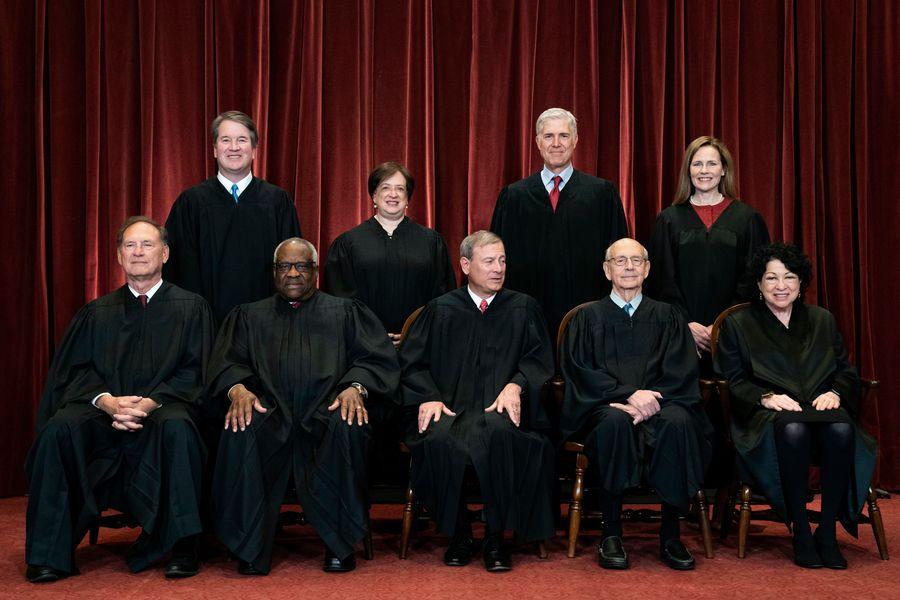
The words and sworn testimony of the justices themselves suggest Trump’s anti-abortion strategy will not succeed. Three years ago, Justice Brett Kavanaugh’s assurance to Sen. Susan Collins that Roe is “settled law” won her support before the Senate Judiciary Committee voted 11-10 to advance his nomination to the full Senate. Without that assurance, he would not be sitting on the court today. His commitment echoed Chief Justice John Roberts’ acknowledgement at his confirmation hearings that Roe is “settled as a precedent of the court, entitled to respect under principles of stare decisis.” Justice Neil Gorsuch gave very similar testimony.
He's Mean, But Is He at Least Bright?
Supreme Hypocrisy
It's Time to End ALL Lame-Duck Sessions
The Court Fight Is About Democracy
Justice Samuel Alito was asked how he would weigh stare decisis, which literally means to stand by things decided, “on the woman’s right to choose.” He testified it “is a fundamental part of our legal system” that “limits the power of the judiciary … protects reliance interests” and “reflects the view that courts should respect the judgments and the wisdom that are embodied in prior judicial decisions.”
Furthermore, Alito noted that “when a decision is challenged and it is reaffirmed” — and he told Sen. Dianne Feinstein he could not think of “any case that had been more tested than Roe” — “that strengthens its value as stare decisis.”
Justice Amy Coney Barrett too committed to “obey all the rules of stare decisis” — the principle “that cases that have been decided by the court … [are] presumptively controlling.” She explained that stare decisis means “don’t disturb the calm. … Courts don’t recklessly get in the business of just stirring up, disrupting people’s lives.” Barrett agreed with Justice Elena Kagan that only a “special justification,” and not merely the view of a majority of the justices that a case was wrongly decided, would warrant overruling a precedent of the court.
The Supreme Court has already rejected the argument that there is a “special justification” that warrants overruling Roe. Justices Sandra Day O’Connor, Anthony Kennedy and David Souter, appointees of Presidents Ronald Reagan and George H.W. Bush, explained in a rare joint opinion in Casey that when the court “resolve[s] the sort of intensely divisive controversy reflected in Roe … its decision has a dimension that the resolution of the normal case does not carry. It is the dimension present whenever the [c]ourt's interpretation of the Constitution calls the contending sides of a national controversy to end their national division by accepting a common mandate rooted in the Constitution.” These justices concluded that overruling Roe would cause “profound and unnecessary damage to the court’s legitimacy, and to the nation’s commitment to the rule of law. It is therefore imperative to adhere to the essence of Roe’s original decision.” That conclusion is even more compelling now, almost 30 years after Casey.
It is inconceivable that the experienced jurists on the court, including Trump’s nominees, did not already have firm views concerning Roe when they testified it is settled law. The court said in Casey it has addressed such an “intensely divisive controversy” as abortion “only twice in our lifetime.” (Their other example was desegregation.) If any of these justices intended to reverse Roe, they would surely have said so at their confirmation hearings, right?
Breyer, Alito and Barrett have all reassured us the court decides cases based on law, not politics, and “is not comprised of a bunch of partisan hacks.” Alito explained in his confirmation testimony that in the 78th Federalist Paper, when Alexander Hamilton was responding to the people who thought the judiciary was being given too much power, he specifically cited the fact that they “would be bound up by precedent and this would … keep them from injecting their own views into the decision making process.” Roberts testified, “There is nothing in my personal views that would prevent me from fully and faithfully applying the precedent as well as Casey.” Alito “emphatically agree[d] … [t]hat’s the essence of what a judge has to do.” So why is there so much fear that the court will now overrule Roe and Casey?
That concern must be unfounded.

Newsom Defies Voters, Juries and Lawmakers To Spare Murderers While Defending Abortion
Curtis Hill • RealClearPolitics
The Algorithmic Tilt
Frank Filingeri • RealClearPolitics
A RealClear Thanksgiving: Investing in a Better Future
David DesRosiers • RealClearPolitics
Trump’s Newsom Problem: Antagonist-in-Chief
Carolina Lumetta • RealClearPolitics
America’s Free Spirit
John Maxwell Hamilton • RealClearPolitics
The GOP Majority Should Go Out in Glory
Daniel McCarthy • RealClearPolitics
RCP Today
Top stories on RealClearPolitics
The Takeaway
Polling intelligence and analysis delivered to your inbox
World News
Featuring the latest world news
Policy
Featuring the latest policy news
Support Our Mission
As part of RealClearPolitics, authors aim to provide balanced, non-partisan analysis by presenting top reporting and commentary from all sides of the political spectrum.
Trusted by policymakers and citizens alike since 2000