Virus Outbreak Arkansas
Hutchinson Threads the Needle on Masks, Vaccines and Liberty
Published Aug. 24, 2021 • Read time: 10m
He certainly sounds like a Southern politician. All contractions and dropped G’s, the Ozark dialect of Asa Hutchinson is low, measured and, above all else, polite. But lately there is an unmistakable tension in the voice of this Republican governor who owes his first government job to Ronald Reagan, who made him a U.S. attorney decades ago. He is beloved in the Biden White House, at least when it comes to COVID-19.
Hutchinson is one of the “good” Republicans—there being just two kinds in the eyes of the current president. Joe Biden made that dichotomy clear earlier this month when he denounced state executives who have banned mask and vaccine mandates in local businesses and schools: “I say to these governors: Please help. But if you aren’t going to help, at least get out of the way.”
While Biden has embraced this fight with GOP governors (most notably Ron DeSantis of Florida) while ordering the Department of Education to “assess all available tools” to bend local schools to federal public health guidance, his administration has held up Hutchinson as a model of cooperation.
Education Secretary Miguel Cardona applauded him from the White House podium for being “malleable to address the increase in spread” of the coronavirus. Moments later, in the same briefing, presidential press secretary Jen Psaki praised the Arkansas governor for “doing exactly the right thing.” Biden even expressed his thanks personally, phoning Hutchinson from the Oval Office to commend his efforts.
All this praise came after a public mea culpa on masks. Hutchinson had signed legislation banning local mask mandates. Then, he changed his mind. “I realized that law was an impediment to protecting our children, and that's why I gave an honest answer,” he tells RealClearPolitics in an interview. “I guess,” he pauses, “it surprises some people in politics.”
Kids' Lives Matter Too
In a Corner of Ohio, Lessons of 2016
2016 Presidential Election Could Decide State Legislative Races
McCaskill Says No to Run for Missouri Governor
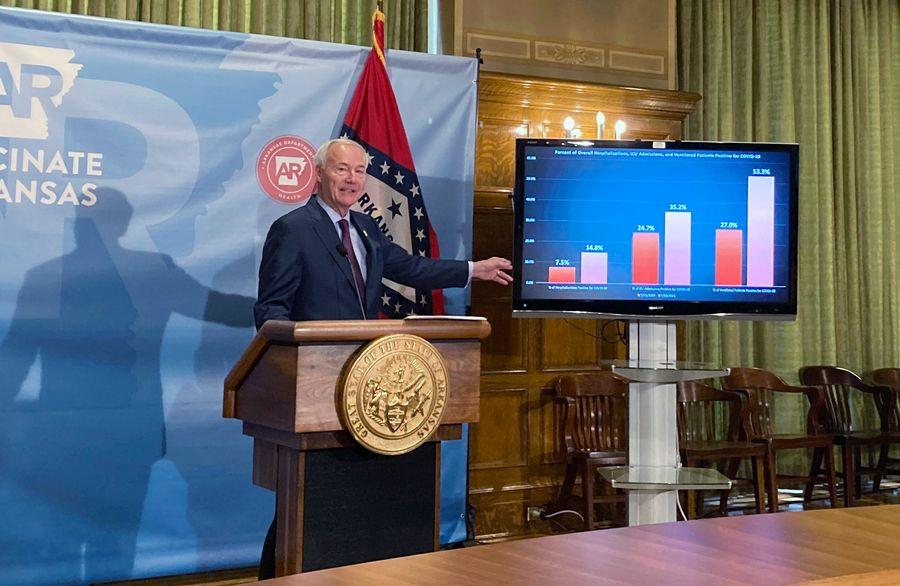
Hutchinson is surprisingly frank. He signed the law in April because his assessment of the science led him to believe “we were out of the woods.” And there was the political science: “I also signed it because, in Arkansas, you can override the governor's veto by simple majority vote.” While the numbers in the state legislature haven’t changed, the number of coronavirus cases has. The delta variant is burning its way through Arkansas, and hospitals are flooded with cases right as the school year is about to start.
“The key fact here was that I wanted to push the vaccinations as the way out of this, and yet there is a population 12-and-under in the schools that could not be vaccinated,” the governor says, understandably griping about how the Food and Drug Administration is taking its sweet, bureaucratic time in authorizing shots for kids. “And so, if we're going back to school, what are we doing to protect them?” At least for Hutchinson, that meant lobbying against the very bill he signed into law.
Three months after the ink dried, he told CBS’ John Dickerson, “It was an error.” Then, when he spoke with RCP five days later, at a time when his state had just a dozen ICU beds open, Hutchinson reiterated how he regretted signing that bill “because it unduly restricted local school districts.” Don’t call it a flip-flop, though. Hutchinson is just doing what he thinks his old boss would. “I like Reagan,” he says. “I'm pragmatic and practical about how we can best get back to normal life.”
Biden World sees a rare partner in Asa Hutchinson, and while he says the call from the president came “out of the blue,” Jeffrey Zients dials the governor almost daily. The head of the White House COVID task force told RCP that Hutchinson “has been a strong leader and effective partner” and Zients would like others to follow his example. “We need all leaders to put politics aside and focus on the American people,” he added, “as Gov. Hutchinson has.”
Like every conservative, Hutchinson knows by heart the nine most terrifying words in the English language. He understands he is supposed to recoil when he hears someone say, “I'm from the government, and I'm here to help.” Yet, he doesn’t shy away when administration officials come calling. He shares many of their conclusions on masking and vaccines too. The difference? Hutchinson works the problem from the opposite angle, seeking to limit, not grow, the role of government. It is consistent with conservative orthodoxy, he insists, if not neatly axiomatic.
For a politician, Hutchinson is pretty soft-spoken. He’s more likely to reach for historical examples rather than talking points when working his way through an answer. After four decades in government, the governor has plenty of material.
It was George W. Bush who made him the first undersecretary for border and transportation security at the Department of Homeland Security. Hutchinson soon found himself in the middle of a philosophical debate about the government’s role in collecting personal data. The dilemma back then seemed straightforward, Hutchinson recalls: “How can we prevent the next terrorist attack and balance all of that with civil liberties?” Sometimes the feds get it right. They also get it wrong. “You go back to World War II and the internment of Japanese American citizens,” he says, building toward an answer about governance in a national emergency. “And in hindsight that didn’t look too good.” While the circumstances change, whether it is a world war or a global pandemic, the thought process does not. “In every national emergency,” he explains, “there's always a tension between individual liberties and public safety.”
“It is the tension that we have always experienced, and it is true in the debate today over how do we manage this deadly virus,” Hutchinson continues. “And it is always a balance, but here there is a responsibility of each individual citizen to protect the community as well as their own individual rights.” The tension in Hutchinson’s voice breaks when he leans into the overall answer. The way to put lockdowns and mandates of all kinds behind us, he says, is simple: “The vaccination helps us to achieve the maximum of individual freedoms, and we can have normalcy in life.”
Hutchinson has been taking that conservative pitch for vaccines on the road, hosting COVID town halls throughout his state. It hasn’t always gone smoothly. One man at an event in Siloam Springs asked Hutchinson, “What's in the vaccine? Give me the insert sheet.” The components of all three of the shots, the Moderna, the Pfizer and the Johnson and Johnson inoculations, are all already public.
“If Mr. Doctor gives me a vial and says, 'Trust me,’” another man at the same town hall shouted, this time at the physician Hutchinson had brought along to provide medical testimony, “I'll give you a vial and you trust me."
None of this really surprises the governor. He has felt plenty of pushback from his constituents on both masks in schools and getting shots in arms. By the time Hutchinson talks to RCP, he sounds downright stoic about the ideological reality of the issue. “Arkansas is a conservative state,” he says, “and skepticism about government is part of our DNA.”
This is true, and even Donald Trump found it difficult to navigate that reality among the MAGA crowd. “I believe totally in your freedoms. I do. You’ve got to do what you have to do,” the former president told supporters at an Alabama rally last weekend. He added, “but, I recommend take the vaccines. It’s good. I did it. Take the vaccines.” Even some of the MAGA faithful booed.
Confronting the carnage brought by the virus may be changing public opinion in ways that public service pronouncements from celebrities and politicians did not. Vaccination rates have increased nationwide alongside the delta variant, a trend mirrored in Arkansas. The state ranks fourth in the country for new cases per capita, according to Johns Hopkins University research data. And while just 39% of adults in Arkansas have gotten both doses of the vaccine, the governor is optimistic that those numbers will rise.
The pandemic has forced all sorts of civics class questions onto the state’s chief executive, and Hutchinson says he is sorting through each looking to limit, not expand, the role of the government.
Public vaccine mandates? Arkansas doesn’t have them, and he says that his role isn’t enforcing mandates, but in educating the residents of his state. What about private sector mandates? Earlier this month, the state legislature took a look at blocking employee-backed vaccine requirements. Here again, Hutchinson works his way through the conflict between a pandemic exhaustion and principle. Workers have their “individual liberties,” he says, and at the same time “business owners can make decisions about their own workplace.” In short, and on most questions, Hutchinson's preference is to leave the individual free to choose. Of course, there are limits.
“Government is not giving children 12-and-under the option not to be educated,” he says with a laugh, noting how the same government that hasn’t cleared the shot for children still requires them to go to school. “Are we gonna do away with that government mandate? No.” Hence the need, at least in his judgment—and according to the latest Centers for Disease Control guidance— for masks in schools.
Threading the COVID needle makes Hutchinson somewhat unique on the national stage. He is term-limited, and he will move out of the governor’s mansion as a successor (presumably former Trump White House press secretary Sarah Sanders) moves in. Hutchinson has already promised publicly not to back her old boss if he tries to regain the presidency in 2024. He has set up his own leadership PAC to play a hand, and possibly forge key partnerships, during the midterms. Some now wonder whether he harbors White House ambitions of his own.
Could a mild-mannered Republican survive a rough-and-tumble GOP primary, though? It would mean a return to the milder mainstream variety of Republicanism, a realignment that one prominent Southern pollster sees as a possibility. “There will always be a constituency for effective governance in the face of disaster,” says Whit Ayres. “Addressing a pandemic effectively is not, at its core, a partisan exercise.”
Ayers, whose firm did work for Hutchinson before he was governor, adds, “It's more a matter of good judgment and effective communication about the strategies that will address a crisis.” Then he paused before saying, “I certainly hope there's always a constituency for that kind of governing.”
Hutchinson knows that most of the headlines he earns these days are about his cooperation with Biden. He is fine with that. “I mean, this is an area that Democrats and Republicans can work together very well,” he says of the pandemic fight. But does he think his kind of conservatism still resonates with the modern GOP? He notes that he was reelected with 65% of the vote. “At least in my election,” he notes, “people have responded to my style of leadership and my conservative values.” And his values are very different than the current president’s. The two couldn’t be more different.
Hutchinson is pro-gun. He is pro-life. He says Biden has “created inflation that hurts Americans” with his spending policies and “created a humane crisis along the border” with his immigration policies. He also takes issue with Biden’s handling of the pandemic, specifically some of the president’s scheduling decisions. Chairman of the National Governors Association, Hutchinson say that “a number” of his colleagues are frustrated that Biden and Vice President Kamala Harris broke with the previous administration’s tradition of joining their weekly COVID conference calls. All the same, he admits, the “fact is, there's some things this president has done well. And there's many things that I totally disagree with him on.”
Of course, this kind of rhetoric doesn’t lend itself to snappy one-liners or the kind of political dunks currently in vogue on the right. Maybe Hutchinson doesn’t either. He knows it is unusual for a disciple of Reagan to partner with a president calling for big government beyond the pandemic. “But that's the tension that we have today,” he says. “We've got to sort through it.”

Newsom Defies Voters, Juries and Lawmakers To Spare Murderers While Defending Abortion
Curtis Hill • RealClearPolitics
The Algorithmic Tilt
Frank Filingeri • RealClearPolitics
A RealClear Thanksgiving: Investing in a Better Future
David DesRosiers • RealClearPolitics
Trump’s Newsom Problem: Antagonist-in-Chief
Carolina Lumetta • RealClearPolitics
America’s Free Spirit
John Maxwell Hamilton • RealClearPolitics
The GOP Majority Should Go Out in Glory
Daniel McCarthy • RealClearPolitics
RCP Today
Top stories on RealClearPolitics
The Takeaway
Polling intelligence and analysis delivered to your inbox
World News
Featuring the latest world news
Policy
Featuring the latest policy news
Support Our Mission
As part of RealClearPolitics, authors aim to provide balanced, non-partisan analysis by presenting top reporting and commentary from all sides of the political spectrum.
Trusted by policymakers and citizens alike since 2000