Coast Guard Academy Biden
Biden's Icebreaker Remark Reveals Cracks in Arctic Strategy
Published May 20, 2021 • Read time: 6m
The ice recedes, and the competition for control of the Arctic quickens.
Russia sailed its navy to the region last summer to carry out its largest war-game exercises ever, while a hungry China has made its Arctic aims known, arguing that despite its mainland lying thousands of miles away, climate change legitimizes its vaunted “Polar Silk Road” initiative. Perhaps more than ever before, then, the region has become a geopolitical convergence point where a nation’s ambitions can rise and fall, quite literally, on the reinforced-steel bow of a boat.
Enter the icebreaker, the instrument of Arctic dominance needed to carve sailing lanes through the frozen sea. Russia has more than 50 such vessels, some nuclear-powered and many reportedly armed. The United States has two. Only one can still sail.
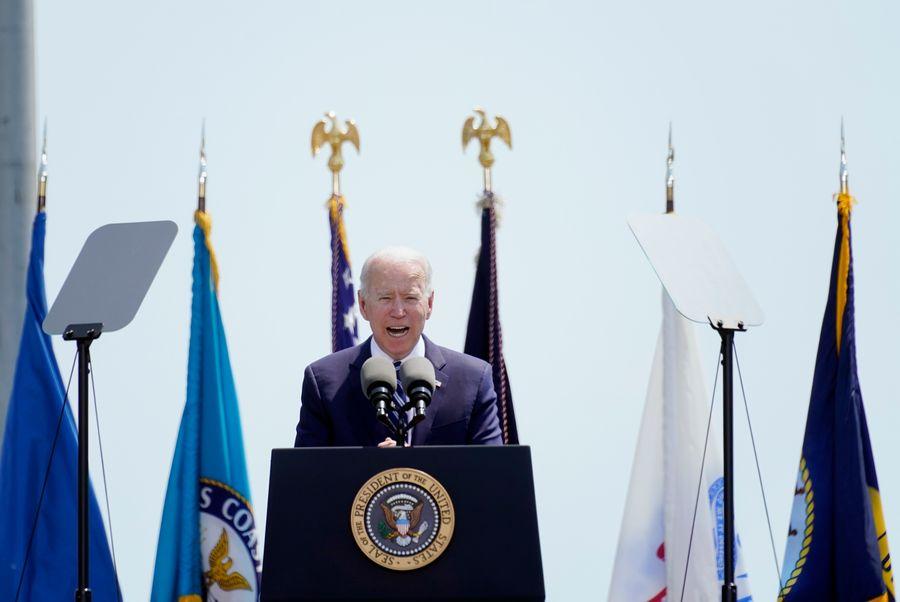
At the U.S. Coast Guard Academy on Wednesday, President Biden addressed the importance of the frigid zone where these ships are most needed. “In the Arctic,” he told graduating cadets, “the Coast Guard is the prow of American presence in the region, rapidly growing in strategic importance as ice recedes and new sea lanes open.”
He also referenced the all-important vessels: “We need modern ice breakers, yes, but just as critically, we need to stand shoulder to shoulder with those allies and partners who share our values, including indigenous communities who are the keepers of traditional knowledge about the Arctic waters.”
Calling Russian and Chinese aggression in the waters lapping at his state “the most significant national security threat our nation has faced in years,” Alaska Gov. Mike Dunleavy told RealClearPolitics he was “relieved President Biden is finally recognizing this danger,” but he insisted, “What we need now is action.”
Is Trump Right About NATO?
Over Here: Competence Amid Repulsive Politics
We're Not a Poor Country, Donald
U.S. Officials Say 2 Americans Died in Brussels Attack
Republican Sen. Marco Rubio, a vocal China hawk, was also glad to hear Biden talk about the need for new ships, but told RCP that the stated equivalence between maritime infrastructure and indigenous partnerships was evidence the president “is more interested in woke virtue signaling and happy diplomatic rhetoric than doing what it takes to defend America’s interests.”
The president’s comments left Sen. Dan Sullivan somewhat confused. “I didn't fully understand it,” the Alaska Republican and perennial advocate of an increased Arctic fleet told RCP. “To be honest, the Alaska Native people want icebreakers as much, if not more, than anyone else in our state and our country.
“Remember, there's a huge amount of increased vessel traffic in the Bering Strait because of the receding sea ice, so I will tell you, whether you're native, non-native, indigenous or not, in Alaska the issue of rapidly moving forward with icebreakers is about as widely shared an issue as I can imagine,” Sullivan added.
The White House declined to elaborate when asked about Biden’s plans to add to the tiny Coast Guard fleet of icebreakers. Sullivan said he was certain the administration understood the need, volunteering that some officials are even open to leasing vessels from allied nations. But something has to be done or the U.S. risks losing out to geopolitical opponents.
“Icebreakers, in many ways, are the roads of the Arctic,” Sullivan explained. “The Russians have superhighways right now. We have dirt roads — with potholes.”
The U.S. icebreakers are operated by the Coast Guard, hence Biden’s reference to them at the academy. The first is the USS Polar Star. Commissioned during the Ford administration, it has 75,000-horsepower engines and can split ice 21 feet thick. The second is the much smaller but newer USS Healy. Commissioned in 1999, it later became the first surface vessel to reach the North Pole unaccompanied. But a fire in its engine bay has left the ship inoperable since last August.
The Biden administration inherited this problem. Congress authorized additions to the fleet in December, and the first new icebreaker is expected to put to sea in 2025. “Between now and then we're just kind of keeping our fingers crossed and hoping for the best that we don't have some kind of malfunction on either of our two icebreakers,” Rockford Weitz, director of the Fletcher Maritime Studies Program at Tufts University, told RCP.
This comes as Russia and China are rushing to exploit the region. The U.S. Geological Survey estimates that about 30% of the world’s undiscovered natural gas and 13% of undiscovered oil may be in the Arctic. Amid that kind of scramble, Weitz added that “keeping your fingers crossed doesn't seem like a sound geopolitical strategy to me.”
It isn’t just about resources either, added Nick Solheim, founder of The Wallace Institute for Arctic Security, which worked closely with the previous administration to develop a strategy for the area. He pointed to the numerous times the U.S. government had to rely on Russian icebreakers to deliver supplies to Alaska ports. In 2011, the Department of Homeland Security granted a Jones Act waiver to a Russian ship, the Renada, to deliver diesel fuel and gasoline to Nome.
“Aside from the duty to defend its citizens in the Alaskan Arctic from potential hostile foreign interference, the lack of American polar security cutter investment harms commerce, science and research in the Arctic and Antarctic regions, and undermines the well-being of the nearly 600,000 people in the State of Alaska,” Solheim told RCP.
“The Arctic is a critically under-funded and under-served region of the United States,” he complained.
These kinds of national embarrassments lend themselves to propaganda coups. China has tried to big-foot its way into the region, dubbing itself “a near-arctic" nation in a recent white paper and busying its shipyards with icebreaker construction.
When asked about that new line from China, a State Department official told Fox News, “There are eight Arctic states, and there are non-Arctic states.” But it is difficult to maintain the strategic importance of the former if the U.S. has to rely on other nations to clear the seas for it, critics warn.
“It kind of fits into the Chinese narrative that the U.S. is a dwindling power, kind of like Britain after World War II. ‘China is on the rise; America is in decline,’” Weitz said. “But that’s not really true,” he quickly added, “under the water, in submarine warfare, we are the leaders.”

A RealClear Thanksgiving: Investing in a Better Future
David DesRosiers • RealClearPolitics
Trump’s Newsom Problem: Antagonist-in-Chief
Carolina Lumetta • RealClearPolitics
America’s Free Spirit
John Maxwell Hamilton • RealClearPolitics
The GOP Majority Should Go Out in Glory
Daniel McCarthy • RealClearPolitics
Republican Majorities Could Return Sooner Than Expected
J.T. Young • RealClearPolitics
The Danger Before the Attack
Leslie J. Sullivan • RealClearPolitics
RCP Today
Top stories on RealClearPolitics
The Takeaway
Polling intelligence and analysis delivered to your inbox
World News
Featuring the latest world news
Policy
Featuring the latest policy news
Support Our Mission
As part of RealClearPolitics, authors aim to provide balanced, non-partisan analysis by presenting top reporting and commentary from all sides of the political spectrum.
Trusted by policymakers and citizens alike since 2000