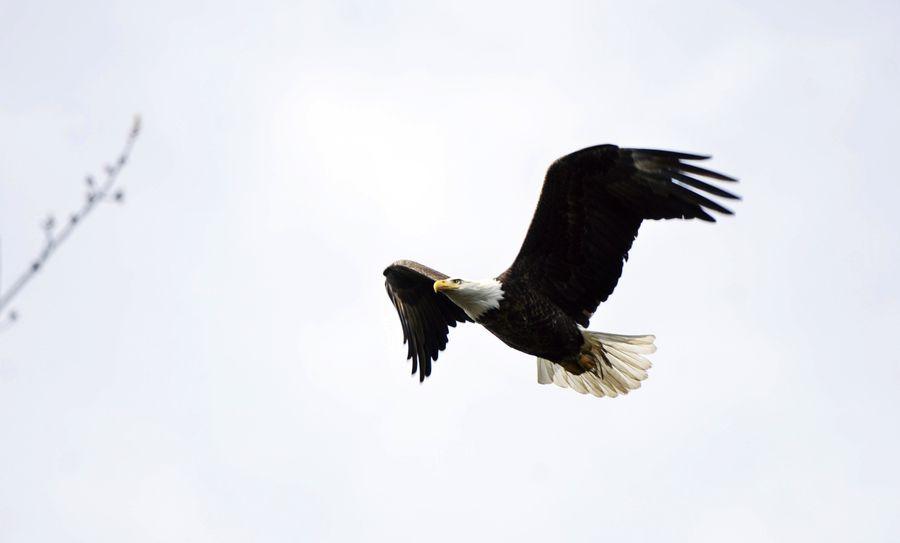
A bald eagle flies along the tree tops near Onota Lake in Pittsfield, Mass., Monday, May 11, 2020. (Ben Garver/The Berkshire Eagle via AP)
What I Learned About CovidMerica Across 8,550 Miles
COMMENTARY
Published Sept. 13, 2020 • Read time: 10m
It was the final August morning in a rented cabin on a South Dakota lake, and as half a dozen family members sat talking and overlooking the water’s placid glass surface, a visitor interrupted the serenity.
“It’s an eagle,” my brother-in-law said in his quiet way. He pointed to a majestically gliding creature overhead in a soft Sunday sun. Very soon, majesty turned to fury, and the bird swooped, accelerating toward the water, attempting to grab a breakfast of surface-feeding fish. It missed, circled high and down and missed again, and again and again, until it gave up and flew away, empty.
Though thrilled with the show by this emissary from the natural world, we were disappointed that the bird left hungry. It seemed symbolic of 2020, having begun with so much promise and anticipation, but devolving into our famed national symbol grasping and coming up with nothing, with so much hidden beneath the surface we could not see, only to fly off and be lost in that endless Dakota sky.
Little did we know how much of a premonition it would be for the family and the brother-in-law, Bill, who had just received great remission news from doctors about an 18-month battle against a rare cancer he’s been fighting so hard. And how, amid a pandemic that has all the world on the edge of the unknowing, life itself is never a sure thing.
That summer week at the cabin, a family tradition that annually reacquaints my wife and her siblings with memories of their youth, was at the center of a 29-day, 8,550-mile drive across the country, from Alexandria, Va., to Los Angeles and back, with many here-and-yonder detours to places like Silicon Valley and Yellowstone and the Wisconsin Dells in between. A COVID-postponed visit in March with a son and daughter-in-law in their new Southern California home was the spark. In mid-July, we headed west.
President Calls Drug Addiction a Health Problem
Lawmakers Hail New Opioid Rules -- But Call for More
No Opiates for the Masses?
Obamacare's Tax-Time Torment
CovidMerica is vastly different in 2020 than the country we had previously explored. Since the 1970s, I have had bylines from 49 states and visited all 50, so I had some context. The differences started from the very route we chose. We purposely avoided hot-spot states like Oklahoma and Arizona altogether. When planned overnight stops – places like Elko, Nev. – suddenly became hot, we canceled reservations and drove on, adding hundreds of miles to overnight where the virus was not such a threat.
We took nothing for granted and arrived at carefully chosen motels with our own cleaning supplies. Over that month, we daily encountered no more people than we would on a trip to the grocery store or on a long walk in Alexandria. You can do that in America 2020 if you choose national parks and two-lane highways over cities and interstates.
Most people we did encounter seemed weary and wary. And despite a parade of rah-rah signs in virtually all of the 21 states we visited declaring some form of “we are in this together,” the opposite seemed to be true.
Roughly half the strangers who crossed our paths in the motels, on the streets, at gas stations and at national parks or along the beaches of Southern California were wearing masks. A few non-maskers were conspicuously defiant, some even making caustic comments about ours.
Mask wearing, and lack thereof, didn't fall along red state/blue state lines during the author's cross-country trip.
(Keith Birmingham/The Orange County Register via AP)
Despite what you can sometimes hear on cable shout shows, this was not a red state-blue state divide; one of the most massive violations of distancing and masking was on the Santa Monica beach, where a group of about 35 young surfers had gathered in a cluster, and where unmasked joggers and packs of bikers huffed and puffed past walkers as if they’d never heard of COVID-19.
The mixed messages from officialdom were ubiquitous. In Illinois, where highway electronic signs repetitively blared that “masks are required,” we saw a mask-free highway patrolman walk into a busy truck stop, where many of the customers also were not wearing them. The town square of Jackson, Wyo., where local news reports declared that tourism traffic was up over 2019 by double-digit percentages, was shoulder-to-shoulder packed with visitors, a large percentage of them not wearing masks. We stayed in a motel on the edge of town. In Yellowstone, we skipped Old Faithful because of crowds.
In some motels, we seemed to be the only customers on an entire floor. In Denver, where a huge lobby was dimmed to near-darkness and the parking lot was nearly empty, we jokingly wondered if we had landed in the Eagles’ “Hotel California.” Yet, other motels were jammed – think Jackson again -- and some guests acted as if it was 2019, ignoring prominent “masks required” signs on the doors. Their indifference mocked the seals put on the room doors to ensure guests they had been cleaned to an anti-COVID state.
So much of America’s history comes from people on the move. The impulses that drove our ancestors, that yearning for freedom and a better life, propelled the westward pioneers of the 19th century and the northward Black Americans escaping Jim Crow and seeking better economic opportunities in the 20th. We are ripe for a repeat. We heard it and sensed it all along the 8,550-mile way.
A young Silicon Valley software engineer said he believed that isolation and working from home had been an epiphany for many like him, and that over the last few months there has been widespread assessing and prioritizing – with many arriving at the shared realization that millions of Americans can live where they want to and work how they want to, and that their employers know this, too.
Pandemic-mandated remote working has sparked an exodus from high-rent cities.
(AP Photo/Jeff Chiu)
This young techie is already seeing exoduses from the valley and predicting more from the expensive-to-live high-tech corridor. He himself is contemplating where he will live next. A Southern California landlord said separate renters discovered during the pandemic they didn’t have to live near their offices and gave notice they were moving to South Carolina and Indiana to be closer to family. In Jackson and in the Black Hills of South Dakota, we heard stories of New Yorkers and others fleeing big cities hit hard by the virus -- or this summer’s protests and riots -- who were buying property to move in permanently.
News stories, both locally and nationally, buttressed the anecdotes, with reports of falling market demand and prices in New York, San Francisco, and other cities. “During the official quarantine, certainly we did get a lot of phone calls – some of them attributed to people saying, ‘I want to get out of the big city and [move] to wide-open Wyoming,” one real estate agent told the Casper Star-Tribune.
Mass movement has followed major shocks in U.S. history. In his autobiography, Ulysses S. Grant, who directed armies across a landscape previously populated with isolated villages and remote farms, declared that the Civil War “begot a spirit of independence and enterprise” and a feeling that “a youth must cut loose from his old surroundings to enable him to get up in the world.” What followed, the take-it-on-faith westward settlement of millions, many of them Civil War veterans or newly arrived immigrants, is embedded deeply in American myth and culture. Our “Grapes of Wrath.”
What has survived through them all is a risk-taking sentimentality and attitude toward failure that remains palpable the further west you go. Our young Silicon Valley friend, who grew up in Northern Virginia, told us that he believed the biggest difference between California and D.C. is in its attitude toward failure. Among the innovators of Silicon Valley, having had one or two failures on your resume is often a plus, a starting point. By contrast, the Washington political class obsesses on others’ failures above all else, trivializing the risk necessary to solve problems.
Driving through America, you also get the sense not just of its inspiring beauty, but a realization that vast swaths of the West and Midwest are still at the mercy of nature in farming, ranching, tourism and other livelihoods, and that to survive you develop an ethic of playing the hand you are dealt. That may explain some of the Midwest red-state resistance to COVID mandates.
But compared with previous migrations, this movement in 2020 is different because of how isolating it can be. Wagon trains and new settlements formed for communal survival; campfire circles remain an American tradition. Settlers saw safety in congregating in numbers. Today, many travelers avoid such communality as if their lives literally depended upon it. Fellow pilgrims are threats; crossed paths are hazards.
Mask-less bikers fill the streets of Sturgis, S.D., during the town's annual motorcycle rally in August.
(Amy Harris/Invision/AP)
Therein lies another rub of the road. You can declare yourself to be totally free and in defiance of COVID’s harm, gather in crowds while mocking mask and distancing orders, as the throngs at Sturgis, S.D., did, days after we drove through. But in 2020, defying science and health guidance is also a declaration against interdependence.
The further west we drove, the more distant the daily dramas of Donald Trump and Congress became. Big swaths of America treat the constant fighting in their nation’s capital carried on cable news like annoying elevator music, as a familiar and irritating refrain they could not change even if they wanted to.
Billboards are still a signs of the times. The ones we saw were heavily concentrated in four categories: religious, adult “superstores,” personal injury lawyers (including one calling himself “The Hammer,” who seemed to have Indiana and Illinois nailed down), and, finally, food banks and pantries.
Missouri, especially, seemed engaged in a billboard competition between religious messengers and adult sex-toy merchants. The food bank and help-the-hungry billboards were often the freshest -- signs of the pandemic’s attack on the economy.
Yet in the end, the eagle made the biggest impression of the 8,550-mile journey. Long endangered, these magnificent symbols of America were never seen by me or my wife in our childhoods on the eastern South Dakota prairies. Now they are back and becoming abundant, not just an emblem of a nation, but living proof of a people’s ability to collectively reverse course in the right way when challenged.
It was fitting that Bill saw the bird first. In raucous gatherings, my brother-in-law was the quiet and contemplative one, a home-loving family man, appreciative of simple pleasures, like pickup rides with a red-headed 2-year-old grandson he’d affectionately nicknamed “Red Menace.” He was the mender and the fixer in the family, a mechanic and trucker, and more interested in helping others have a good time than attending to his own desires. Pointing out that eagle in flight was one of his many gifts to us.
During the week together on the lake, we had been extremely protective and COVID-careful around him, masking up, distancing, constantly cleaning surfaces. Because of his cancer, he’d worn a mask long before COVID, so he was a stickler on risks and boundaries. We made plans for next year, optimistic he’d be with us again, proud of his tough fight against a terrible disease.
And then, five days after we parted, Bill was killed in a car accident two miles from the home where he and his siblings were raised.
Even for 2020 it seems surreal to write this, too trite to summon the usual homily of living to the fullest because you never know when it will end. The only thing we can do for him now is to try to be more like him, to be just a little bit kinder to everyone we encounter down the road past 2020, realizing that life is a gift, but never a guarantee.

Newsom Defies Voters, Juries and Lawmakers To Spare Murderers While Defending Abortion
Curtis Hill • RealClearPolitics
The Algorithmic Tilt
Frank Filingeri • RealClearPolitics
A RealClear Thanksgiving: Investing in a Better Future
David DesRosiers • RealClearPolitics
Trump’s Newsom Problem: Antagonist-in-Chief
Carolina Lumetta • RealClearPolitics
America’s Free Spirit
John Maxwell Hamilton • RealClearPolitics
The GOP Majority Should Go Out in Glory
Daniel McCarthy • RealClearPolitics
RCP Today
Top stories on RealClearPolitics
The Takeaway
Polling intelligence and analysis delivered to your inbox
World News
Featuring the latest world news
Policy
Featuring the latest policy news
Support Our Mission
As part of RealClearPolitics, authors aim to provide balanced, non-partisan analysis by presenting top reporting and commentary from all sides of the political spectrum.
Trusted by policymakers and citizens alike since 2000