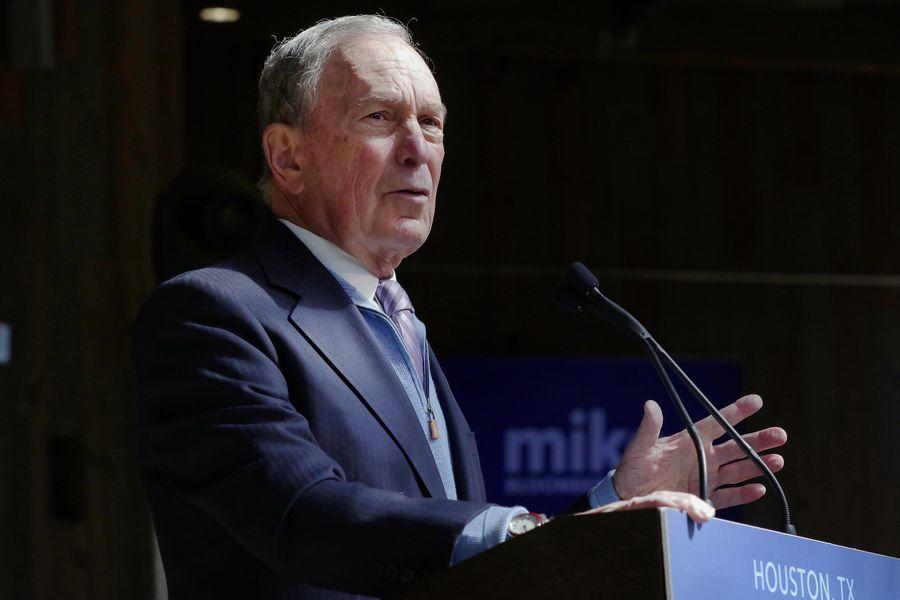
Democratic presidential candidate former New York City Mayor Mike Bloomberg speaks during a campaign event at The Rustic Restaurant, Thursday, February 27, 2020, in Houston. (AP Photo/Michael Wyke)
Mike Bloomberg's Fuzzy Math
ANALYSIS
Published Feb. 28, 2020 • Read time: 3m
Mike Bloomberg is supposed to be super-smart, but he somehow came up short on understanding the arithmetic of the Democratic primaries. His belated entry into the race was supposed to provide a centrist alternative to Bernie Sanders. Instead, because of Democratic rules on delegate distribution, Bloomberg could put Sanders over the top on Super Tuesday.
Let’s stick to California, which I know best, although the Democratic requirement that a candidate must obtain 15% of the vote to get any presidential delegates applies to other states as well. (For those of you who follow The Cook Political Report, political analyst David Wasserman has been alerting readers to this dynamic.)
California will send 494 delegates to the Democratic National Convention in Milwaukee. Of this number, 271 will be chosen from the state’s 53 congressional districts. Ninety delegates are based on the statewide results, also apportioned by percentage. Another 54 delegates are state legislators, statewide officials, big city mayors and party officials pledged to a specific candidate. Only 79 delegates are unpledged delegates; they include the governor, members of Congress and other party big shots.
The key factor is the 15% requirement. The Public Policy Institute of California recently polled Democratic voters (and independents, or No Party Preference), who can select a Democratic ballot if they so choose. Sanders was way ahead with 32%. Four candidates — Bloomberg, Biden, Buttigieg and Warren — had between 14% and 12%. If the statewide election actually comes out this way, Sanders would get all 90 at-large delegates plus the 54 pledged delegates. In this scenario he’d probably clean up in many of the congressional districts as well.
Lies, Assault and Cover-ups Don't Stop Donald Trump
Trump Stands by His Man; Obama on a Health Scourge; Hayden Interview; Reagan's Courage
Analysis: For Trump, Few Limits to Win-At-Any-Cost Approach
What If Clinton Isn't Indicted?
That’s because the California rules discard the votes of any candidate who does not reach the 15% threshold. Say, for example, Bloomberg and Biden reach the threshold and Buttigieg and Warren do not. Then Buttigieg’s and Warren’s votes would be discarded, even though together they might have as much as 28% of the total vote. If lesser candidates are included, as much as 40% of the vote could be simply discarded. Sanders, Bloomberg and Biden would then share the delegates, with the largest percentage going to the winner. This would give Sanders many more delegates than he would earn in a true proportional system without the threshold and the discarding of the votes of anyone who does not reach 15%. It’s the latter quirk that balloons the delegates for the winner and anyone else who qualifies.
Bloomberg may have reasoned that the election would come down to a contest between him and Sanders and that both of them would profit from the discarded votes. But that was always an unlikely scenario, given that Bloomberg is not on any ballot until Super Tuesday, March 3. There would be no reason to expect other centrists to drop out before Super Tuesday after participating in only two caucuses and two primaries, counting the South Carolina primary this Saturday.
Given the arithmetic of the primaries, the Bloomberg equation was defective from the outset. That’s not to say that he or one of the other candidates couldn’t make chicken salad from this mess. But the rules (and much else) favor Sanders.
One other point: California has a notoriously slow vote count, and counting ballots in the congressional districts will take time. We’ll probably know the statewide winner on March 3 or March 4, but we won’t know how many delegates he’s earned if any of the candidates are close to the 15% threshold. State officials are trying to lower expectations and say the delegate allocations won’t be known until the vote is certified on April 2.

A RealClear Thanksgiving: Investing in a Better Future
David DesRosiers • RealClearPolitics
Trump’s Newsom Problem: Antagonist-in-Chief
Carolina Lumetta • RealClearPolitics
America’s Free Spirit
John Maxwell Hamilton • RealClearPolitics
The GOP Majority Should Go Out in Glory
Daniel McCarthy • RealClearPolitics
Republican Majorities Could Return Sooner Than Expected
J.T. Young • RealClearPolitics
The Danger Before the Attack
Leslie J. Sullivan • RealClearPolitics
RCP Today
Top stories on RealClearPolitics
The Takeaway
Polling intelligence and analysis delivered to your inbox
World News
Featuring the latest world news
Policy
Featuring the latest policy news
Support Our Mission
As part of RealClearPolitics, authors aim to provide balanced, non-partisan analysis by presenting top reporting and commentary from all sides of the political spectrum.
Trusted by policymakers and citizens alike since 2000