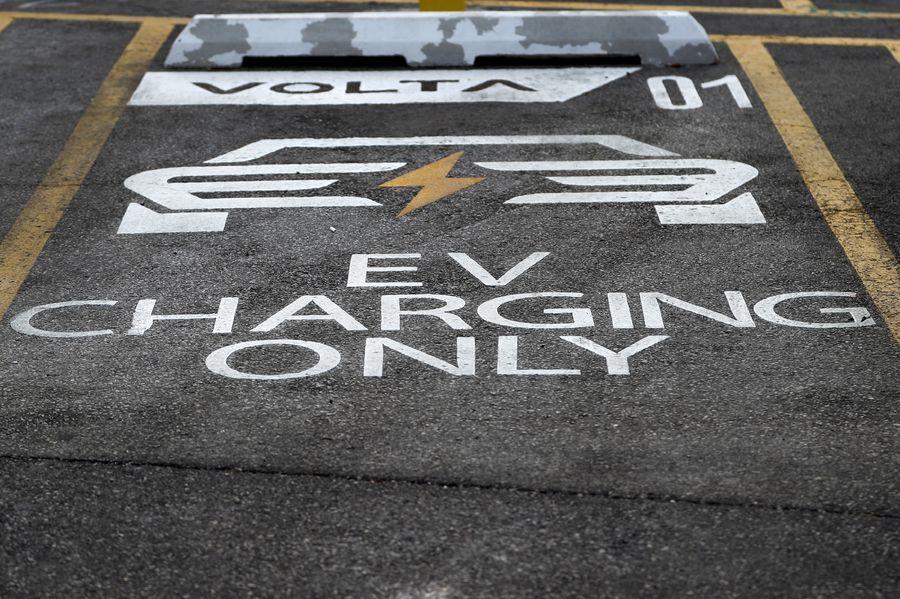
This Dec. 20, 2019, photo shows a designated parking space for electric vehicles at a Chicago area grocery store. Owners of electric vehicles in a number of states will start seeing fees to pay for road repairs in the new year. At least eight states plan to charge new or higher registration fees for electric vehicles or plug-in hybrids. (AP Photo/Charles Rex Arbogast)
How Dems Can Sell Their Climate Bill to the GOP
COMMENTARY
Published Jan. 21, 2020 • Read time: 4m
Senior Democrats on the House Energy and Commerce Committee recently rolled out their plan to reach net-zero greenhouse gas emissions by 2050. Since this bill is still in the drafting process, now is the time to remind key Democrats that if they are serious about greenhouse gas reductions, they should invite private-sector solutions to climate change to help garner Republican support.
While the exact text of this new climate change proposal has yet to be finalized, the early version appears to be heavily reliant upon government mandates to combat climate change, a top-down approach that surely won't bring many (if any) Republicans to the table.
One component of the plan, announced by House Energy and Commerce Chairman Frank Pallone (D-N.J.) and other senior Democrats on the committee, including Reps. Paul Tonko of New York and Bobby Rush of Illinois, is a mandate that electricity providers get an increasingly larger percentage of their power from clean energy sources, starting in 2022. The plan also attempts to reduce greenhouse gas emissions from the construction sector by requiring zero-energy-ready buildings -- structures that produce as much renewable energy as they consume -- by 2030.
Chairman Pallone stated that "this is not a messaging bill. We're going to try to move this bill." But Ranking Member Greg Walden (R-Ore.) deemed the proposal a "missed opportunity," given the expected lack of bipartisan support, which is critical for any legislation to become law under the Republican-led Senate and President Trump.
Fortunately, Democrats can rectify this issue and bring Republicans on board by including market-based, private-sector solutions to climate change in the final version of the bill. While the thought of a compromise might have seemed impossible a decade ago, we have seen a significant shift away from climate change denial in the Republican Party.
Senior Republicans on the Energy and Commerce Committee have publicly discussed the need to address climate change in committee hearings, and the highest ranking Republican in the House, Minority Leader Kevin McCarthy of California, issued a warning to his colleagues that younger voters care about climate change and the party is risking its long-term electoral viability by ignoring this critical issue.
Now is the time for Democrats to take advantage of this shift. By including the private sector as a source of solutions to address climate change, Democrats have an opportunity to pass legislation that will make substantial progress in reducing America’s greenhouse gas emissions.
One such bipartisan compromise could be to provide incentives that promote private-sector investment in electric vehicle (EV) charging stations.
Transportation is the largest source of greenhouse gas emissions in the United States, and to address it, the current draft plan would ratchet up tailpipe emissions rules on new cars and trucks. But forcing car manufacturers to produce emission-friendly vehicles, like EVs, won’t make a difference unless consumers buy the vehicles.
Gavin Newsom's Misguided Redistricting Initiative
A Warning Against the Overuse of Sanctions
Open The Books on the California State Checkbook
Senate Passes Bill Addressing Heroin, Opioid Crisis
As it stands, consumers are hesitant to purchase EVs due to range anxiety, or the fear of not being able to charge up when and where they need to. The private sector has already found the solution for fueling gasoline-powered vehicles, and incentives would allow these small businesses to transition quickly into fueling the vehicles of the future.
Given the political landscape, this is the perfect opportunity to bring Republicans to the table and develop a bipartisan plan to address climate change.
Thankfully, there is still time, since the final language of the bill is being debated and discussed. By including market-based, private-sector solutions to climate change, Democrats alongside Republicans could craft legislation that would actually pass Congress and become law. If successfully reducing greenhouse gas emissions is the goal, as it should be, we need reasonable legislation that can garner support from both sides of the aisle to make a real impact.

A RealClear Thanksgiving: Investing in a Better Future
David DesRosiers • RealClearPolitics
Trump’s Newsom Problem: Antagonist-in-Chief
Carolina Lumetta • RealClearPolitics
America’s Free Spirit
John Maxwell Hamilton • RealClearPolitics
The GOP Majority Should Go Out in Glory
Daniel McCarthy • RealClearPolitics
Republican Majorities Could Return Sooner Than Expected
J.T. Young • RealClearPolitics
The Danger Before the Attack
Leslie J. Sullivan • RealClearPolitics
RCP Today
Top stories on RealClearPolitics
The Takeaway
Polling intelligence and analysis delivered to your inbox
World News
Featuring the latest world news
Policy
Featuring the latest policy news
Support Our Mission
As part of RealClearPolitics, authors aim to provide balanced, non-partisan analysis by presenting top reporting and commentary from all sides of the political spectrum.
Trusted by policymakers and citizens alike since 2000