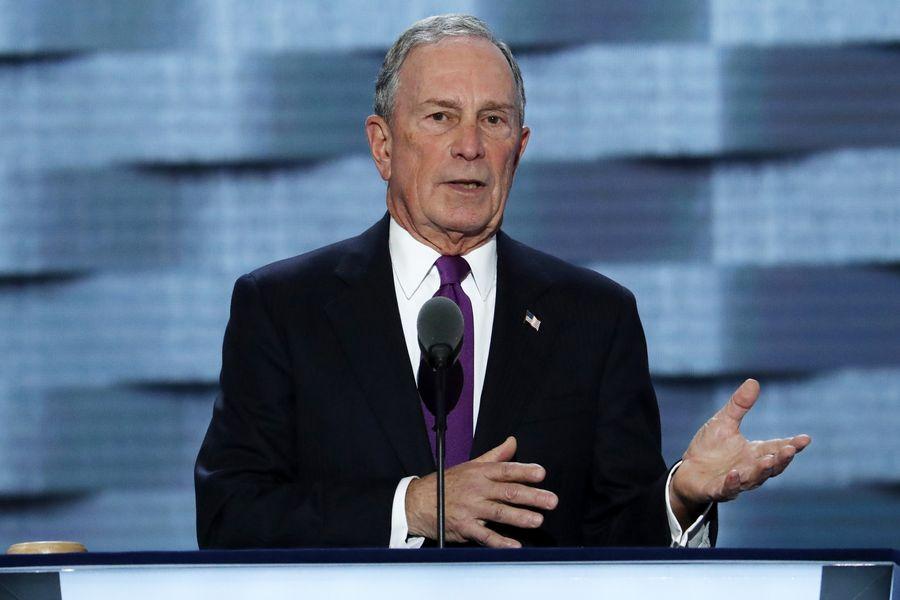
FILE - In this July 27, 2016, file photo, former New York City Mayor Michael Bloomberg speaks during the third day of the Democratic National Convention in Philadelphia. With Bloomberg now running for president, the news service that bears his name said Sunday, Nov. 24, 2019, it will not "investigate" him or any of his Democratic rivals, and Bloomberg Opinion will no longer run unsigned editorials. (AP Photo/J. Scott Applewhite, File)
Why a Contested Democratic Convention Is Possible
COMMENTARY
Published Dec. 27, 2019 • Read time: 4m
About this time in every presidential nomination contest there is talk of a brokered convention. As if on cue, we’re hearing it again.
The thought of such a convention races the hearts of political junkies everywhere. It conjures the image of power brokers deciding the fate of the nation in a smoke-filled room. In 1924, it took 103 ballots for Democrats to settle on dark horse John W. Davis.
While it is not likely the 2020 Democratic nomination will be brokered in a backroom – rule changes have made that more difficult – it is possible that the convention could be contested, which means it would require more than one ballot to select a nominee.
In years past, most delegates went to conventions unelected by voters and unpledged to candidates. This happens less frequently these days. “Favorite son” candidacies, once used to park delegates until deals were cut, are now extinct. The “unit rule,” which forced state delegations to vote unanimously for one candidate, is also gone. Democrats now require the nominee win only a majority of delegates, long ago discarding the old two-thirds requirement.
During the last seven decades, candidates from both parties have usually gathered enough momentum from primary victories to clinch the nomination before conventions began.
Party strategists instinctively fear prolonged intraparty battling and its effect on general election prospects. That’s why they push to unite around one candidate as fast as possible. Next year, there will be several opportunities for that to happen. The first comes in February when four states vote. If Joe Biden wins Iowa and New Hampshire and continues to top national polls, an effort could emerge to rally around the former vice president as the nominee. While it’s conceivable something like that could happen, it’s more likely party activists would oppose shutting down the competition so soon.
Sanders Seeks Caucus Trifecta Win to Close Delegate Gap
Sanders Fighting Perception He Can't Overcome Clinton Edge
Clinton Targets Trump as Sanders Circles
Sanders, Clinton Differ Sharply at Flint Debate
The next milestone is Super Tuesday, March 3. At that point, 40% of delegates will have been selected from 18 states. Unless it’s a tight two-way contest, there will be enormous pressure to stop the fight by the end of April when 88% of delegates from 40 states will have been elected.
Despite forces working against it, a contested convention with multiple ballots is possible. While such a thing hasn’t happened since 1952, unique circumstances surrounding this election have increased the odds. For starters, there is immense pressure on Democrats to find a candidate who can beat Donald Trump. If the most electable contender stumbles along the way, a contested convention may be needed to find a new one.
Second, proportional allocation of state delegates and the 15% support threshold to win delegates also make it tougher to assemble a majority.
Superdelegates, who automatically become delegates by virtue of their positions as elected officials, are another factor. The next Democratic convention will have 758 of them. To weaken their influence, a rule was recently passed to prohibit superdelegates from voting on the first ballot, but not on subsequent ballots. Ironically, if a second ballot is required, this could give the pros more influence than ever. It will take 1,919 delegate votes to win a first-ballot victory. When you add in superdelegates on a second ballot, the bar rises to 2,298.
Candidates unable to win on the first ballot may bow out and use their muscle to stop or promote others. If Michael Bloomberg cannot be king, for example, he may be kingmaker. He’s in a unique position, of course, since he could fund the entire general election out of petty cash.
Keep in mind that a second ballot won’t necessarily change who wins. A contested convention may only delay the inevitable.
The candidate who gains the most popular votes and delegates during the primaries – be it Biden or someone else – would still demand the nomination on the basis of fairness, even if he or she fell short of a delegate majority. It’s not certain superdelegates would challenge that conclusion for fear of alienating voters back home.
In any case, a contested convention would be fascinating, a relic of older days brought back to life in a new, media-saturated environment. While far from a certainty, it’s not impossible.
Political junkies, take heart, you may finally get your wish.

A RealClear Thanksgiving: Investing in a Better Future
David DesRosiers • RealClearPolitics
Trump’s Newsom Problem: Antagonist-in-Chief
Carolina Lumetta • RealClearPolitics
America’s Free Spirit
John Maxwell Hamilton • RealClearPolitics
The GOP Majority Should Go Out in Glory
Daniel McCarthy • RealClearPolitics
Republican Majorities Could Return Sooner Than Expected
J.T. Young • RealClearPolitics
The Danger Before the Attack
Leslie J. Sullivan • RealClearPolitics
RCP Today
Top stories on RealClearPolitics
The Takeaway
Polling intelligence and analysis delivered to your inbox
World News
Featuring the latest world news
Policy
Featuring the latest policy news
Support Our Mission
As part of RealClearPolitics, authors aim to provide balanced, non-partisan analysis by presenting top reporting and commentary from all sides of the political spectrum.
Trusted by policymakers and citizens alike since 2000