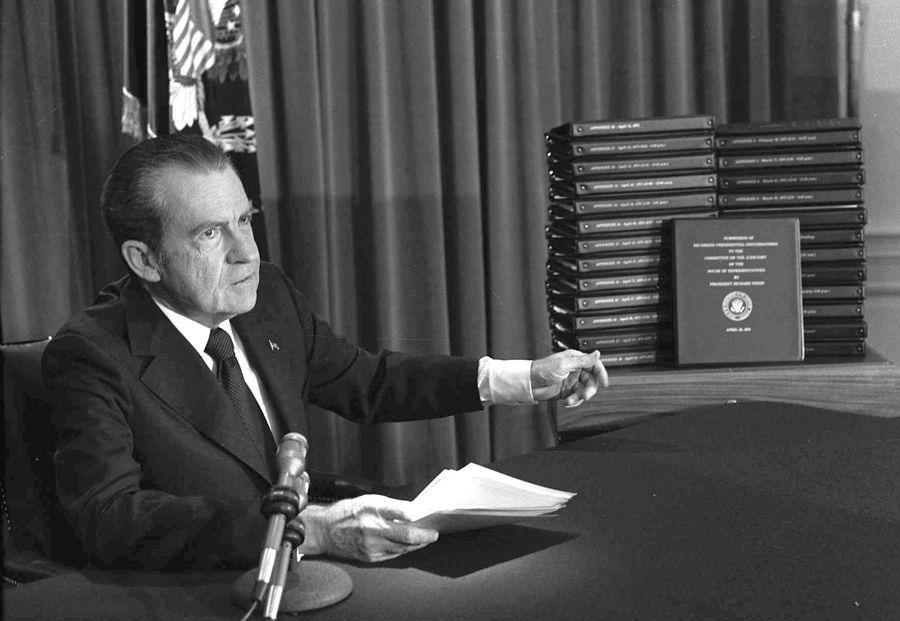
FILE - In this April 29, 1974 file photo, President Richard M. Nixon points to the transcripts of the White House tapes in Washington, after he announced on television that he would turn over the transcripts to House impeachment investigators. The public impeachment inquiry hearings this week usher in a rare and momentous occasion in American history as Congress debates whether to remove a sitting president from office. (AP Photo/File)
Nixon to Clinton to Trump: Insiders Recall Impeachments Past
Published Dec. 18, 2019 • Read time: 13m
House Speaker Nancy Pelosi said it is all about the principle that “no one is above the law.” The subject of her comment called it “witch hunt garbage.” That is how the impeachment of President Donald J. Trump officially began: with a somber-toned press conference and a tweet from the gut.
Inevitably, attempting to end the 45th presidency of the United States prompted comparisons with impeachments past.
“I am not a crook,” declared President Nixon, who later resigned in the face of certain removal from office. “I did not have sexual relations with that woman,” insisted President Clinton, who was impeached in the House but acquitted in the Senate. “I made a perfect call, not a good call; a perfect call,” now argues Trump.
History tends to distill episodes such as these into easy sound bites, so such juxtapositions are only natural. But Trump, true to his norm-busting nature, has fought impeachment like no one before him.
If this were an alternate world, one where Trump trusted old friends, he might listen to Bill Clinton, who recently said that he would counsel the current president to lay low. He would suggest that Trump say something like “‘I’ve got lawyers and staff people handling this impeachment inquiry and they should just have at it. Meanwhile, I'm going to work for the American people.’ That's what I would do.”
And that is what Clinton did do while an independent counsel probed his sex life. He acted presidential. He focused on legislation — even ordered missile attacks on Iraq. He hoped the public would forget about the unpresidential things that happened with that cigar and that intern in a blue dress. The strategy for White House aides, summarizes Mike McCurry, “was compartmentalization.”
The FBI Gained Access; We'd Already Lost Our Privacy
Is Trump Right About NATO?
Arizona's Voting Rights Fire Bell
U.S. Officials Say 2 Americans Died in Brussels Attack
Mornings began with a staff meeting. The chief of staff set the agenda at 7:30, and the different department heads would go around the table reporting their plans. When it got to the press secretary, the group would pause, maybe somebody would sigh, and then someone would always say, “Well, we know what you’re going to be doing today, Mike.”
While the spokesman got pounded by the press, the rest of the White House carried on with business as usual. “It was just this general sense that you had to plug along and do your job,” McCurry recalls. “Meanwhile, I was just getting creamed at the podium about blue dresses and every little detail.”
Rep. Bob Livingston during the House debate on four articles of impeachment against President Clinton.
AP Photo/APTN, File
If Clinton couldn’t keep his hands to himself, he could at least keep quiet. He didn’t have a choice. “Bill Clinton could not elaborate. In fact, one could say he elaborated too much when he testified under oath and lied,” remembers Bob Livingston. The Louisiana Republican was next in line to become speaker — a plan of succession that would be derailed by his own indiscretions — and was confident his party had the president dead to rights. The silence from the Oval Office was smart, Livingston admits all these years later: “Anything he said was only going to cause him more problems.”
But Trump won’t stop talking. “I don’t think he understands why the hell they’re impeaching him other than the fact they don’t like him,” Livingston says. “He feels personally aggrieved and insulted because he doesn’t think he committed a crime.”
And when Trump feels threatened, Trump argues with reporters or calls into “Fox & Friends” or tweets. He has been doing all three, especially the latter. As the House Judiciary Committee met to debate articles of impeachment last Thursday, the president sent 123 tweets, a record for this presidency (and, of course, any presidency).
If the psychology of the two presidents is different, so are the facts. Two decades later, no one doubts that Clinton lied. He even apologized publicly, telling more than a hundred ministers gathered in the East Room for a prayer breakfast that “I have sinned.”
Those transgressions were made public, detailed meticulously in a 453-page report by Independent Counsel Ken Starr. Clinton had told a grand jury he didn’t have sex with an intern. He said the same to the American people until DNA evidence proved he was lying. But compare that to what Trump did — asking a foreign power to investigate a potential political opponent — and Clinton alumni bristle.
“The whole Lewinsky scandal broke in January and it went eight months until the Starr report came out. It was ghastly,” McCurry remembers. Were people offended by the affair? Yes. Was it worth kicking him out of office? “I don’t think anyone felt it rose to an impeachable offense,” the former press secretary says. “Clinton had lied in front of a grand jury about a sexual dalliance. It is very hard to compare that to what’s happening with Trump. They are of an entirely different order.”
Newt Gingrich agrees. To an extent.
The godfather of small government came to Congress from Georgia. He dreamed of a conservative revolution, and he started one. He had plans for sweeping legislation, not impeachment. He got both in the end and it hastened the end of his Capitol Hill career but — bitter irony — left Clinton in office. All these years later, Gingrich thinks back and says the current situation could not be more different.
“We decided we had to move forward on possible impeachment when we received the independent counsel report asserting that there were 11 items on which Clinton was guilty,” he explains. It was Starr who first leveled the charges, who first used the word guilty. Lying under oath is perjury and that, Gingrich notes, is a felony.
Then-House Speaker Newt Gingrich in 1997. He says Clinton committed a crime, but “Trump is guilty of being Trump."
AP Photo/Joe Marquette, Pool, File
“After that report we did not have any choice but to move forward, and a number of Democrats voted with us to initiate the investigation,” he says. And that is the difference between then and now in the mind of the former speaker — Clinton committed a real crime. But what about Trump? Well, says Gingrich, “Trump is guilty of being Trump, and that is enough for the left to want to drive him from office.”
It is difficult to remember now but there was a time when Republicans and Democrats got along, even sort of liked one another. And Republicans could do business with Clinton. He was a pragmatic president who borrowed one of their talking points when he declared “the era of big government over” and who agreed to their ideas when he signed a budget that cut federal spending.
Livingston even played a couple rounds of golf with the president and liked him well enough. As the speaker in waiting, he also called the 42nd president to tell him an impeachment vote was coming.
Clinton ordered the bombing of Iraq two weeks before Christmas. The cruise missiles were launched, ostensibly, because of weapons treaty violations. Republicans griped that the destruction was a ploy to kick impeachment into the New Year. Hence, the call. When Livingston dialed up Clinton, he said Republicans would delay the vote but told him to expect impeachment before Christmas. They were on the phone for 10 minutes. Clinton was not surprised and Livingston remembers it all as “very cordial.”
Little about this current presidency has been cordial. Trump hadn’t even taken the oath of office before paperwork was filed with the Federal Election Commission to create a pro-impeachment super PAC. Riots broke out in D.C. on Inauguration Day. Four months into the Trump presidency, Rep. Al Green of Texas called for impeachment on the House floor. Two years later, a newly elected, less-than-polite Rep. Rashida Tlaib of Michigan promised a rowdy crowd that Democrats were “going to impeach the motherf-----.”
No one accuses Trump of being polite (he recently joked that Pelosi’s teeth were falling out). No Republican thinks Trump has gotten a fair shot, either. But impeachment came for Clinton, Gingrich says, because Clinton committed a crime. That is different from what has happened to Trump, Livingston adds. Democrats have always hated him and have always searched for a pretext to remove him from office early — it is, he says, “impeachment in search of a crime.”
“I put my career on the line for it, and so did others too. This was not something that we accepted idly,” Livingston, now a lobbyist, says of the last impeachment push. He does not believe Clinton would have been impeached had he not lied under oath. But House Republicans believed it was their duty, even if it wasn’t going to be popular: “The polls showed that 60% to 70% of the people were against the impeachment.”
Contrast those numbers with the RealClearPolitics polling average on the current impeachment attempt. Support for removing Trump from office stands at 46.9%. Opposition, 47.6%. It is as divisive a question as one could find. But moving ahead certainly isn’t as daunting a prospect for Democrats as what Republicans faced in 1998. While Trump’s job approval numbers have never broken the 50% threshold, the popularity of Clinton never flagged. If anything, impeachment made the American people like him more. Gallup polling data from that time shows that his approval numbers never dipped below 60% throughout the entire ordeal, and when the House impeached Clinton those numbers bounced up to 73%, the highest of his tenure.
The House action clearly was a bad bet. The Senate dismissed the charges, and Clinton remained in office. Republicans lost House seats in 2000 and their leadership thinned. Gingrich promised to step down as speaker when threatened with a revolt in his own caucus, and Livingston resigned after admitting to an extramarital affair of his own.
Unexpected casualties like these follow a process that, neat and tidy on paper, is wildly unpredictable in practice. Richard Nixon, who carried 49 states in his lopsided re-election, certainly never foresaw impeachment. But five Republican operatives had decided to break into the Democratic National Committee headquarters in the summer of 1972. They got caught.
Bob Woodward, right, and Carl Bernstein led the way in exposing the Watergate coverup.
AP Photo
Subsequent coverup attempts by the White House failed, and the story started leaking to the press, making James Prochnow’s daily commute to work uncomfortable. The whip-smart young lawyer would ride the bus into the city from the Arlington suburbs, and “every day the whole conversation was just about Watergate.” He knew more than any of the other passengers but couldn’t say anything — Prochnow was detailed to the White House legal team defending the besieged president.
Nixon was pugnacious, at times paranoid, infusing his staff with a similarly aggressive mentality. Working from the first floor of the Old Executive Office Building, Prochnow and his colleagues prepared a legal defense with a single goal: to prevent a Senate conviction.
“It was a matter of being an advocate through-and-through,” the lawyer says, thinking back on the long days spent scouring legal libraries and longer nights spent hammering out arguments. Always confident, Prochnow thought Nixon could prevail if he got his Senate trial and says he “didn’t feel things were hopeless until he resigned.”
Nixon was rumored during his final nights and days in office to have wandered the halls of the White House, confiding in portraits of presidents long past. It is uncertain when he lost hope. Until that point, Nixon fought. “Some of it was due to his hardscrabble upbringing. He came from nothing and had to claw his way into the arena,” presidential biographer and White House veteran Kasey Pipes explains. “He was used to being in that arena and being knocked down. His nature was to get back up again and fight.”
Nixon had plenty of enemies, not unlike the current president. Also, not unlike the current occupant of the Oval Office, Nixon went to war with the press, dismissing them as “privileged men” out of step with the public. But Nixon had to contend with the three major networks and powerful newspapers while under threat of impeachment. He could not call into “Fox & Friends” to reach 1.5 million Americans any given weekday. He also couldn’t leverage social media to go over the head of the White House press corps. Even if Nixon had had the Internet, Prochnow insists “he wouldn’t have been tweeting.”
Perhaps it was that pugnacity that undid Nixon. “There were many potential exits on the highway to disaster,” remembers Geoff Shepard, who served as principal deputy to the Watergate defense counsel. One of them would have been coming clean. After all, Nixon did not order the break-in or know it was planned. But, Shepard says, “At each point the decision was made to go another way.”
“In his own way, Nixon was every bit as combative as Trump. One intriguing issue is ‘At what point do defensive efforts to protect yourself politically become an obstruction of justice?’” he muses. “Both individuals feel they have been wrongly accused and then pilloried by a hostile media. It’s little wonder they respond as they have.”
But the comparison is not one-to-one, Shepard says: “There was no question that there had been criminal wrongdoing, both the [Watergate] break-in and the coverup.” He knows better than most, having helped compile the final transcription of the now infamous Nixon tapes.
It was a Sony TC-800B recorder, a relic of that bygone era, that captured a conversation between Nixon and his chief of staff, H.R. Haldeman, on reel-to-reel tape. On the morning of June 23, 1972, the president ordered the coverup. Nixon wanted the CIA to push the FBI to close its investigation of the break-in, six days after it occurred.
Onetime Nixon speechwriter Pat Buchanan recommended the incriminating White House tapes be burned.
AP Photo/Cliff Owen
“We would not have been impeached if the tapes had not been discovered,” former White House aide Pat Buchanan says. This was the so-called “smoking gun.” Without the recordings, Buchanan is confident Nixon would have survived. At the time, he recommended the tapes be burned.
Like the blue dress that implicated Clinton, the tapes directly implicated Nixon. The closest thing to a smoking gun in the current impeachment push is the July 25 phone call between Trump and his Ukrainian counterpart. The president made a transcript of that conversation public. In his estimation, it was “perfect.”
Democrats disagree and are expected to vote on his impeachment in the House on Wednesday. A party line outcome is likely, illustrating yet another distinction between Nixon and Trump. The current president enjoys the unqualified support of his party while the disgraced president only resigned at the urging of his own allies in Congress.
It was conservative elder statesman Barry Goldwater who advised Nixon to step down. Today Republicans want their president to stay. The Senate will likely vote acquit.
The House vote will be aired on every major cable news channel and broadcast network, with all of Washington watching on Wednesday, especially aides at the White House. Prochnow remembers a similar moment. It was when Nixon resigned. He didn’t watch on television. He didn’t see it on Twitter. Someone ran into the room to share the news.
“I just put down my pen and closed my notebook,” the lawyer says, remembering history.

A RealClear Thanksgiving: Investing in a Better Future
David DesRosiers • RealClearPolitics
Trump’s Newsom Problem: Antagonist-in-Chief
Carolina Lumetta • RealClearPolitics
America’s Free Spirit
John Maxwell Hamilton • RealClearPolitics
The GOP Majority Should Go Out in Glory
Daniel McCarthy • RealClearPolitics
Republican Majorities Could Return Sooner Than Expected
J.T. Young • RealClearPolitics
The Danger Before the Attack
Leslie J. Sullivan • RealClearPolitics
RCP Today
Top stories on RealClearPolitics
The Takeaway
Polling intelligence and analysis delivered to your inbox
World News
Featuring the latest world news
Policy
Featuring the latest policy news
Support Our Mission
As part of RealClearPolitics, authors aim to provide balanced, non-partisan analysis by presenting top reporting and commentary from all sides of the political spectrum.
Trusted by policymakers and citizens alike since 2000